Frustrated with your scheduling? Try the easiest-to-use calendar app, made by and for maid service owners.

Brought to you by expert maid service owners
Onboarding new employees is sometimes an afterthought, but it shouldn’t be. Integrating new employees into your business is an important first step toward growing your business, especially considering that each new employee you hire will come to represent your cleaning business.
If you’ve struggled to plan onboarding before, we get it. With employee shortages and busy schedules, it can be easy to let relief take over when you finally hire someone. But how each new hire leaves impressions on clients matters, and a solid, organized onboarding process is a great way to ensure everyone represents your cleaning business professionally and predictably — from the way you clean to the way you handle disputes.
Before you learn the tricks of the trade, ask yourself: Are you approaching your hiring process the right way? Do you assume that your new employees will quit soon, or that it’s almost a waste of your time to train them in the first place?
If your answer is yes, then you’ll be surprised to find out that onboarding is no less crucial to the success of your business than recruiting. Highly engaged employees result in a 21% greater profitability for your business. That’s a lot of money! So why throw it away with a poor onboarding process?
Table of contents
What to include in your onboarding checklists
Once you’ve set the tone for your business, you’re ready to tackle your first checklist. Your checklist serves as your map. It guides your onboarding process so that you don’t have to improvise at the last minute. The best part is that once you have a checklist, you never have to reinvent it! Nothing feels better than showing up prepared, right?
Welcome Checklist and Setting Expectations
You need to prepare for a new employee starting at least a few days before their start date. If you don’t have these things ready, your new hire might get the impression that you aren’t organized or don’t care enough about them — or their job — to prepare ahead of time. The first week should be about making your employee feel at home and teaching them some basics. It’s important to strike the right balance between teaching, answering questions, and letting employees adapt to their new work environment.
Here are the steps you need to take care of before your employee walks through your doors, so your day flows smoothly and your employee feels confident.
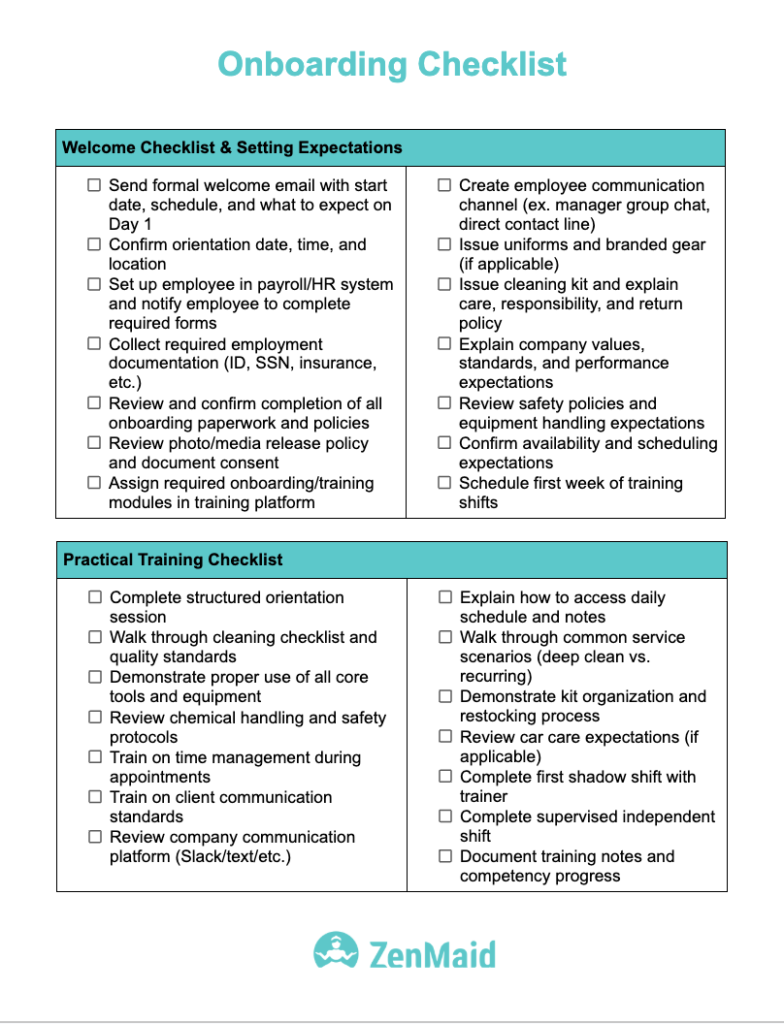
- Send a formal welcome email with start date, schedule, and what to expect on Day 1
- Confirm orientation date, time, and location
- Set up employee in your payroll/HR system and notify them to complete any required forms
- Collect required employment documentation (ID, SSN, insurance, etc.)
- Review and confirm completion of all onboarding paperwork and policies
- Review photo/media release policy and document consent
- Assign required onboarding/training modules in training platform
- Create employee communication channel (ex. manager group chat, direct contact line)
- Issue uniforms and branded gear (if applicable)
- Issue a cleaning kit and explain care, responsibility, and return policy
- Explain company values, standards, and performance expectations
- Review safety policies and equipment handling expectations
- Confirm availability and scheduling expectations
- Schedule the first week of training shifts
Make sure that you go slowly because you don’t want to throw everything at them all at once. Take out a chunk of your day each day of their first week to check in. This might seem like a lot of time to spend, but it will pay off in dividends later when your cleaning business is chock full of well-trained, respectful, committed employees.
Practical Training Checklist
After you’ve completed the previous steps and your employee feels more comfortable, it’s time to begin their practical training. As we said earlier, even when your new hire has prior cleaning experience, they may not perform exactly as you expect — or even within the same safety protocols. Extending your best practices and training new employees to follow them makes it less likely that mishaps happen in the future.
At Serene Clean, this checklist looks like this:
- Complete a structured orientation session
- Walk through cleaning checklist and quality standards
- Demonstrate proper use of all core tools and equipment
- Review chemical handling and safety protocols
- Train on time management during appointments
- Train on client communication standards
- Review company communication platform (Slack/text/etc.)
- Explain how to access daily schedule and notes
- Walk through common service scenarios (deep clean vs. recurring)
- Demonstrate kit organization and restocking process
- Review car care expectations (if applicable)
- Complete first shadow shift with trainer
- Complete supervised independent shift
- Document training notes and competency progress
It’s especially important to remind your new hire that your business operates with a team mentality. Every person on the team plays an important role. Every person is valuable. Every person is responsible for the cleanliness of the house. Encouraging accountability and trust is essential, but that is built on mutual respect.
Pre-Shift Follow-up Checklist
Whew, you’ve done a lot of work up until this point! Take a deep breath and keep it up. You’re almost there.
Before your employee starts their second day, you should conduct a pre-shift follow-up. Set aside 30 or so minutes to do the following:
- Send day-before reminder text with shift details
- Confirm start time and location
- Confirm employee has full kit and supplies
- Confirm uniform compliance
- Review appointment notes and client preferences
- Confirm transportation reliability
- Reinforce punctuality expectations
- Ask if there are any questions before shift
- Ensure access to communication channel for day-of support
- Confirm employee understands service type for the day
- Remind of photo requirements (if applicable)
- Confirm safety tools (personal alarm/pepper gel if applicable)
- Reinforce quality over speed expectations
- Encourage positive mindset and professionalism
If anything makes you raise an eyebrow, take note and make sure to follow up again the next day or two to check in.
Post-Shift Follow-up Checklist
This brings us to the last part of our onboarding checklist. For at least five shifts, implement a structured follow-up with your new employees. Your structured follow-up shows that you care about your employees and that you want to make sure that they feel respected, valued, and prepared for the tasks ahead of them.
Here’s an example of what this checklist looks like:
- Confirm shift completion
- Review any issues or client concerns
- Request feedback from employee about training experience
- Review quality checklist results (if first solo shift)
- Document performance notes
- Confirm time logged correctly
- Reinforce strengths observed
- Identify improvement areas
- Confirm equipment returned or stored properly
- Confirm supplies restocked
- Schedule next shift
- Add employee to ongoing performance tracking
- Add to birthday/start date recognition tracking
- If referral involved, document referral bonus eligibility
On the flip side, checking in often communicates to your employees that they are still in the learning process and you (and your team) recognize that and want to support them.
The first day of onboarding matters for your cleaning business
Think back on your first day at a new job. You might have felt overwhelmed, confused, scared, or inadequate — and at the very least, you were probably looking to do a good job. After all, you never get a second chance to make a good impression.
A good onboarding process is one that shows your new employee how to do the best possible job on their first day. The quality of your onboarding process affects your employees’ readiness to be part of a team.
To create a successful onboarding program customized to your cleaning business, here’s our suggestion for how to plan your new hire’s first day:
Describe your culture
Your company’s culture gives your employees a sense of what the company is — its mission, values, beliefs, and systems. It’s important that you show what’s “normal” in your business.
Clarify your new employee’s job description
They need to understand their role in your company and all of the expectations that come with it. Even if you hire experienced cleaners, you shouldn’t assume that their previous company ran the same way as yours. If you tell an employee that they start at 8:30 a.m., you need to clarify whether that means they arrive at a residential home at 8:30, or they need to clock in at 8:30 and gather their supplies for the day. It’s better to be too specific rather than not specific enough.
Share your compliance policies
This element of your onboarding process covers the legal and policy-related side of your business. During this segment, you’ll cover harassment, discipline, safety, drug use, etc. This is a crucial part of your onboarding process because you don’t want to wait until a drug- or alcohol-related incident occurs to cover your compliance practices. Plus, you always want to share your expectations with your team up front to avoid any confusion. Start early!
Emphasize connecting with each other
This can be an overlooked part of the process. Connection is vital because your employees need healthy relationships with one another. Your new hires need to feel like they are free to ask questions and that they are accepted and respected. If an employee doesn’t feel comfortable talking with other, experienced employees, then they are bound to make wrong decisions. And what follows? A bad customer experience.
At the end of the day, helping your new employees feel connected and included in the business helps set the tone for a healthy company culture. Interested in learning more about this topic? Read here next!
7 Best Onboarding Practices for Your Cleaning Business
Your checklist serves as a guide for your onboarding process. Even though it’s a lengthy process, the checklist makes it fairly simple to follow through on, and the checkboxes help you visualize your progress.
How you choose to use your checklist is up to you. Every business is different, and you will inevitably add some of your personality to this process. As you add your own touches to the onboarding process, there are seven best practices that we recommend including:
- Be prepared
- Be systematic and welcoming
- Involve an onboarding “buddy”
- Be clear about roles and regulations
- Set expectations early
- Follow up often
- Review and modify your approach as you learn
Free Onboarding Template for Your Cleaning Business Employees
Below is a free employee onboarding checklist you can steal for your cleaning business! To access the doc, go to File > Make a copy and customize it however you’d like:
🔗: Download Your Employee Onboarding Checklist!
Next Steps
We hope you feel better equipped to hire new cleaners with these checklists. The next step in your hiring process may be to automate it! Automation is key if you’ve felt stressed and crunched for time while you onboarded a new hire. Learn how Courtney Wisely does it in this article.
If you’re still thinking through how to train your new hires, check out this guide to planning your training process.
Our free ZenMaid Mastermind community, filled with other like-minded business owners, is here to answer your questions, ease the burden of onboarding, and encourage you to reach your potential. Come say ‘hello’ and check it out!
QUICK TIP FROM THE AUTHOR
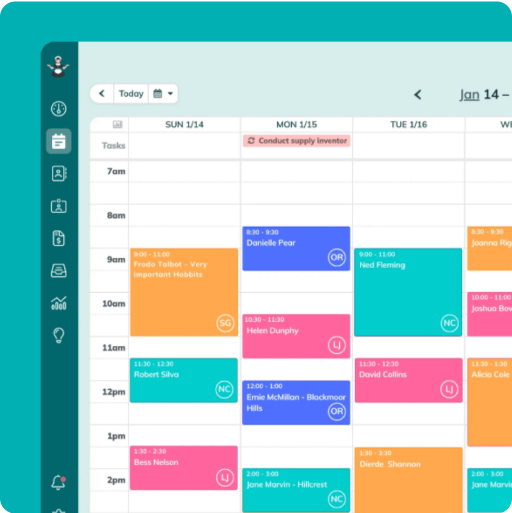
Simplify and enjoy your scheduling with a scheduling software made for maid services
- Have a beautiful calendar that's full but never stressful.
- Make your cleaners happy and provide all the information they need at their fingertips.
- Convert more website visitors into leads and get new cleanings in your inbox with high-converting booking forms.
- Become part of a community of 8000+ cheering maid service owners just like you.
Start your FREE ZenMaid trial today and discover the freedom and clarity that ZenMaid can bring to your maid service! Start your FREE trial today