Frustrated with your scheduling? Try the easiest-to-use calendar app, made by and for maid service owners.


Brought to you by expert maid service owners
Listen on: Apple Podcasts, Spotify or YouTube
Introduction
Coming up next on the Filthy Rich Cleaners podcast: “So actually, it was very easy at that size, because I always carried one relief person for every 10 people.”
Stephanie: Hello, everyone. Welcome or welcome back to the Filthy Rich Cleaners podcast. I am Stephanie from Serene Clean, and today’s fabulous guest is Miss Sharon Tinberg herself, and a legend in our industry. If you guys do not know who Sharon is, you are in for a treat, because she has seen every single thing you could ever wonder about in the cleaning industry and then some. So Sharon, thank you for joining me all the way from Texas.
Sharon: Thank you. After an introduction like that, I think I’ll bow out right now.
Stephanie: You guys listening have no idea the lengths we just went to to get this dang technology working. Oh my goodness. Sharon, for the people who do not know you, where do you even begin? I don’t even know. Let’s take it back. Shall we take it back to what you did before you opened your very first cleaning business?
Table of contents
- Introduction
- Sharon’s Journey Before Cleaning
- The Hostile Takeover and Starting Upstairs Maid
- Why Training Matters
- The Biggest Training Mistake: Shadowing
- The Nine Steps to the Bathroom
- The Most Missed Item: The Door
- Periodic Tasks and Retention
- The Numbers Behind Retention
- The Software Gap and a Simple Fix
- Managing 754 Clients
- One-on-Ones and Keeping Turnover Low
- W2 vs 1099
- Scaling Stages and the Software Pivot
- Pre-GPS Scheduling
- Clean Smart Academy: The Four-Part Program
- Why This Training Works
- What’s Coming Next
- Closing
Sharon’s Journey Before Cleaning
Sharon: Well, first of all, Stephanie, thank you so much for having me on this show, and thank you to Josh, who connected us. Yes, from nowhere, Josh pops into my life, and the next thing I know, I’m on a podcast with Stephanie. So life is bizarre, right? At any age, you never know. So I had, ironically, 17 jobs in my life before we started Upstairs Maid. And I didn’t really start it. My ex-husband called it the hostile takeover. So 17 jobs were really such a blessing when it comes right down to it, because it gave me a little bit of so many different things that I learned along the way. And I will tell you, I quit a job when I got bored, and I catch on fast. That was a gift I received from God. And so I get bored fast. And I never badmouthed the boss once. I never said a bad thing about a company. I just left, went on to the next one. And I said, the bad thing is, I paid for that dearly in the cleaning service. Because you know what they say, what goes around comes around. I got it big time. But what it taught me was I knew that if I didn’t develop those people and all they did was clean houses, I’d lose them too. If somebody would have put me on the next step, I would have stayed with them.
And then there’s another thing that we learned back in our corporate days, when IBM lost its pizzazz and people no longer necessarily wanted to work for the Big Blue. It was women, because we were still definitely not in the boardroom. And they said, when you get a new title, leave that job with that title and go to a new job. Because nobody in that job will ever see you at that level. If you came in as a clerk, even though they make you a supervisor, in the eyes of management way up, you’ll always be a clerk. So take that supervisor title with you and go to a new job where you come in as a supervisor, because that’s what you are now. And leave that one when you become a manager. And I will admit, each step, I started pretty low. The grade point from college was 2.3, and it was during a recession, so I couldn’t find a job. At least I have a degree. So that really helped me. And my last job was a long answer to a very short question. In 1982 is when I found MCI, and I was actually with them for — well, I take that back. Anyway, I left them in 1988 and I was making $80,000, which today would be like $250,000. And I was met with a thousand people. So I’d worked my way all the way up.
The Hostile Takeover and Starting Upstairs Maid
Sharon: And I too walked off of that job and got a $20,000 severance check. And my ex-husband, who is now unfortunately deceased, he fell in love with me, moved to Austin, had no education at all. So he had a little bit of money. So he spent $30,000 on a cleaning service and played with it for a year. And that’s when I walked off my job. And he calls it the hostile takeover.
Stephanie: So you came in, you’re like, this is — I’m gonna do this thing.
Sharon: Well, we needed the money, because I now have a corporate mortgage and no money. I personally actually had $125,000 back then — there was a lot of money in savings. But I’m a farmer’s daughter. I was afraid to spend that money, in case this didn’t work. And now what? What if I can’t find another job? Because we actually started in 1988. It was a huge recession in Texas. So I started in a really crazy time. I walked off a job in a really crazy time that was guaranteed income. But it’s the best thing that ever happened to me, because we had to make it. We couldn’t play with it. And that made all the difference. So we turned 30 clients that we bought for $30,000 into $1.98 million, when I got out of there in 2008.
Why Training Matters
Stephanie: So for our listeners who are probably very intrigued by many things that you just said — Sharon is an expert on cleaning training, right? Like training our cleaners and everything about how to whittle that process down and be very efficient. And obviously, we all struggle with training, and that is one of the most unsavory parts of the business and most frustrating parts. And it’s just so easy to just say, screw it, throw them to the wolves. They’ll figure it out, right? And why is that not the best way? Why would you suggest not to do that?
Sharon: Well, number one, it’s very expensive. And number two, it’s so stressful. And number three, you don’t have to anymore. You really don’t have to do that anymore. You can actually find an easier, better way. I don’t know how to say it. I will say this — go try my free trial, because I’ve got people in Canada who love it, who say, yes, Sharon, I never thought I would agree with you on this, but you can clean a home perfectly in three days of training. And I remember 18 years ago, when I made that statement, I thought I was going to get tomatoes thrown at me. Nobody came home perfectly every time. And by God, now I have a few owners who say, yes, you can, if you follow this process. It took me 17 years to figure this out. Give me a break. I think I finally have it.
The Biggest Training Mistake: Shadowing
Stephanie: What mistakes do you see time and again with training? What do you think that industry-wide, we do wrong?
Sharon: I am going to say shadowing the trainer is the biggest mistake in the world. Get yourself some decent videos. I have animations. Number one, people don’t understand — there’s process and procedure. Process is, what do you clean when? And procedure is, what tools, products, and actions do you use to clean that, now that you know you need to? And very few companies have a process. They take it right out in the field, and they show them the products, and they go to the sink and they start cleaning. That’s not process. Process is, where do you start? What do you do? So I have nine steps to the bathroom, and they are definitely defined motions between each step. I don’t care what they do in the step, kind of, but I do care about the defined motions from one step to another, because it drives them not to make mistakes.
The Nine Steps to the Bathroom
Sharon: And an example of that would be — in step six is when we put everything into our aprons. And there’s a reason for that. When you scrub a toilet, you don’t need all those towels in your apron. They just get in the way, and they get wet while you’re down there scrubbing. And now when you need them dry, when you want to shine, they’re all wet. So cleaners, aprons — because they’re cumbersome. Well, they’re cumbersome because you made them put all that stuff in. And I started that way back when, when I did my first core videos. I was so proud of them, proud of the fact that we used aprons. So we stuffed them with every single possible thing we could find. Put this in and put that in and look, we got everything we need. Well, it took me about 12 years of training in the field, office after office, realizing this is really stupid. I mean, we’re plowing all of it in there. We never use it. So we scrub, we rinse, we do everything but shine before the sixth step. And then we put everything in that apron, and we start at — and that’s like dusting. We start at the most missed item in that room. Do you have any idea what that might be?
The Most Missed Item: The Door
Stephanie: Well, you told me in our last conversation, so it’d be cheating. Doors. You said doors.
Sharon: It’s the door. And I can guarantee you, if you owners go out and check any homes yourselves, trainers probably won’t come back and tell you they’re dirty, because they do the training. But go out with your own eyes, which wouldn’t hurt once in a while, and take a look at your own homes. Because one thing that was revolutionary to the owners — and I went to 63 offices, I think, and trained. So I have trained thousands of people, literally. I go out with the cleaners, I would take pictures of the homes, and the clients — the owners — were just like, oh my God. I had no idea. They knew something was wrong, but they didn’t know how wrong, because we don’t go out in the field. I never went out in the field. And I probably should have. I will say, if I had to do it all over again, I would be more like Warren Buffett. Every now and then you need to go out in the trenches and take a look at what you’re doing, because you’ll be amazed. And go right to those doors and door facings and see what you see in the bathrooms.
So yes, we start with the door, because then you’ll never miss that again. And we just hug the wall all the way around, so we don’t go right to the sink. Next to the door is an electrical plug. Next to that is a picture. So you don’t miss all of that stuff. That’s the biggest problem.
Periodic Tasks and Retention
Sharon: Then the second thing I will say about this industry — and this is not covered in my videos, but I’m going to do another segment on them, maybe, if these ever sell — but it’s periodic tasks. I think companies are very wrong. And I just had a conversation with an owner the other day. I can’t get owners to buy into this. But I think it’s the reason why we had 754 repeat clients in 2008, before there was Facebook. So tell me how we got big, and I’m going to tell you it’s because we kept those homes very clean, and we never lost anybody. Once you get them — I mean, come on, when you’re looking at stamps to get them, you don’t let them go away. So we were on customer service. We called every six months. I mean, we were just on top of it. But we did periodic tasks on a cyclical basis. If you were weekly or biweekly, every time we came to your house, we would do one deep cleaning task with each visit until we were done with them, and we started them over again. So our baseboards never got dirty. They didn’t need a deep cleaning halfway through the year. I mean, come on. I think that’s an integrity issue. If you’re going to charge somebody four or $5,000 to get their house cleaned, I personally don’t think you have the right to call them in six months and say, oh, by the way, it’ll be another $150 because your baseboards are dirty. What do you mean? My baseboards are dirty? I’m paying you to maintain my home. And I’m not sure what you all call maintaining a home if you’re not doing periodic tasks. That’s not maintaining it like you did when you did the deep clean. You’re letting it get dirty. That’s not maintenance.
The Numbers Behind Retention
Sharon: And I think people don’t wrap their heads around that enough, because it’s an extra task. But our cleaners did 800 square feet per hour with the task. But I talked to somebody the other day that’s trying to drive his to 900, which is really good.
Stephanie: That’s fast. For maintenance?
Sharon: Yeah. No, I think 800 is what you can do with a task. It’s good, but he’d be better served, I think, dropping down to 800 and doing the task. But, of course, he doesn’t feel that way. He’ll probably see this and laugh about it. But I do think that’s a huge problem. And retention is what it’s all about. It’s no more expensive than $280 to acquire another repeat client. And client acquisition is not near as high as repeat client acquisition. So I would say, do those tasks. I think that’s huge.
And then one step further — even though this has nothing to do with training — but you’ve got to sell the clients before you need a training program. So I’m going to throw this out there too. And one of the gals who’s using my training program is doing this, and says it’s working. I don’t charge a first-time-in fee. I just do a regular clean for the regular price, and do not one deep clean task. And then our second visit, I do the first deep clean task. The third visit, the second. Until I cycle through them, and then I start them all over again.
The Software Gap and a Simple Fix
Sharon: And I don’t try to define this by client. I would love to. In my day, every client was on a different task because we had files that went out with the cleaners. Now you can’t do that. But there is no software program — and I’m not sure if ZenMaid does it or not — that allows you someplace where you go, and at this point in this cleaner’s home right now, I’m on this task. So it would automatically move with the visits and tell the cleaners what to do that time. And it would be different per client. I’m sure it would be a programming nightmare, but it would certainly be nice to have.
But so what we’re doing in my offices that I work with — and it’s very easy — is we’re just doing the same task for every home that visit. Weekly and biweekly will probably be different, because they are done more often. But we say, okay, this week, we pick — you all wet wipe the baseboards. And then weekly clients, you do the outside of the kitchen cabinets. And they just do it in the home. So it’s easy to manage.
Stephanie: That’s interesting. I like the idea of doing that. If you’re not going to include all of those in your basic package, to just rotate through those, that’s interesting.
Sharon: And then you can charge a lot less the first time in.
The Filthy Rich Cleaners podcast is brought to you by ZenMaid. ZenMaid is the all-in-one software built for cleaning companies, making scheduling and client communication way easier. Check us out at ZenMaid.com.
Managing 754 Clients
Stephanie: I’d love to hear just in general — I mean, you have some pretty clear takes. You’ve been in this industry now for decades, literally. And I want to get into managing that size of a company before you sold the cleaning company. And you had how many recurring clients? 754. I’m sure everybody’s mind is just blowing right now. So at that scale, what were the biggest issues? Was it just managing the sheer number of employees? Or just staying on top of everything? I just can’t fathom it. How many office staff did you have?
Sharon: I had an office manager. I split the city in half, and I ran the teams the same way. I also had three-person teams. Okay, I don’t know if you could do that today with all the transportation on the highway, but if you could keep them all on the same block, you could still do that. So actually, it was very easy at that size, because I always carried one relief person for every 10 people, always.
Sharon: And if they were the next person to get the next opening, if they came to work every day, if we wanted them there, and if their work was good and their speed was good, they got the next job. So at 40 people, I had four relief people. And you know what, Stephanie? I promised them all 20 hours a week, because I know they could eat out of my pocket too much. But I promised them 20 hours a week. I don’t think there was a week when somebody didn’t get 20 hours. I always promised a full-time job in 30 days, because at that size I could give them a full-time job in 30 days. Some of them lasted five when they were full-time. So it was very, very easy. I mean, you have to be confident with the fact that your clients aren’t going to skip. Ours did some. We didn’t run a high skip rate. I think people skip more when your cleanings aren’t as good, because it doesn’t mean as much to them. So having good cleanings is the whole purpose behind all of it.
Stephanie: I’m still just coming back to the sheer size of the company. And so you mentioned what we call floaters, or on call, or whatever you want to call them. So basically, you were just always hiring and having somebody — you would say, we’ll get you up to full-time, I guarantee you 20 hours. And then they were just the fill-in until you could get them to full-time. Can you explain that more?
Sharon: Yes, but I’m going to say, when you do 95 jobs a day and you have 52 cleaners, you’re probably going to have a need for a new cleaner. I mean, come on, that’s only 12 a year if you do one a month. And I promised them a job in 30 days. And we had turnover, like anybody. But I am going to say I thought our turnover was pretty low.
One-on-Ones and Keeping Turnover Low
Sharon: And I think it was because of my one-on-ones, which I’m a strong believer in. We did, from the day I opened up those doors — well, two weeks after — but I got that from MCI. We always did at MCI. We do a one-on-one with every single employee. It staggers. When you’re an owner, you do them with your managers every week. Your managers do it with whoever they report to, and it just staggers down. But every person in our company. Now, I did it by teams, because it created the synergy in the teams. If you have solos, you have to do it by solos. But everybody should get their 10 minutes.
W2 vs 1099
Stephanie: 1099 versus W2 — you’re always going the W2 route, then?
Sharon: I’m always going to go to the W2s. Clean Smart Academy does make it capable, at least for 1099 contract people, to now have trained employees. I’ve checked into this. And in most states, it is totally legal to ask your contract labor people to be certified.
Scaling Stages and the Software Pivot
Stephanie: Do you remember just thinking about scaling to that size? Was there any definitive — I mean, you had obviously been in so many leadership roles previously. Do you remember any definitive stages where you guys had to really change the way you did things? Like, okay, this isn’t working anymore at this current size? Obviously, one of them being teams. It sounds like adding a third — like working in teams of three.
Sharon: Third person — that was survival, you know. But truly, if I can get to three teams, I’ll do it again. I love it. Well, one pivotal point was trying to get some software. At 200 repeat clients, we were scheduling manually.
Stephanie: How? Like on pen and paper and a calendar?
Sharon: I write about this in my book. I do. I write about it in my book. I got to 50, and I was writing all the names down on the calendar. And, you know, the blocks aren’t that big. Because back then, you didn’t have the stuff where you could write on it and then erase it. We had blackboards. So at 50, I was overwhelmed because I didn’t have enough space. So by God, by then I could use an Excel spreadsheet on that big, fat PC on my desk. So I got an Excel, and I gave every weekly client a 100 number. So 100, 101, 102, 103. Then every other week’s were the 200s. Every three weeks were the 300s. And monthlies were the 400s.
Pre-GPS Scheduling
Sharon: And then every five weeks, Mike and I would sit down, and I would take out a big calendar, and he would take that Excel spreadsheet, and he would say, okay, 101 is Anderson. And I would go to the calendar where 101 was when we last cleaned them, to see where their day was on. And then I’d just write 101 on Monday — every Monday, if they were five weeks — 101, 101, 101, 101. And we went through all 200 clients like that, until everybody was on this calendar. There were all kinds of numbers everywhere, in every square.
Stephanie: No GPS yet, huh? Like, how are your cleaners finding these houses?
Sharon: Maps. Oh my God. When you saw somebody, you would go to the Mapsco book. As a matter of fact, Nancy and I were walking Mapsco books. If you told me 963 North First Street, I would say G24. I knew exactly what area that map was in. As a matter of fact, when we got our first software and somebody came in, they said, you can’t know that. And I said, yeah, we do. I mean, after you’ve scheduled that many people, it’s just right up here in your brain. So we did it by Mapsco. And then we’d go to Mapsco and take the copy, and then we’d highlight it and staple it to the inside of the folder with a profile sheet on one side and the others. And then, when I got out of there, we had rafters of files that were one-times. Because when somebody called, we couldn’t shove another one-time in there if we tried. But when people called back, we were professional. We didn’t want to go through all that again anyway. So we’d say, hold on a second. We’d go to the file, and we’d file them all alphabetically, Poor Anna. And we’d go find the last name, and we’d pull it out and say, is this still you? Which was great. And that’s what made me finally upgrade again to software.
Clean Smart Academy: The Four-Part Program
Stephanie: For those who are interested in Clean Smart Academy — obviously you’ve alluded to that throughout the conversation. Can you tell us a bit more about what that looks like and what people can expect from the software?
Sharon: Yes, it’s a four-part program that allows you to make the paradigm shift of not having to have your cleaner follow the trainer, but instead they follow Bella and the Professor while they’re cleaning. And then the trainer actually goes out and watches them clean and never picks up a towel. So the four parts are an animation, which is the process — what do you clean when? It’s very engaging, because it’s animated. You saw it. It’s really cute characters. It sucks them right in. Then there is a manual that you edit. So it’s your products, your tools, and your actions. So when you get out in the field, you don’t have to say, we use this product. No, they’ve already seen that in the manual. Then in the manual, there’s also — it breaks down each major item, like a shower and a sink. And there’s a human being cleaning it, again, because the animation is one thing, an actual cleaner doing it is another thing. And then it all wraps up in a quiz, so you’ll know that they are ready to go when they get out in the field.
Why This Training Works
Sharon: When you get out in the field, why would you have a trainer clean and then watch it again? That is a waste of time. As a matter of fact, that offers inconsistency. If everybody watches the Professor and Bella go through this whole thing and then are using your products and your tools, it will be remarkably consistent. But it is software. And the downside is, if you do this — just like buying any software, just like ZenMaid’s software — if you don’t put your own customers into it, it’s not going to do you any good. So if you use this training program and you don’t update your manual, it’s not going to do you any good. They aren’t going to be able to connect the dots. And that’s what’s so amazing. I have the only training kit in the world that you can put your own products, tools, and actions into. And that makes it wonderful.
What’s Coming Next
Sharon: The other thing I’m going to announce today, which is huge — if you want to know more about my history and more about what I think, in a very fun, novel-type way, that’s a quick read — I have written the book. “Trying Doesn’t Do It, Doing Does.” It’s going to the editor next week. It is a fast, fun read, but I think you will walk away learning some things without a doubt. And if nothing else, it’ll be a great reminiscer, because all of you can relate to something that’s said in that book.
Closing
Stephanie: That’s amazing. Oh my gosh, Sharon, this has been amazing. And I will see you at CleanCon in March. So anybody wanting or considering CleanCon, this should go live before then. Both Sharon and I will be there. So I’m sure that she will be happy to say hello. And make sure you guys say where you heard her on, if this is the first time that you’ve been introduced to her. But if they are interested in you, Sharon, where do they go online to find you?
Sharon: CleanSmartAcademy.com. Or YouTube, or Facebook. I have venues everywhere. Just look for CleanSmartAcademy.com. I have 236 videos on YouTube. And there is a free trial, by the way, for the training program. You can have it for five days and just try it out and see what you think.
Stephanie: I’m definitely going to be giving that trial a go, because I want to. I’m very intrigued by this concept, because that’s a lot faster training than what we do in Serene Clean. So I’m super excited to explore it myself. But Sharon, thank you so much for your time today. And all of our listeners, please give her some love in the comments below. Hit that like, hit that subscribe, and we’ll see you on the next episode of Filthy Rich Cleaners. Bye, guys.
If you enjoyed this episode of The Filthy Rich Cleaners podcast, please be sure to leave us a five-star review so we can reach more cleaners like you. Until next time, keep your work clean and your business filthy rich.
Note: This transcript has been edited for clarity and readability.
Resources Mentioned in This Episode
QUICK TIP FROM THE AUTHOR
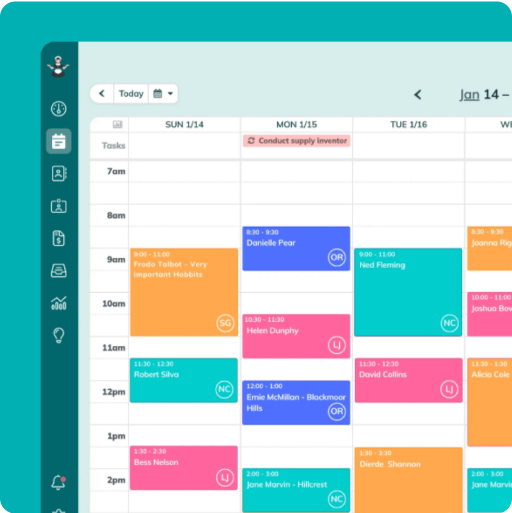
Simplify and enjoy your scheduling with a scheduling software made for maid services
- Have a beautiful calendar that's full but never stressful.
- Make your cleaners happy and provide all the information they need at their fingertips.
- Convert more website visitors into leads and get new cleanings in your inbox with high-converting booking forms.
- Become part of a community of 8000+ cheering maid service owners just like you.
Start your FREE ZenMaid trial today and discover the freedom and clarity that ZenMaid can bring to your maid service! Start your FREE trial today