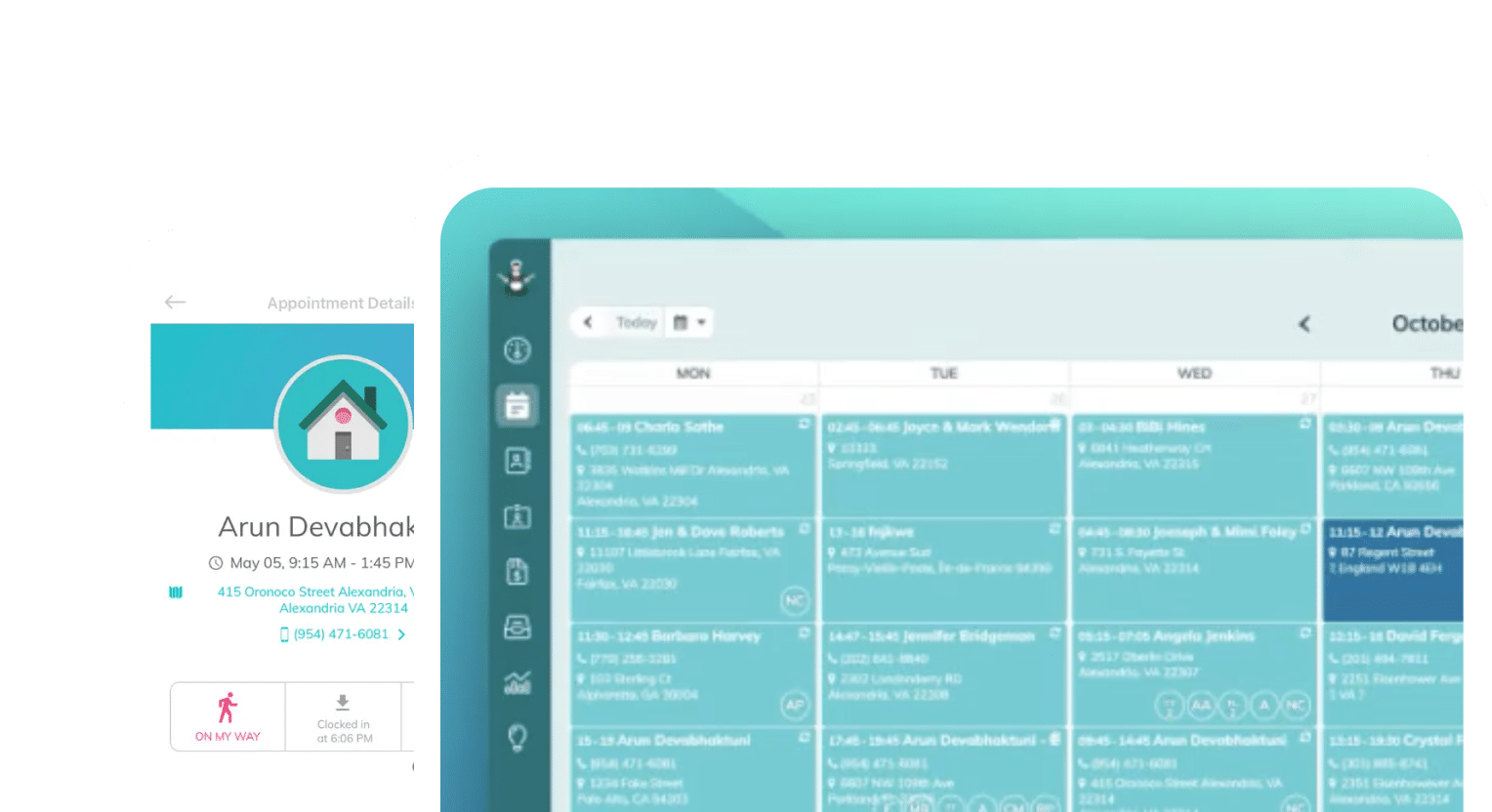
Frustrated with your scheduling? Try the easiest-to-use calendar app, made by and for maid service owners.

If you’re starting or growing a cleaning business, one of the most important hiring decisions you’ll make is whether to use independent contractors (1099) or W-2 employees. This is often the thing that trips business owners up the most, so we’re here to clear the air.
These two worker types are not interchangeable — and misunderstanding the difference can lead to business pains like inconsistent quality, or worse, fines and legal risk. The reality is that misclassifying your employees can get you in a sh*t-ton of trouble.
This guide breaks down the real differences between ICs and W-2 employees, so you can choose the right model for your cleaning business without risking legal ramifications.
What Is an Independent Contractor (1099 Cleaner)?
An independent contractor is a self-employed individual or cleaning company that provides services to your business for an agreed-upon fee. You pay them per job or project, and they are responsible for their own taxes, insurance, and business expenses.
Similarly to how a business pays a contractor for marketing services, for example, they receive the payment from you in full and have to handle the taxes and filings on their own.
In the United States, independent contractors are often called “1099 workers” — named after the tax form they receive. Despite the nickname “1099 employee,” contractors are not employees of your business.
These are the typical characteristics of contract cleaners:
- Handle their own taxes and benefits
- Set their own schedules
- Work for multiple clients or companies
- Provide their own equipment and supplies
- Carry their own insurance
Pros and Cons of Hiring Independent Contract Cleaners
Contract cleaners can make sense in certain stages or situations.
Pros of Hiring Independent Contract Cleaners
Lower upfront labor costs
You pay only for completed work and avoid payroll taxes, benefits, and workers’ compensation expenses.
Flexible staffing model
Contractors allow you to scale labor up or down based on demand, seasonality, or job size. This means you can pick and choose when you need them more (or less) often.
Faster hiring and onboarding
Contractors typically require less onboarding, paperwork, and training, so they can get to work ASAP.
Access to specialized services
Many contractors specialize in deep cleaning, post-construction, carpet cleaning, or windows, letting you offer niche services without having to go through explicit internal training.
Reduced administrative workload
Contractors manage their own taxes, insurance, and benefits, simplifying payroll and HR tasks. This is a heavy lift off of the administration burden for business owners.
TL;DR: Contractors are useful for variable demand or short-term needs, but they’re rarely ideal for consistency and growth.
Cons of Hiring Independent Contract Cleaners
Limited control over work quality
You cannot legally dictate schedules, methods, tools, or training, making consistent quality harder to enforce.
Inconsistent availability
Contractors may decline jobs, prioritize other clients, or become unavailable to work for you with little notice.
Higher long-term cost for recurring work
Contractors often charge premium rates to cover their expenses, which can exceed employee costs at scale. Paying a premium is only worth it in certain situations, so make sure to keep this in mind.
Lower loyalty and brand alignment
Contractors may work for competitors and are not tied to your company culture, making it easy for them to jump ship.
Misclassification risk
Treating contractors like employees can trigger IRS or state penalties, back taxes, and audits. This is bad, so try to avoid this at all costs (literally).
Additional resources
Because there’s so much nuance to this decision, we also recorded a full podcast episode that dives into what it’s really like to run a cleaning business with independent contractors.
Cleaning business owner Stephanie Pipkin sits down with Chris Schwab — who has operated a fully remote cleaning company for over 10 years and coached hundreds of owners through this exact challenge — to break it down:
Pros and Cons of Hiring W-2 Employees
W-2 employees make more sense long-term, but the full list of things to consider is below:
Pros of Hiring W-2 Employees
Maximum control over work
You control schedules, routes, cleaning methods, products used, and service standards. This level of control enables predictable quality and brand consistency.
Easier training and quality enforcement
W-2 employees can be required to follow your SOPs, attend training, and accept feedback, which makes continuous improvement possible.
Consistent service for recurring clients
Employees are more likely to service the same clients regularly, which improves trust, retention, and customer satisfaction.
Stronger team culture and accountability
Employees are part of your internal team, which supports accountability, communication, and shared expectations.
Lower long-term cost at scale
While more expensive upfront, employees don’t charge per-job premiums. For recurring residential or commercial accounts, this often reduces labor cost over time.
Higher loyalty and retention
Employees are less likely to work for competitors or leave suddenly, protecting institutional knowledge and client relationships.
Cons of Hiring W-2 Employees
Higher fixed costs
Employers must pay payroll taxes, workers’ compensation, unemployment insurance, and sometimes benefits, regardless of workload. Yes, that means even when business is slow.
Administrative and compliance burden
W-2 employment requires ongoing compliance with federal and state labor laws, payroll processing, and record-keeping.
Less flexibility during slow periods
As mentioned above, employees must still be paid even when demand dips, which can strain cash flow for newer businesses getting off the ground.
Higher risk if demand is inconsistent
Without predictable bookings, employee payroll can outpace revenue.
Tax Differences: Independent Contractors vs. Employees
Here’s the simplified breakdown in the US:
| Category | W-2 Employee | 1099 Contractor |
|---|---|---|
| Payroll taxes | Employer withholds & pays | Contractor pays themselves |
| Self-employment tax | No | Yes |
| Benefits | Employer provides required benefits | Contractor provides their own |
| Year-end forms | W-2 + W-3 | 1099-NEC |
| IRS risk | Low if compliant | High if misclassified |
⚠️ Important: If you control how, when, and with what tools someone works, they are likely an employee, even if you call them a contractor!
Full Comparison of W-2 and Independent Contractor Employees
| Category | W-2 Employees | Independent Contractors (1099) |
|---|---|---|
| Legal status | Employee of your business | Self-employed individual or business |
| Common name | W-2 employee | 1099 contractor (not an employee) |
| Who controls schedule | Employer | Contractor |
| Who controls cleaning methods | Employer | Contractor |
| Training requirements | Can require training and SOPs | Cannot require training |
| Equipment & supplies | Typically provided by employer | Provided by contractor |
| Ability to enforce quality | High | Limited |
| Service consistency | High | Variable |
| Worker availability | Predictable | Inconsistent |
| Loyalty to business | Higher | Lower |
| Ability to work for competitors | Typically restricted | Allowed |
| Pay structure | Hourly or salary | Per job or project |
| Payroll taxes | Employer withholds and pays | Contractor pays own taxes |
| Self-employment tax | No | Yes |
| Benefits required | Workers’ comp, unemployment, possibly PTO | None |
| Administrative workload | Higher | Lower |
| Cost structure | Higher upfront, lower at scale | Lower upfront, higher long-term |
| IRS misclassification risk | Low if compliant | High if treated like employees |
| Best for | Consistent growth and brand control | Flexible or short-term labor |
How Wages Typically Work (Hourly vs. Percentage)
Now let’s talk about wages. Cleaning businesses usually pay cleaners one of two ways:
Hourly Pay
- Most common for both W-2 employees and contractors
- Ensures predictable earnings
- Encourages thorough, unrushed work
Hourly pay is best for quality-focused businesses and recurring services.
Percentage Pay
- Cleaner earns a percentage of each job
- Labor costs scale with revenue
- Can motivate speed — sometimes at the expense of quality
Percentage pay is best for businesses with strong quality-control systems in place.
So…Which Is Better for a Cleaning Business?
There’s no universal answer, but there is a clear pattern:
Hiring ICs is trickier, hands down. But for new or small businesses with variable demand, contractors can provide flexibility
For growing businesses that value consistency, control, and brand reputation, on the other hand, W-2 employees are usually the better choice.
Wrapping Up
Contractors offer speed and flexibility. Employees offer stability and scalability. The right choice truly depends on your size, cash flow, demand, goals for growth, and how much control you need over service quality.