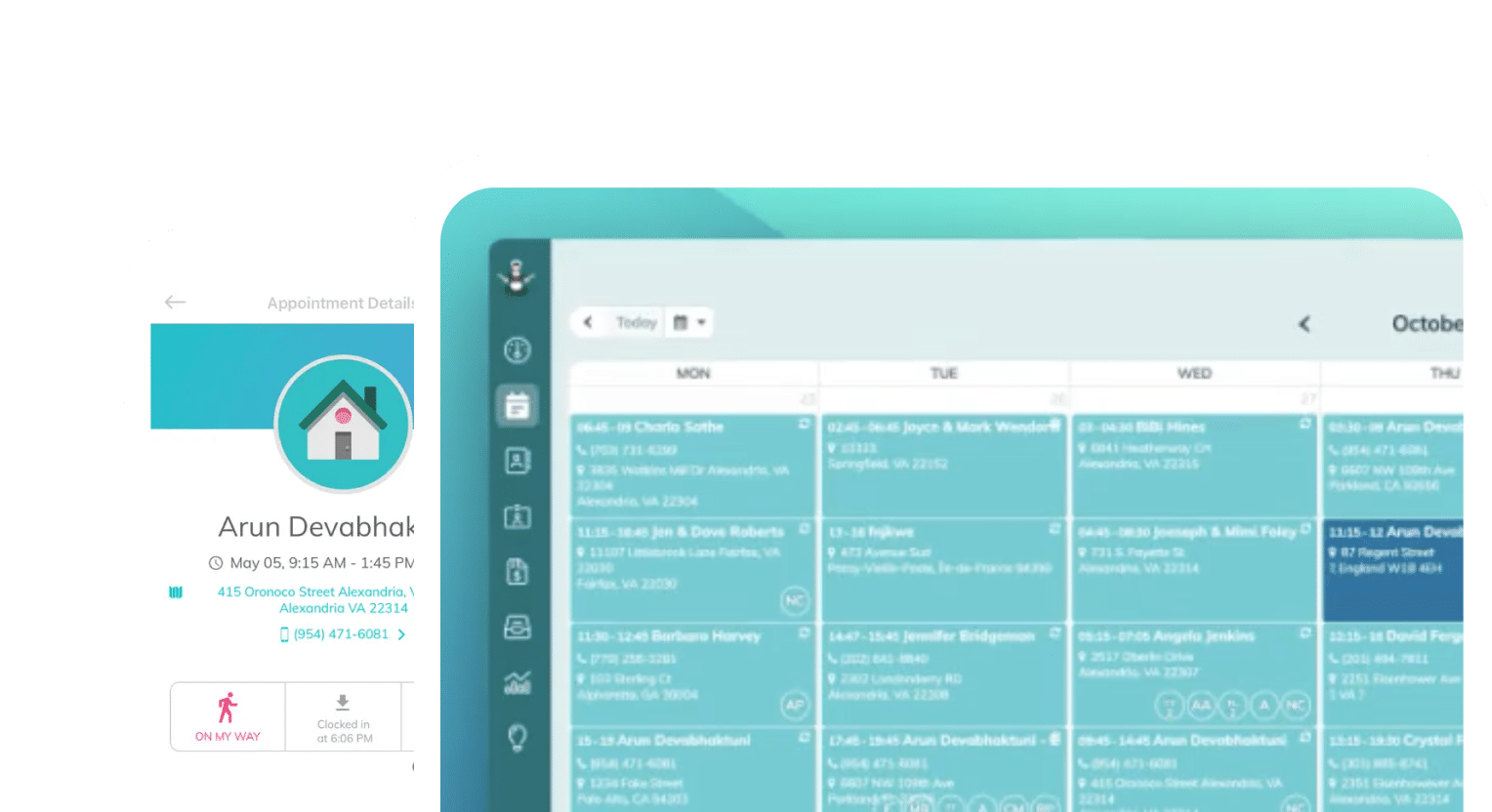
Frustrated with your scheduling? Try the easiest-to-use calendar app, made by and for maid service owners.

Every cleaning business owner has heard some version of this complaint: “The last cleaner was great, but this one missed the baseboards.” Same service, same price, different result. This kind of inconsistency erodes your recurring clients’ trust and bookings.
But consistency isn’t a hiring problem; it’s a documentation problem. When every cleaner knows exactly what “done” looks like and can check it off in the moment, your quality no longer depends on who’s holding the vacuum that day.
In this guide, we’ll break down how to standardize your service delivery and why it’s actually important for multiple parts of your business to make these changes. You’ll also get a seven-step build plan and a 30-day rollout that your team won’t hate.
What Does “Standardizing Service Delivery” Actually Mean for a Cleaning Business?
Most cleaning business owners go straight to thinking about training new cleaners well. Each cleaner needs to serve each cleaning client the same way, in the same order, and to the same extent every time.
But this is only half the story. Even well-trained cleaners will have their own methods, practices, and opinions on standards that you need to clarify, or eliminate if they weaken quality.
There are four things you need to clarify to make sure every cleaner meets your service delivery standards:
- Scope: What’s included in a Standard vs. Deep vs. Move-Out. Get specific, and take a look at our checklist templates for inspiration
- Sequence: Your order of operations. Explain why top-down or back-to-front cleanings matter, such as mopping floors farthest from the door first to avoid leaving footprints
- Finish standard: What “done” looks like, in observable terms. Take pictures of what you consider done and explain clearly: “no water spots on chrome” is more helpful than “clean the bathroom well”
- Proof: Photographic record that the work happened, made available for review before the client complains
These four things form the basis of a Standard Operating Procedure (SOP) document. It’s more detailed than a plain checklist, which covers scope and coverage, because it defines your finish standard in a way that sets expectations clearly.
Why Do Standards Break Down as Teams Grow?
Standards will shift as teams grow. New hires need time to internalize their training, and experienced cleaners may be slowed down by trainees if you’re training by shadowing. Higher turnover means institutional knowledge, or the tips and tricks cleaners have built over the years, leave with them.
Without proper systems in place, you’ll only catch these gaps in people’s understanding of “done” when clients complain.
Even though this is common, it’s avoidable with the right strategies in practice. Consider these common methods of training and service quality assurance. Each one has a failure point:
- Training-by-shadowing means new hires will learn whatever the trainer’s habits are, including the bad ones, and are more likely to repeat them
- Paper checklists get filled in at the truck at 4 p.m. from memory, not in the moment during a cleaning
- You’re still doing QA for all of the cleaners you’ve hired, which won’t scale far past five or six cleaners
- No evidence of the cleaning exists until a complaint arrives, so every correction in training feels reactive and personal
Luckily, these are common reasons for standards breakdowns in the cleaning industry, which means there are many ways to recognize and fix them, too.
Specify what you look for in a completed cleaning — write it all out and organize it. This will benefit your business and help you retain clients.
Your cleaners will feel better supported in their roles, too. If any of these issues feel too familiar to you, it may be time to standardize your service quality and write out all of your delivery instructions in an SOP document.
Our Four-Layer System for Consistent Service Quality
At ZenMaid, we’ve seen successful cleaning businesses like Serene Clean and The Funky Sponge build systems of work that ensure consistent service quality. Not random checklists or manual reviews — they use clear communication across four layers of work.
In the following table, we’ll match each layer of this work with its purpose in clear communication:
| Layer | Question it answers | What it looks like | Why it’s important |
| 1. Define | What is our standard? | Written SOP per service type: scope, sequence, finish standard, time budget | Setting standards in writing makes things clear and enforceable |
| 2. Deploy | How does the cleaner receive information during appointments? | Digital checklist attached to the appointment, on the phone, tapped as work happens | Easily accessible, in-the-field reassurance that teams follow protocol |
| 3. Verify | Did the work actually happen? | Completion data, photos, spot audits scored the same way every time | Proof — for clients and employee reviews |
| 4. Improve | What do we need to change next? | Feeding redos and complaint patterns back into the SOP and training | Builds your standards and improves your quality over time |
The most important takeaway from this system of work is that standardization only happens at the point of work. Your standards need to be accessible to cleaners in the field.
SOP documents are a part of starting a business, but when they sit in drawers or in PDFs on your computer, they’re not useful. Make them real, useful documents that cleaners can use while they work.
Tools like ZenMaid offer digital, shareable checklists your cleaners can take with them on the job. We’ll cover more tools like this in the following section.
Why Digital Checklists Standardize Quality Better Than Paper Checklists
Paper checklists work fine for solo operators, but as soon as you hire your first cleaner, managing them gets difficult. You have to print checklists for everyone, organize them by assignment, meet up to pass them out, and then just hope they get used and not thrown away by accident.
Doing this every day, for every cleaner, adds up to a lot of wasted time. Digital checklists stop all of that repeat work, standardize cleaning instructions across like appointment types, and make it easy for cleaners to use.
| Paper checklist | Digital checklist | |
| When it’s completed | Usually from memory, after the job | Tapped in real time, in the room |
| Who sees it | Nobody, unless it’s scanned | Owner sees completion live |
| Updating the standard | Reprint, redistribute, hope | Edit once, applies to every future job |
| Proof for disputes | “She says she did it” | Timestamped record + photos |
| New-hire onboarding | Verbal + shadowing | The checklist is the training |
| Feedback | Vague (“be more thorough”) | Item-specific (“blinds were skipped on 3 of 5 jobs”) |
The biggest difference between the two is underneath all of those rows.
A paper checklist standardizes what your cleaners cover. A digital checklist standardizes what they cover and gives you a record of what each cleaner did.
This is what turns a checklist from an unhelpful reminder into a supportive system. You also gain clear feedback you need to give your cleaners — “you need to be more thorough” is an opinion, whereas “the blinds got skipped on three of your last five jobs” is a fact. This makes problems fixable, not a criticism.
Owners who make this switch usually notice the tone of their team conversations change before they notice the quality numbers move.
How ZenMaid can help you
In ZenMaid, you can build custom checklists for each type of cleaning you sell. Standard, deep clean, and move-out cleanings can each have their own checklists, which are pulled each time a cleaner runs a job. Assign a checklist to an appointment, and it shows up in the cleaner’s mobile app, and you can see completion status as the job happens instead of waiting for the day to end.
Here’s the full walkthrough of setting them up.
Build Your First Standardized Service in 7 Steps
Don’t try to standardize everything all at once! Pick one service, get it right, then copy what you built to other services. Here’s how we’d suggest you tackle this:
1. Pick one service to start
Usually, the best place to start is your recurring standard clean. It’s almost certainly your highest-volume service, which means it’s where inconsistency costs you the most and where you’ll see results fastest. Deep cleans and move-outs are more complex and can wait.
Do this today: Pull your last 30 days of jobs and confirm which service type you booked most. This is where you standardize.
2. Shadow your best cleaner and write down what they actually do
Whether you’re your best cleaner or not, write down exactly what is done at your best jobs. Either follow your cleaner through one full job, or do a job yourself, and keep your phone’s notes app open to record the real cleaning service you give.
Get granular: list the room you start in, what gets carried in immediately versus left in the car, when they wipe down versus when they vacuum, and where they save time. This is your draft SOP.
Starting this way is better than writing something at your desk because it’s real, and it already works, which means you’ll get far less resistance when you roll it out.
Do this today: Book two hours to ride along on one clean this week.
3. Write the finish standard for each room in observable terms
This step gets skipped most often because it feels obvious. But it isn’t obvious — and it’s worth explaining so you stay clear. “Clean the bathroom thoroughly” isn’t a standard; it’s a hope. Two cleaners can both do it and produce different results, and neither of them would be wrong.
A finish standard describes what done looks like clearly enough that someone could verify it from a photo, such as:
- No water spots or streaks on chrome fixtures
- Mirror clear at eye level with no wipe marks
- Shower glass clear, no film at the bottom third
- Floor edges and behind the toilet base free of dust and hair
Write these for your five most complaint-prone areas first. You don’t need them for everything.
Do this today: Open your last 10 complaints and write a finish standard for each one.
4. Cut the list to what actually matters
A 90-item checklist is completed by tapping without being read. Cleaners aren’t being lazy when they do this; it just takes too much time, and they’re trying to keep a schedule. A list that can’t be honestly finished teaches your team that the checklist is pointless.
Aim for 15 to 20 items on a standard recurring clean. Filter this by considering how often you receive client complaints when each item is missed. If you don’t have many complaints about an item, it belongs in the SOP as training material, not on the working checklist.
Do this today: Take your draft list and delete anything that has never generated a complaint.
5. Build it as a digital checklist and attach it to the service type
In ZenMaid, you can attach the checklist to the service so it’s automatically tied to every matching appointment. Once a cleaner accepts an appointment, they have access to the checklist, and your involvement in the process ends.
This also makes updates painless later. When you improve one item, all future jobs inherit the improvement.
Do this today: Build the list in ZenMaid and assign it to your next week of standard cleans.
6. Add photo requirements to your 3–5 highest-complaint items
Photos are powerful and easy to overdo. Requiring one for every item turns a three-hour clean into a photo shoot your team will quickly regret.
Pick the small number of items that generate the most complaints or redos, things like shower glass or the oven interior. Require photos for these items only to start.
As you build proof of where disputes actually happen, your cleaners are more likely to double-check before they leave because knowing a photo is coming changes how carefully someone finishes a surface. Then, you’ll also know which items require photos, and which ones do not.
Do this today: Look at your complaint log and pick the top three.
7. Set a time budget per section
Adding an expected time to each section of the checklist will benefit your business in many ways. The first benefit is that your checklist does more work for you: it becomes a pacing tool in addition to a quality tool.
This matters more than it sounds. Most quality problems in a maid service are actually time problems. For example, say someone falls behind in the kitchen and rushes the last two rooms. A time budget gives cleaners space to realize they’re behind schedule in the moment, and gives them a chance to catch up before you notice it in an email three days later.
The second benefit of the pacing tool is that it gives you a new stream of clear, honest data on how long the work actually takes. This is hugely important to know when finding your production rate — or how you should price your services. Understanding whether you’re losing money on your jobs or you need to adjust is key to growing your business.
Do this today: Time your next standard clean room by room and use those numbers as your starting budget.
How Do You Match Your Standard to What Clients Actually Expect?
Standardizing your services does not mean clients won’t still complain. A standard only prevents complaints if the clients agree to it before the first clean.
Most “quality problems” in the cleaning industry are really scope problems. Even though your cleaner did exactly what they were supposed to do, your client expected something else and complained.
After you standardize services, you can further close this gap. Here’s how:
- Share your checklist with your quote: Owners avoid this because they’re worried it invites nitpicking. In practice, it does the opposite: you look organized next to your competitors who generalize. It also puts scope disagreements on the table before there’s money involved, so it usually converts better and prevents fights
- Publish your boundaries, not just your inclusions: Write down what’s included, what’s an add-on at extra cost, and what you simply don’t do. Don’t leave room for anyone, cleaners or clients, to assume what you do and don’t do. Naming them costs you nothing and saves the awkward conversation later
- Send the completed checklist with your “job complete” message: This is an easy way to prove your value to clients. If your client is only getting an invoice and a house that looks nice, they may feel underwhelmed. When they see 31 specific things that you took care of while they were at work, you show your client exactly what they’re paying for, which works to justify your price at renewal time
- Use the checklist as the neutral third party: “Item 14 was marked complete at 2:15 p.m. — let’s take a look at it” is a completely different exchange than “she says she did it.” You can fix the problem, and nobody has to be called a liar to resolve the issue. This matters a lot for keeping good cleaners
- Watch for expectation drift on recurring clients: A home that was an easy job in January won’t be the same in August. There could be a new puppy, new baby, new hardwoods, or a teenager who moved back in — any number of changes could have happened, and the scope you priced then is now the scope you’re losing money on. Revisit scope with recurring clients every six months, and it will be a normal conversation if you schedule it ahead of time
After you’ve implemented this system, you still may receive client complaints. At the very least, you’ll know in these cases that you have a legitimate complaint you need to handle.
Measuring Quality So You Know Standards Are Working
If you’re just getting started, we recommend looking at these five metrics:
- Complaint rate per 100 jobs + Response time: Use a rate, not a raw count. Raw complaints go up as you grow even when quality improves. Divide your number of complaints by the overall number of appointments you’ve completed to find your complaint rate. Make sure you respond quickly, within 24 hours
- Redo/re-clean rate vs. Complaint rate: Your redo rate is the single best proxy for consistency. Every redo is a job you performed twice and got paid for once. But if you’re getting more complaints than you need to do redos, you likely need to set clearer expectations with clients at booking
- Checklist completion rate by cleaner: Low completion usually means the list is too long or the team doesn’t believe anyone reads it. Both are fixable, and both are your problem to solve, not theirs
- Variance in job duration for the same service type: This is harder to measure without software, so when you implement digital checklists, start checking your job duration. When three cleaners take roughly two hours to clean the same size home, they’re following the same sequence. But when one is taking an hour and 30 minutes, and another is taking three, they are definitely not following the same protocol — and one of those numbers is going to turn into a complaint
- Client retention vs. attrition rate: Most churn decisions get made in the first month, and inconsistency between clean one and clean two is a common trigger. Start measuring this once you’re past the third clean
To get a full picture of your quality metrics, check out our article on seven metrics to measure service quality for residential cleaning businesses. Check these every 90 days or so to keep your business healthy, but know that gathering your CSAT and NPS scores may be difficult without historical data.
How to Roll This Out Without Your Team Hating It: A 30-Day Plan
Your standardization plans will not go well if they’re introduced badly. You don’t want your teams to think they’re slacking.
But when introduced well, your service delivery standards become what finally protects them from unfair complaints. How you handle the first week of the transition matters a lot to the outcome.
Take your time with the rollout and make sure your teams feel supported. Move slowly:
- Week 1 — Explain the why, and don’t do it alone: Tell the team plainly what you want to create: a documented standard, which means nobody gets blamed for a miss they didn’t cause, and nobody has to guess what a picky client expects. Have your best cleaner co-write the SOP with you. Her name on the document gives your other cleaners confidence in the document’s value, and does more for adoption than any policy announcement you could write
- Week 2 — Pilot with one crew and one service type: Assume the first version of your checklist is wrong. Items will be out of order, your time budget will be too optimistic, and there will be at least one task nobody has done in a year. Ask your cleaners for feedback and change it in front of them. Your cleaners will feel heard and appreciated as partners in building the standards
- Week 3 — Roll out to all crews and start reviewing data weekly: Look at completion patterns once a week, and reserve your coaching efforts on patterns instead of one-off misses. One skipped item is a bad day; the same item skipped five times is either a training gap or a checklist that’s asking for something unrealistic, and both of those are worth a conversation
- Week 4 — Wire service delivery into onboarding and your feedback loop: New hires should learn that the checklist is the job itself, not paperwork attached to the job. Clients should also know that their feedback is appreciated — and whatever your quality feedback loop looks like, connect it back to specific checklist items so improvements land somewhere concrete
Our full guide, Training for Cleaning Staff: Best Practices from Our Experts, walks you through how to build out a robust training program for new cleaners just like this.
Frequently Asked Questions
What’s the difference between an SOP and a checklist?
An SOP is the reference document that explains the standard and its full method, product dilutions, safety notes, and what to do in edge cases. A checklist is that standard compressed into the items a cleaner checks off while they work.
The SOP trains; the checklist executes. Most businesses that struggle with consistency have written one of these without implementing both, in practice, together.
How many checklists does a cleaning business actually need?
One per service type you sell, not one per client. Most residential cleaning businesses need three to five: recurring standard, deep clean, move-in/move-out, and sometimes post-construction or an add-on list. Client-specific instructions belong in the job notes, not in a separate checklist. What a single client wants should not affect your baseline standards.
How long should a house cleaning checklist be?
15 to 20 items for a standard recurring clean, and 35 to 50 for a deep clean. The length of your checklist only tells half the story, though.
You need to be realistic about whether a cleaner working at their average pace could honestly complete every item within the time limit for a job. If they can’t, they’ll start marking things done that aren’t, and your data stops meaning anything. This will affect your ability to accurately price jobs over time.
Do digital checklists slow cleaners down?
Slightly, in the first week. It usually takes between two and four minutes per job for cleaners to tap off checklist items in their app as they finish each room, especially before it becomes a habit.
After that initial period, the time lost becomes a rounding error against the cost of a single redo, or an unpaid return visit plus the time lost to commuting. The bigger risk to speed is a checklist that’s too long, not the format it’s in.
How do I standardize quality if all my cleaners are subcontractors?
Standardize the deliverable rather than the method. With independent contractors, dictating step-by-step how work must be performed can affect worker classification, so the safer approach is to specify the scope, the finish standard, and the proof of completion you require, and leave the sequence and technique to them.
Classification rules vary by state and change over time, so confirm your specific setup with an employment attorney before you build your process around it.
Can checklists be used as proof if a client disputes the work?
A timestamped completion record with photos is far stronger evidence than anyone’s memory. This should be used as the genuinely useful tool it can be for resolving client disputes and fighting payment chargebacks. It isn’t a legal guarantee of anything, but it changes the conversation from two conflicting accounts to a shared set of facts, which is usually enough to settle the disagreement before it becomes a refund.
Build Consistency With Standardized, High-Quality Services
You can’t just hire your way to consistent service quality. Even great cleaners produce different results when nobody has written down what the result is supposed to look like.
If each cleaner is filling in the blanks with their own judgment, you have a documentation problem, and documentation is something you can actually fix. Define your standard, put it in your cleaners’ hands at the moment of work, verify it happened, and use what you learn to make it better. Do that for one service type, and you’ll have the pattern for all of them.
Ready to stop being the quality control department? Try ZenMaid free for 14 days and build your first digital checklist this week, so every clean looks the same whether you inspect it or not.