Frustrated with your scheduling? Try the easiest-to-use calendar app, made by and for maid service owners.

Brought to you by expert cleaning business owners

Tips and advice shared here have helped us grow our own maid services. The ZenMaid team currently has 5+ current and former cleaning business owners on our team, including our Founder and CEO, Amar. We’ve been in the maid service industry for 10+ years and counting.
We partner with amazing leaders in the cleaning industry, including Debbie Sardone, Stephanie Pipkin, Angela Brown, Chris Schwab, and many more — all to provide you with the latest industry insights.
We’ve built the easiest-to-use, comprehensive cleaning business software, built specifically for the industry!
Listen on: Apple Podcasts, Spotify or YouTube
QUICK TIP FROM THE AUTHOR
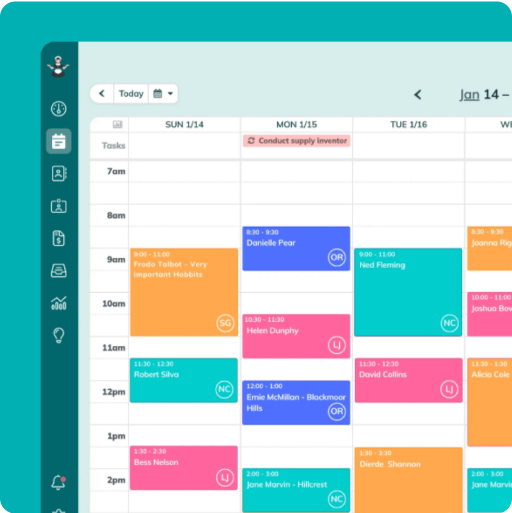
Simplify and enjoy your scheduling with a scheduling software made for maid services
- Have a beautiful calendar that's full but never stressful.
- Make your cleaners happy and provide all the information they need at their fingertips.
- Convert more website visitors into leads and get new cleanings in your inbox with high-converting booking forms.
- Become part of a community of 8000+ cheering maid service owners just like you.
Start your FREE ZenMaid trial today and discover the freedom and clarity that ZenMaid can bring to your maid service! Start your FREE trial today
Meeting LaShanda Brown
Stephanie: Welcome or welcome back to the Filthy Rich Cleaners podcast. I am your host Stephanie from Serene Clean, and today’s guest is Ms. LaShanda Brown in New Orleans. She has owned Sweeping Hands Cleaning Service — LaShanda, how long have you been in business?
LaShanda: May 1st it’ll be 18 years.
Stephanie: Oh my gosh! And today, April 1st, is my seven years in business — so it’s my business birthday. We’re literally a month apart. I am super excited for you guys to hear her story. She came from the healthcare path, which interestingly enough, I think a lot of owners do — for a variety of reasons. We’re going to dive into her story and how she’s built an incredibly successful cleaning business in New Orleans. LaShanda, thank you so much for your time today.
LaShanda: Well, thank you for having me.
Table of contents
- Meeting LaShanda Brown
- From Nursing to Sweeping Hands
- Hiring: “If You Build It, They Will Come”
- Teams vs. Solo Cleaners
- Business Mix: Vacation Rentals, Residential, Commercial
- Building a Vacation Rental Niche
- Pricing Vacation Rentals the Right Way
- Laundry Operations and Office Organization
- Stories From the Field
- Duvet Covers and the Details That Matter
- Team Structure and LaShanda’s Role
- Mentorship: Sharon Tyberg, Courtney Wisely, and Dene Wolf
- COVID, Systems, and the Financial Wake-Up
- Growing as a Leader
- Software Stack: ClickUp, ZenMaid, ADP, RingCentral
- Working with a Spanish-Speaking Team
- Family, Legacy, and Work-Life Balance
- Get Out and Connect
- Resources Mentioned
From Nursing to Sweeping Hands
Stephanie: Tell me — you started in the healthcare industry. Where did you grow up, how did you get into that career, and what did the switch look like?
LaShanda: I grew up in New Orleans, born and raised my entire life. I started in healthcare — medical assisting for about a decade, then nursing. It was actually during my nursing career when the cleaning service was born. Healthcare gets stressful, so I would clean for friends almost as a form of therapy. It just felt good to see the before and after.
I had one particular friend who had a coworker over after I’d cleaned her house. The coworker couldn’t believe my friend kept her house so clean, and my friend said, “No, my friend LaShanda does it for me.” She said, “Give me her number — I want to see what she charges.”
When she called, I’m a nurse at the time. My first reaction was like, what, can I clean your house? I didn’t even think about it that way. But then she told me what she was paying her cleaner, and I thought — now wait a minute, I can get that done in two hours. And even as a nurse making decent money, that hourly rate was something else. So I ended up cleaning her house, she became my first client, and Sweeping Hands was born.
I actually just lost her as a client about two years ago — but only because she moved to Texas. For years I had her, and of course she told a friend, and a friend told another friend. That’s been the way I’ve grown the business.
Stephanie: That is incredible. And the longevity of that first client is amazing. What inspired the name Sweeping Hands?
LaShanda: I’m from New Orleans, so we’re kind of into the woo woo stuff over here. I went to sleep and woke up with the name already there. The hands just came to me. I didn’t have to think about it at all.
Stephanie: I love that — when things just hit you and you’re like, yep, this is it. So word of mouth is happening, but you’re still a nurse. What was the decision-making process like when you decided to leave?
LaShanda: It just didn’t make sense anymore. And when you think about the word “nurse” — what it actually means to care for people — cleanliness is a part of mental health. When you walk into a space that’s cluttered, your mind kind of feels the same. Once it’s clean, you can relax. Things feel better. So I went from nursing people physically to nursing them mentally. Same thing, just different. And the good side is that sofas and chairs don’t normally code on you.
Stephanie: Oh, that’s morbid but amazing. Yes, true.
LaShanda: Exactly. At a certain point I was turning so much work away that the business side kicked in. It made more sense not to wait two weeks to be paid from somebody else’s work. So the decision was pretty much made.
Stephanie: And you’re a mother — how many kids did you have at this point?
LaShanda: Three girls. They were about five, six, and seven when I started the business. I had not officially divorced but was separated, and I was raising them by myself. Having that flexibility in my schedule made it work — at least in the beginning, before you really know what you’ve gotten yourself into. But it just worked.
Stephanie: Were there any fears about leaving the stability of nursing?
LaShanda: I know that I didn’t have fears, but I don’t think it was confidence either. The business grew so much that it didn’t leave me space to be afraid. The proof of concept was already there.
Stephanie: I love that. And now you have grandchildren!
LaShanda: Four kids total — three girls, then a son — and three grandkids.
Stephanie: Holy crap, you’re gorgeous. Everybody who’s cleaning right now, pick up your phone and look at this woman. Immaculate skin.
LaShanda: That’s the cleaning business sign right there.
Hiring: “If You Build It, They Will Come”
Stephanie: Talk to me about hiring — when did you make that decision, and what were those first experiences like?
LaShanda: Hiring has actually been the easiest thing for me, and I can’t explain why, because I know it’s a challenge for a lot of cleaning services. I had one lady work with me for about six months, the business kept growing, and she knew someone else who needed work. It made me think of that old line — if you build it, they will come. The more we grew, the more people came looking for work.
Stephanie: So your employees were largely word of mouth as well?
LaShanda: That’s still my business model. We hire in-house — we have sisters, moms and daughters. It’s always been that way.
Stephanie: Have you run into any issues with family members on staff? We have a no-immediate-family rule — especially no couples. How do you navigate that?
LaShanda: I definitely wouldn’t do the couple thing. My husband is great, but working together seems like a lot. Kudos to anyone who can. But sisters and mom-daughter teams — I think it’s about setting those boundaries and expectations upfront. For the most part, I like to keep family members on separate teams. If there’s something going on at home, you don’t want it spilling into work.
I started with them separate, but now I have two sisters who work together, and when I need to give that team a day off, it’s easier than splitting them up and retraining everyone around a new pairing. Just setting expectations in the beginning — this is the schedule, this is what’s required — has worked. I’ve never had a serious issue with it.
Stephanie: The positive side is that whoever recruits them has spoken highly of you, and hopefully they’re just as hard a worker. For us, the biggest issue is they want the same schedule and often want to carpool — so if the car’s out, we lose two people at once. But like you said, good communication goes a long way.
LaShanda: The hard part is when one person isn’t performing and you have to let them go. I typically wind up losing the whole team.
Stephanie: Exactly. They’re not going to take it kindly, even when it’s with cause.
Teams vs. Solo Cleaners
Stephanie: You mentioned you run teams. Has that always been the case?
LaShanda: It depends. Short-term rentals are my niche, so I use teams of two for individual houses. But pre-COVID, I had a condominium with close to a hundred units and we used a solo cleaner model there — we paid per room rather than per hour, and we only had that small window between 11 and 4 to get rooms cleaned. Hiring someone for five hours straight didn’t make sense. I still have five cleaners doing solo work there, but for everything else it’s teams of two.
Business Mix: Vacation Rentals, Residential, Commercial
Stephanie: What’s your split — how much of your business is vacation rental versus residential and commercial?
LaShanda: Vacation rental is probably around 60%, residential around 34%, and commercial about 6%.
Stephanie: I did not realize you were so heavily vacation rental. Is that because of New Orleans?
LaShanda: New Orleans has a lot of short-term rental properties, and I think we’ve kind of mastered that niche. We have a good reputation and a lot of great clients.
Building a Vacation Rental Niche
Stephanie: How are you procuring vacation rental clients?
LaShanda: Word of mouth, that’s it. And with the property management companies we work with — as their portfolio grows, there’s more cleaning for us.
Stephanie: Looking back, what are some mistakes you made early on with vacation rentals that you’ve since streamlined?
LaShanda: The whole Airbnb thing is huge now because of social media, but I’ve been doing vacation rentals for about 13 years before it was popular. What actually happened was it became a spinoff business. Clients who had vacation rentals in the city but lived outside of it started calling me to wait for the plumber, let in the cable guy — and I realized I was doing more running around than cleaning. That’s what pushed me to open my own property management company for short-term rentals. It helped me see exactly where that line was.
Now when clients come on — especially the mom-and-pop owners excited about their first Airbnb — they come in on our system. That eliminated a lot of headaches. We’d have someone say they want 15 towels for a three-person booking. We’d have to explain: no, we need consistent numbers every time, and we go from there.
The biggest challenge was pricing it correctly. The cleanings themselves can be easier than residential — no personal items, different dust buildup — but then you have linen management, maintenance reporting, and keeping track of inventory. Just a different kind of job. Communication is everything. When clients come on, we make it clear: this is how we’re set up, this is what’s required, and this is what you can expect from us.
Stephanie: So you’re educating the less experienced owners and taking the reins with confidence.
LaShanda: Or they go to another company — and that’s fine. Not everyone will be a great fit. But because I also run a property management company, I understand exactly what they’re looking for. At the end of the day, it’s a business. You have to run it like one.
Pricing Vacation Rentals the Right Way
Stephanie: What mistakes do you think owners will run into when they’re getting into vacation rentals?
LaShanda: You have to be dead-on with your rates. When you give a flat rate for short-term rentals, you have to build in the reality that not all guests will leave the place clean. I work with integrity across all my businesses, and I don’t think it’s fair to call a client and say, “This one was really bad, I’m charging you more” — unless it’s truly extreme. The normal stuff — extra trash, beer cans — we pick it up. The cleaning might take a few extra minutes, but I’m also not going to call and say the guest was great so I’m charging less. The flat rate absorbs all of that. No fluctuation. Every checkout costs the same.
Have a linen plan. We require two sets — we come in with the clean set and take out the dirty. If you’re trying to grow in this niche, you don’t want to commit to washing laundry on-site. If there’s a same-day checkout and check-in and the washing machine breaks, you will get blamed. The cleaner always gets blamed for everything. So you need to think forward and have your processes in place for that.
And in New Orleans, we don’t have regular traffic delays — we have street parties and parades. You have to schedule around those things and build in buffers.
Stephanie: Scheduling turnovers is actually something we talked about this morning with my management team. We have some vacation rentals in rural Wisconsin and the turnovers land smack in the middle of the day. How do you make it as efficient as possible when multiple cleanings are all competing for that same window?
LaShanda: Knowing your routes, knowing your city, staying ahead of events. For Mardi Gras, streets get blocked two hours before the parade starts. If the parade is at 11, streets are blocked at 9 — and we might have an 11 o’clock checkout on that same block. My team is as dedicated as I am to making sure guests come into a clean and ready property, so we cross over before things lock down. Sometimes you have to pay extra to make sure it gets done. You have to look at the bigger picture.
Technology helps with routing now. My VAs handle that even though they don’t live in the city. The key is building in enough buffer between jobs so that if something comes up, you’re already covered.
Stephanie: So not scheduling everything back to back — giving some breathing room and expecting the unexpected.
LaShanda: Exactly. And knowing traffic patterns. East Bank to West Bank might take 7 to 10 minutes on a regular day, but at 2:30 or 3 o’clock it slows down and stays slow until 5:30. With daylight savings now, we might just work until dark if necessary. You stay informed and you adapt.
Laundry Operations and Office Organization
Stephanie: Do you have washers and dryers in your office, or how are you handling laundry?
LaShanda: We do have washers and dryers in the office, but we primarily do the laundry offsite. It’s almost like a mini laundromat at this point with the volume we handle. We run two shifts — day and night. We focus on sheets, towels, and duvets. For things outside of that — pool towels, for example — we’ll handle them if there’s time, but for large properties we may upcharge. We calculate by the bag but give one set price so clients know what to expect without a bunch of line items.
Stephanie: How do you keep everything organized so the wrong linens don’t end up at the wrong property?
LaShanda: We use color-coded nylon linen bags — each property or property management company has its own color. We also label the bags on the outside with the address and what’s inside. The laundry person pulls what’s needed for each team. In New Orleans, we have a lot of what we call doubles — one structure, two separate houses — so we have to triple-check that teams are going to the right address. We check, check, check.
Stephanie: We’ve definitely had cleaners forget to grab the laundry and show up at the house empty-handed. You learn that one fast.
Stories From the Field
Stephanie: Okay, I have to ask — what’s the craziest thing you’ve walked into?
LaShanda: We have seen it all and cleaned it all. Literally. We had one checkout that we all refer to as “the pee party.” That was a challenge.
Stephanie: So there was pee everywhere.
LaShanda: Yeah. We’ve had situations where there were fights inside the units — blood everywhere. We had someone pushed from a window who did not make it, and we had to clean after the fight that started inside the room. We’ve had a drive-by where someone got shot inside an Airbnb. We’ve had weddings. Sex parties with all the paraphernalia — and you have to notify the owner in case something was left behind.
Stephanie: Have you ever had to mail anything back?
LaShanda: Nobody comes to claim those items. We photograph everything, notify the owner, and then they go in the trash. We’ve seen drug needles. Yeah — it’s an interesting business.
Stephanie: How do you instruct your cleaners to handle all of this? Because we’re laughing, but it’s a real safety conversation.
LaShanda: Being a nurse was helpful with the whole OSHA piece — cross-contamination, bloodborne pathogens. At Sweeping Hands, we clean for health. That’s how our training is framed. And in New Orleans, I’m more comfortable with my ladies traveling in pairs regardless. Safety is always going to come first. They’ll say, “I can do it alone if you pay me more” — but no. Safety comes first.
Stephanie: That’s why I love the SOS feature in ZenMaid. You can hit a button from the app and your whole team gets alerted immediately. Most of our cleaners are female, so it’s a real concern.
LaShanda: Correct. Gloves on, roll with the punches. At this point, it’s not out of the norm for us.
Duvet Covers and the Details That Matter
Stephanie: Any tips on getting duvet covers on fast? Every time we have one, our cleaners want to scream.
LaShanda: Practice, practice, practice. When a new cleaner comes on, I start them in the kitchen — that’s easier. The beds, especially with duvets, that’s for a certain personality. Some people just love it and go straight for it. For the rest of us, we go handle the bathrooms and kitchen.
Stephanie: I have literally burst into tears at a vacation rental because I was so frustrated with a bed.
LaShanda: I will go clean the bathroom and kitchen every time. Those duvets are difficult.
Stephanie: Okay, I have to come back to the pee party. How did you handle the mattress?
LaShanda: The smell wasn’t even the main issue — it was the mattress itself. That’s when superhero mode kicks in. I used to do staging for short-term rentals, so I had a storage unit with extra TVs, mattresses, furniture. We just swapped the mattress out.
There was another time — a property I managed — where somebody must have literally thrown another person through the wall. It was a same-day turn and we could not lose the booking. We found a big picture to hang over the hole. It worked.
Another time, there was a fist print in the refrigerator door. No explanation — somebody must have ducked and the fridge took the hit. Whenever guests would notice it at check-in, we just made it part of the character of the house.
We always require owners to have waterproof mattress covers. The cotton ones won’t cut it for obvious reasons.
Stephanie: What about blood?
LaShanda: It doesn’t happen often, but we’ve dealt with it. We keep peroxide on the cart. Works great.
Stephanie: Short-term rentals have the best and wildest stories just because of the volume of people coming through. And I love that quick thinking — go get a picture, document everything.
LaShanda: You feel responsible. I always tell the ladies — people have saved their entire lives to come to New Orleans. We have to make this the best experience. The women who stay with me long-term share that same vision. That’s why we work so well together.
Stephanie: That’s a really powerful way to give your team a sense of purpose. It’s almost like the Disney experience.
LaShanda: And it really is about the details. Someone walks in and the place is beautiful, smells incredible — they’re so excited. They go to the bathroom and there’s no toilet paper. We’ve lost clients over things like that. The details are everything. We’re doing real work out here.
Stephanie: For me it’s hair. Other people’s hair in the shower. The whole place could be spotless, but if I see that one hair, it ruins it.
LaShanda: The lint roller is our best friend. The ladies do a really good job.
Team Structure and LaShanda’s Role
Stephanie: What’s your team size right now?
LaShanda: Five cleaning teams, one solo cleaner at the condo, one person who cleans a building Monday through Friday, two laundry ladies — one just quit so I’m working on that — two inspectors, and my VAs.
Stephanie: And one person’s entire job is just laundry?
LaShanda: Just laundry. Yep.
Stephanie: How has your role evolved over time?
LaShanda: I’m pretty hands-on, though I don’t feel like I need to be anymore. The VAs handle all the scheduling, invoicing, phone calls, and emails. I still take care of payroll, manage my cleaners, and handle inventory. I’m in the office in the morning to greet the ladies, and then they get to work.
Mentorship: Sharon Tyberg, Courtney Wisely, and Dene Wolf
Stephanie: You mentioned in your intake form that mentorship has been a huge part of your growth. You mentioned Sharon Tyberg — an absolute legend. What have you learned from her, and what has coaching done for you overall?
LaShanda: Sharon — Ms. Sharon, I’m shouting you out — she changed my whole life. I first came across her through ZenMaid. I reached out with a question and she just answered me. No invoice, no anything. I thought that was odd. But the advice she gave me worked exactly like she said it would.
The second time I called, she helped me again. The third time, she said, “LaShanda, I can’t keep telling you what to do — I want you to come to a training.” At the time she was doing small in-person sessions. I was hesitant. She said, “If you don’t come, you’ll be in the same situation.” So I went.
I walked into a room of 10 people, and nine of them had million-dollar cleaning companies. I felt completely out of place. But I did exactly what she told me to do. I still have that original workbook — over a decade old. I did what she said, and I got out of the field. I stopped cleaning. It was life-changing.
From there I connected with Courtney Wisely. She’s quick and real — she’ll get right to it. I had all thumbs when it came to technology, but I built out my entire ClickUp system because of her. Once you can customize a system yourself, that confidence carries into everything else in the business.
And when I realized how much money I’d made without keeping it, I reached out to Dene Wolf — she’s a financial coach who specializes in cleaning services. Her class helped me understand how to read my P&L and know exactly what my profit margins are across each division. A lot of people want to say they have a million-dollar business. But it’s not what you make — it’s what you keep.
Stephanie: I would love to have Dene on the show. We’ll have to make that connection. And as a reminder — we had Sharon on not too many episodes ago where she talked about her training system and online platform for cleaners. Really revolutionary stuff.
What’s special about our industry is the wealth of knowledge in it and how many people genuinely want to share it. I think it has a lot to do with the fact that people drawn to cleaning businesses tend to have a servant’s heart. Acts of service is our love language.
LaShanda: Absolutely. And those coaches matter most in the stressful times — when things aren’t going the way you’d like. I don’t know how to quit, but there have been times I’ve questioned everything. Having someone say, “You’ve gone too far to stop — you can do this” — that’s everything.
COVID, Systems, and the Financial Wake-Up
Stephanie: Were there any pivotal moments where you really struggled?
LaShanda: COVID was actually one of those moments — and I say that in a good way. I was moving so fast without systems in place. The work kept coming and coming. And when you reach a point where you realize you had a million-dollar business with no gas money in your pocket, that wakes you up.
Right before COVID hit, I locked myself in an Airbnb for five days and built out my entire ClickUp system. I told myself I just needed the time to get it done. I’m from New Orleans — we’re into the woo woo stuff — and I swear, two weeks after I got home, the whole city shut down. The universe gave me the time I needed. Since then, it’s been smooth sailing. I went paperless in 2020 and never looked back.
Stephanie: The financial piece is scary for a lot of owners. We had our own wake-up moment last year — digging into the numbers was the only way to understand what was actually going wrong.
LaShanda: You have to be able to see your business. Knowing your profit margins by category, being able to look at your P&L and immediately understand what’s happening across vacation rentals, residential, and commercial — that clarity changes everything. And honestly: a lot of people want to say they have a million-dollar business. But it’s not what you make. It’s what you keep.
Growing as a Leader
Stephanie: How do you feel like you’ve grown or changed since you opened the business?
LaShanda: I don’t worry as much anymore. If we get a complaint, I’m not falling apart. I use it as a growing opportunity. If a cleaner who’s been with me four or five years suddenly quits, I’m not scared. It comes with the business. You just keep going.
I’m also a lot less emotional. Early on, one complaint and I’d be ready to overhaul everything. Now I treat it as information — make a tweak, and move on.
Stephanie: That volatility — how much things affect you emotionally — it really does calm down over time. And it has to, because your team is watching. You can’t be a good leader when you’re freaking out.
LaShanda: Correct. You just keep going.
Software Stack: ClickUp, ZenMaid, ADP, RingCentral
Stephanie: You use ClickUp — which is basically my whole life too. When did you bring ZenMaid into the business?
LaShanda: When Amar started, I started with him. We didn’t actually hit it off well the first time — I canceled. But I came right back a week later because it was just so easy and it worked. People in the industry recommend other things, but if it’s not broken, don’t fix it. ZenMaid has grown with me.
Stephanie: It’s really cool to hear that with such a large vacation rental business, ZenMaid has scaled so well for you.
LaShanda: Tell everyone — use the duplicate button. It works perfectly for vacation rentals because they’re not on a recurring schedule. You can get them on different days without the hassle of rebuilding the job every time.
Stephanie: What else are you using?
LaShanda: A bookkeeping software, RingCentral for phones, ADP for payroll. That’s pretty much it. I don’t use many.
Working with a Spanish-Speaking Team
Stephanie: Where are your VAs located?
LaShanda: Venezuela. No big time zone difference, and most of my cleaning staff are Spanish-speaking, so the VAs are great for bridging communication.
Stephanie: Do you speak Spanish?
LaShanda: I do not. But over the years you almost develop your own language with the team. I know the words — I just can’t form sentences. Day to day we get by, and for anything serious I bring a VA in to make sure everything is clearly communicated.
But before Google Translate got as good as it is, I had a situation where a client told me one of my cleaners missed cleaning a vase on the table. I copied and pasted the feedback and sent it to her directly. She read it and immediately quit. The translation must have come across like we were accusing her of stealing from the client. I could not get through to her — she thought we were saying she took something from the house. That was a hard lesson. For anything sensitive, you need a human translator, not just a copy-paste.
And once I tried to show off my Spanish to the team by saying I was the oldest one in the group. Used the wrong word entirely. Meant something very different.
Stephanie: We’ll leave that one to the imagination.
LaShanda: We definitely get by on charades.
Family, Legacy, and Work-Life Balance
Stephanie: Your kids are older now — any future entrepreneurs in the family?
LaShanda: My oldest daughter works for me now as my field supervisor. It happened kind of naturally. When my dad got sick and I didn’t feel comfortable leaving to do property checks, she stepped in and just kept rolling with it. She has a whole new level of respect for what this business actually takes now that she’s seeing it up close.
My other girls have their own paths — one is a beautician and realtor, one is a nurse, and my youngest is in pilot school and working as a 911 operator right now. They all do amazing things, and I’m proud of that. But I love that the business has someone in it who gets it.
She used to help me refill supplies out of the back of the truck when she was five or six years old. Now she’s running field operations. That’s a full circle.
Stephanie: And what a life skill for her no matter what path she takes.
LaShanda: I’ve always told my cleaners the same thing I live by: working every day during the holidays doesn’t mean you’re sacrificing your kids. You pick the day to celebrate. Christmas is a season — pick one day when it’s slow and make that your Christmas. Birthday parties, graduations, important days — let me know and those days are off. We try to close out or avoid same-day bookings on the big holidays so the ladies can be home.
You can raise happy, emotionally healthy children and still work hard. I stand on that from my own life. And we do little things at the office to build that fellowship too — because this business can be isolating if you let it be.
Get Out and Connect
LaShanda: Make sure to attend events and seminars. When you’re running a business, you can lose a lot of friends — you just can’t participate in things the way you used to. But at industry events, you meet people who understand exactly what you’re going through. Some of my closest friends now are people I met at a conference. We face the same issues, so we can actually support each other in a real way.
Stephanie: Sharon was at CleanCon in Indianapolis and I got to see her in person. They’re doing one in Austin, Texas in September — around the 28th.
LaShanda: That’s definitely doable. I’ll be there.
Stephanie: I would love to see you there. Everyone, please leave LaShanda some love in the comments. Let us know your favorite part — and which story hit you the hardest. Like, subscribe, and we’ll see you on the next episode of Filthy Rich Cleaners.
LaShanda: Thank you.
Resources Mentioned
- Sweeping Hands Cleaning Service Instagram: https://www.instagram.com/sweepinghandscleaning/
- ZenMaid cleaning business scheduling software: https://get.zenmaid.com/
- ClickUp: https://clickup.com/
- RingCentral: https://www.ringcentral.com/
- CleanCon (Austin, Texas in September): https://www.mycleancon.com/austin
QUICK TIP FROM THE AUTHOR
Simplify and enjoy your scheduling with a scheduling software made for maid services
- Have a beautiful calendar that's full but never stressful.
- Make your cleaners happy and provide all the information they need at their fingertips.
- Convert more website visitors into leads and get new cleanings in your inbox with high-converting booking forms.
- Become part of a community of 8000+ cheering maid service owners just like you.
Start your FREE ZenMaid trial today and discover the freedom and clarity that ZenMaid can bring to your maid service! Start your FREE trial today