Frustrated with your scheduling? Try the easiest-to-use calendar app, made by and for maid service owners.

Brought to you by expert cleaning business owners

Tips and advice shared here have helped us grow our own maid services. The ZenMaid team currently has 5+ current and former cleaning business owners on our team, including our Founder and CEO, Amar. We’ve been in the maid service industry for 10+ years and counting.
We partner with amazing leaders in the cleaning industry, including Debbie Sardone, Stephanie Pipkin, Angela Brown, Chris Schwab, and many more — all to provide you with the latest industry insights.
We’ve built the easiest-to-use, comprehensive cleaning business software, built specifically for the industry!
Listen on: Apple Podcasts, Spotify, or YouTube
Introduction
Stephanie: Hello everyone. Welcome or welcome back to the Filthy Rich Cleaners podcast. I am your host, Stephanie from Serene Clean, and I am absolutely thrilled to have Simone back from Housemum. She was our second episode. Can you guys believe that? That was a very long time ago, it feels like, but the time has flown.
Simone: I know, and I just went and looked back at the video and I’m like, was I filming on like a potato? Like my camera looks terrible. But it was — it was also Christmas time and I had like a Christmas tree in the background. I think I had Christmas lights too.
Stephanie: So yeah, now, nice little hot summer for us here and hopefully cooler winter for you in Australia. What’s the temperature like there?
Simone: I haven’t been outside yet this morning, but we’ve got our heater on, so I’m nice and warm at the moment.
Stephanie: That sounds quite pleasant, ’cause it’s over — well, I don’t know what it is in Celsius, but it’s over 100 degrees here in Savannah and brutal. Like, we have a heat advisory right now. Like, they don’t go outside, it’s so bad. Like, I have cleaners calling out because of the heat. They’re like, we’re not going into those commercial facilities without air conditioning. Fair enough, right?
Simone: Gotta be cool while working.
Stephanie: Exactly. So Simone, obviously, you know, we connected over a post in the ZenMaid Mastermind, and that is what I am so excited to talk to you about — about transitioning from cleaner to having staff members. But before we get into that, I would love to hear, it’s been a year and a half since we last spoke, what has Housemum been like? What new things have happened? Anything particularly exciting that you wanna share?
Simone: So much has happened. I just feel like sometimes you’re just so in the day to day that you forget to like step back and actually look at what you’ve done and be proud of what you’ve done. And so at the moment, I’m just really proud that I finally hit my milestone of 30 employees, which felt like a never. And it was just like, you’d get so close and then someone would leave, and then you’d be like, hi, someone, and then someone else would leave. It’s like that elusive 30, but I’ve finally achieved that now, which I’m really happy about.
We’re really tightening up our training processes, which has been exciting, because we’re really moving into — or owning what we were — is that being in a luxury space. So, elevating the service. Housemum word of the year for 2026 is “exceptional.” So when we had our development day in February, it was all about, how do we deliver exceptional services here? How can we be better? We’re always striving to be better. And that’s from my end, from my team’s end — we always want to be doing better and delivering the best possible service that we can for our clients. So yeah, it’s just been a really well-winned 18 months and on track to continue being so, which is great.
Stephanie: Oh, that’s so incredible. It’s crazy how aligned we are, because 30 is our curse number too. Like, we hit it and then immediately down to 29 again. It’s been like this for so long and we’re like, we’re gonna do it.
Simone: It’s like, I could have been at 50 like six years ago when I started, if I didn’t care, right? If I just didn’t care about who I hired. But also, I probably still wouldn’t be in business, because I would have had the wrong people out there working and representing Housemum. So the reason it takes time is because we care about what we do.
What Housemum Actually Does
Stephanie: Especially considering the services that you provide are very niche. They’re very different than typical house cleaning companies. So for those of you who have not listened to our conversation, I would say definitely go give it a listen. But Simone, for those who haven’t heard, talk about your services, please, because yeah, you guys are very unique.
Simone: We are different, yeah. So we’re not actually cleaners. We’re in the cleaning industry space, but we are actually a household management company. So my team are called home assistants or house managers. I believe over in the US, the term “mother’s helper” is actually quite aligned with what we do as well. So basically we come in and we are the other mom in this household. So we can help with not just cleaning, but laundry, linen changes, meal prep, organizing. We run errands for our clients. We literally go out and do the grocery shopping. We go out, we pick up the dry cleaning. And we keep the home running smoothly.
Someone asked me recently, oh, does that include, you help out with childcare? We don’t. And that’s just because that’s a whole nother world that I don’t wanna get into. But anything that helps the home run smoothly, that’s what Housemum does.
Stephanie: I mean, I have kids, yeah. And that’s the goal. Like, to have somebody like your company — that to me is like the ultimate luxury, especially for working parents. Like, that for me is the biggest concern with having children, is like work. Like, how do you handle that with two very career-driven parents? So I just — God sent.
Simone: We have a lot of clients who aren’t parents. And I get on the phone with them and they’re like, is it okay that I’m not a mom yet? I’m like, absolutely, that’s not — it’s meant to be that feeling of your mom coming and staying with you and taking care of you. So it doesn’t necessarily mean you have to be a mom or you guys are parents. It’s, you’re busy. How can we make everything a little bit easier for you?
Stephanie: Yeah, because it really is just the overwhelm of — running a household is so overwhelming. So it’s incredibly impressive what you’ve built, because I just can’t — I can’t imagine the amount of, I would say, detail-oriented and specificity of each client, because every home is very unique when it comes to what you’re doing. Compared to like us, we’re trying to make it all the same, make it all the same, where it’s the complete opposite for you guys.
Simone: It is. It’s, how do we — we want to get to know that family so well that it’s basically like our family. And so we know that, and we know that routine. We know where things go and what they like and all the little bits and pieces that make that home run smoothly. We know everything.
Stephanie: And what is, I would say, the least frequent visit — frequency, or you know what I’m saying? The, what — yeah. I don’t know how to phrase that, but how many times?
Simone: Yeah. Usually weekly. We do have a lot of people who book us multiple times a week. We have clients who book us five times a week. So we’re there, and we’re only recurring booking. So we don’t work with one-off clients. We are — we know exactly what we’re doing, because we can’t get to know those ins and outs that I’m talking about to make it so personalized if we’re there once every six months. It just doesn’t work for what we do. So it’s really important that, as a minimum, they need to commit to a weekly visit with us.
Pricing at the Top End
Stephanie: And just, you know, before we transition here, I’d love to hear — for anybody whose interest is piqued, you know, here in the States, over in Australia, anywhere else that you guys are listening from — when it comes to pricing, ’cause I wouldn’t even begin to know how to price this service. Is it even in the realm of what we’re used to with cleaning? Is it much higher because of the nicheness?
Simone: A little bit. So we are definitely at the top end scale. We’ve got clients now paying us $99 an hour, and, you know, with a three-hour minimum. And that client’s still booking us multiple times a week. So I think when you start getting to that price point, you attract a different type of client as well. You’re working with those executive-level families, the ones that care more about time saving rather than how much does this cost. So I am filtering all the time. You know, we use our ZenMaid booking form to filter people and to find out if their first question is, how much is this or how much per hour? I know already they are not our ideal client, because someone coming to us is more about, what can you do? How often can you come? That’s what they wanna know.
Stephanie: Yeah, they want the solution. It doesn’t really — like, cost is secondary. It’s like, fix my problem and do it well, that I can trust you, all of the things. As for vetting and your staff — I mean, yeah, 30 people who could do that, that’s impressive. So are you just finding moms? Is that your actual most likely employee?
Simone: And that’s how it started out. It was, I was looking for people that were like me, that were homemakers and really took pride in caring for their home and caring for other people. I do have a couple of team members now who are not moms, but they had come from big families, so they understand how family life works. That’s what I’m looking for as well, because those skills I can’t teach. I can’t teach common sense, and I can’t teach someone how to be intuitive and know all that — that lunchbox sitting over there needs to be washed up and then put away, or does it need to be repacked again with lunch for school tomorrow? Those are things that are intuitive. And so I can’t train that. And that’s what I’m looking for when I’m hiring people.
Stephanie: I honestly don’t know if I could do that job. Like, I’m not very good at those things. Like, just like what needs to be done. Yeah, that’s fascinating. Wow, yeah, that’s incredible. So over the past year and a half, what’s been the biggest challenge, would you say, in the business?
Hiring People Who Care
Simone: I’ve gotten a lot stricter on hiring processes. So, you know, still there are still times when some people will slip through the hiring process and you think they’re going to be good and then they’re not. And every time I ignore that gut feeling, every time I learn — I’m like, I keep getting taught the same lessons, and it’s like, Simone, stop it. It doesn’t happen often anymore. But there are those times when they’ll slip through and I’m like, it’s because I hired out of desperation, because I knew I wanted to fill something. And so because I did that, then it risks your reputation. It risks clients being dissatisfied and then they move on, because you’re replaceable. Well, what we do is niche, but people will replace you if they can.
Stephanie: Yeah, whether that be individuals. I mean, would you say that individuals are actually your biggest competition? Like somebody, they just find somebody?
Simone: Yeah, pretty much. Working with someone that works independently rather than working for a company is our biggest competition. And that can be everything from, they just want to work directly with someone, versus it can even be a price thing. And again, if price is their concern, they’re not my ideal client anyway.
Stephanie: What does your administrative staff look like? Is it just you still?
Simone: It’s myself. I’ve got pretty much myself. I have one, Angie, she’s my accounts assistant. She’s been with me three years and she used to be a client of mine and approached me for the role. She said, “I love what you do.” And actually she is still a client, but she approached me because she was a client. And then I’ve got Christy who does a little bit of customer service support, but the majority of the time it’s me. But it’s so smooth, because a lot of what we do is automated.
Stephanie: That’s incredible. Yeah, hats off to you. I’m so dazzled. Like, my mind just blows when I think about doing what you’re doing, and just that — it’s wildly impressive. So kudos to you. There should be more of that type of company. I think that that would be incredible. I’ve literally never even seen that anywhere that I, you know, around where I’m from or here. Obviously again, individuals, but never company size.
Simone: I think it’s because I love what I do as well. Like, I love getting to know our clients on those booking calls, and I’m very much a part of the process of learning about what they like and dislike and making it personalized. And a lot of people come to Housemum because of me, because they see me on social media and they’re like, “You get me. You understand what I need.” And so they like to talk to me.
Stephanie: Well, and I think it highlights that your business can look like however you want it to look like. Like, some people want to never talk to a customer. Some people want to talk to every customer. And that’s the thing — there’s no cookie cutter, this is the best way. It just depends what you want with your business. That’s the exciting thing about business. It’s yours. You’re in the driver’s seat. You get to do what you want and create it the way that you want.
Simone: A hundred percent. A hundred percent.
The Question: Going From Solo Cleaner to a Team
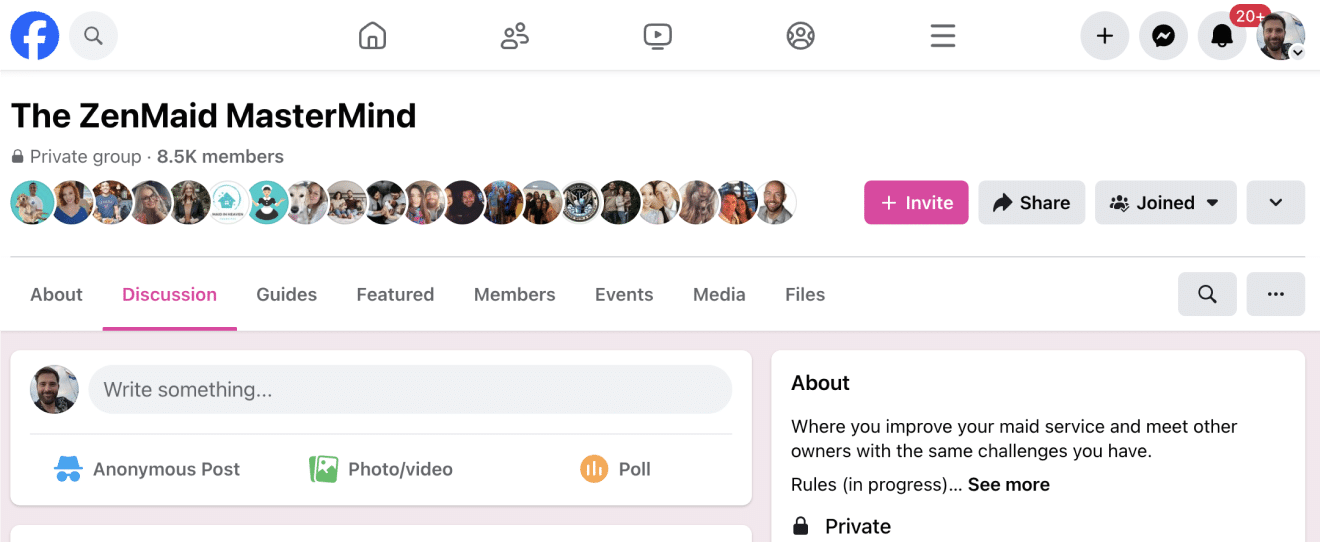
Stephanie: Well, Simone, the reason I broached having you on is, we both commented on a post that took off in the ZenMaid Mastermind on Facebook. And it’s about transitioning from solo cleaner to running a team. And this is from Miss Courtney Burleson on May 14th. And we’re like, let’s talk about it, ’cause it’s such a good question. It is a very common question that people have and a common issue, and a lot of fear around this thing, especially if somebody’s been an individual cleaner for a long time. It’s very scary to introduce other people into your baby.
So Courtney writes: “Hey everyone, looking for advice from people who successfully transitioned from solo cleaner to actually running a team. I’m currently cleaning solo and honestly I’m burnt out physically. I actually love the business side of things — client communication, systems, marketing, growth ideas, admin, et cetera. I’m just getting tired of being the one doing all the cleaning. I also know I’m probably not even the best cleaner. I do a good job, right? But I think my clients stay because of my personality, communication and reliability more than perfect cleaning. My honest long-term goal is probably to become the worst cleaner in my company, LOL, and hire people who are better technicians than me.
“The issue is I cannot seem to pull the trigger on hiring. This is my only income source, so stepping back feels risky. But I also know I can’t really grow while I’m doing all fulfillment myself. I’ve actually kept advertising minimal because the thought of adding more clients to my own schedule is overwhelming. What I want to do is hire two to three people, bulk train them, and finally start pushing growth hard. But I feel stuck in the middle of, I need to stop cleaning so I can grow, but I can’t afford to stop cleaning yet.”
So, for those who have been here, few questions. Did you slowly phase yourself out or just rip the bandaid off? At what point did hiring feel safe enough? How did you financially handle the transition? What helped you finally let go and trust employees? Would love any honest advice from people who have made it through this stage.
A lot of people get stuck. Staying a solo cleaner because of these same reasons, but also they’re scared. They’re like, “I know my quality. I know my clients love me.” And they’re scared of introducing someone new. I’ve even seen on the ZenMaid group sometimes where people are concerned their clients will leave them if they introduce someone new. So, yeah, lots to talk about here, lots to unpack.
Simone: Oh, absolutely. And first and foremost, not unfounded fears. I mean, my first hires — I mean, I’ve talked about them — truly a nightmare experience. So it’s like, especially when you have legitimately a bad experience with staff members in the early days, it’s like you have this very low confidence in the whole thing, and then it feels like you’re proven right. Like, “Oh, don’t do that. Just be solo. Like, you got burned, don’t do it.” And I kept — I hear a lot of people would talk to me and say, “No one will ever care about your business like you will.” And that is true to an extent, because this is our baby. But there are people out there that love their jobs. So those people do exist. They 100% do. I’ve got a ton of them. You’ve got a ton of them. You just have to sift through a lot.
Phasing Out vs. Ripping Off the Band-Aid
Stephanie: So let’s start at the top. Did you slowly phase yourself out or just rip the bandaid off? ‘Cause both you and I were doing the work before we hired people.
Simone: Yeah. So I was working in the business for six weeks before I started hiring. It only took me six weeks because my end goal was never to be staying in the business. I was always going to be external and have people out there working for Housemum. So I wanted to hire quickly so that I could transition people in. And so it was still slow, but I had them working alongside me to essentially then do handovers and start replacing myself.
Stephanie: So I was cleaning part-time because I still had my full-time job. So nights and weekends. So I also had to hire pretty much immediately. There was no choice in the matter if I wanted any more clients. There was no more room in my schedule. Most people don’t want nights and weekends anyway. So let’s see, I started in April 2019. By June of 2019, I had my first staff member. So within, yeah, that two-month period. And immediately started bringing her along to the cleanings, and at least tried to have her there once. Twice is kind of our ideal when we are doing our transitions now between cleaners, but at the time, just didn’t really have that luxury always. And then just kind of reassured the clients that she would be great.
Spoiler alert, she was not great. And they all — I mean, it was bad. And luckily they all stayed with me. I was able to like fix all of the chaos that she caused. And then I just, from there, just kept rapidly hiring till somebody stuck, basically. And a couple people stuck. So it was a slowly-phase-myself-out. I still cleaned. For the most part, I was done cleaning within, I think, like any regular clients, within maybe a year and a half or so. I would say a year. I can’t honestly even remember. I didn’t hold on to one long-term client much longer than anybody else. I went and cleaned Kelly’s on Tuesdays ’cause I loved her. She loved me. And she was very much like — it was kind of that, I want you. I also wanted to clean for her. I loved her house. But then it just came to a point where it wasn’t feasible anymore. And she’s still with us today.
Simone: I was the same way. Like, you do have your favorites, but there comes a point — for me, it was, I’d be out there and then my phone — I’d come out, and I always have my phone on silent because I’m not one of those people that want to be looking at my phone while I’m in a client’s home. And so I’d come out and I’d have all these messages from my team. And then I just realized that my place wasn’t here anymore. I needed to be managing my team, and they needed me in that role as well. They needed to have someone they could call on.
Stephanie: That’s so true. And when you are — ’cause I would be the one, you know, stuck in my phone in the bathroom, like trying to deal with the chaos. So it just wasn’t — it is so stressful to try to be doing both the administrative, as anybody listening now knows, administrative from the field while you’re in a cleaning. It’s very challenging. And then at the end of the day, you need to go home and do scheduling and invoices and all those things. So it’s like, you’re just working 24/7. So there has to come a point when you just realize that’s not your job anymore. And as Courtney said, that’s where the burnout comes from, is just wearing all of the hats all the time.
Stephanie: And the reality is, introducing other people will temporarily cause, I would say, more stress in a lot of ways, especially if you’ve never done it before. I had never managed people before. And even if I had, I don’t think I was prepared for this type of staff member or just the situations. I’ve never dealt with those before. So it was pretty shocking, and like, jumping in head first to a lot of things I never had experienced before, and never being in charge of people in that way, despite having, I would say, decent leadership skills. But nothing can prepare you for some of the crazy things that staff members [do].
Simone: Yeah, I honestly think I need to write a book, or a collective book of all of our stories of — what is someone called in sick for today? What is their reason? Why have they not come to work today?
Stephanie: Oh yeah. An elaborate list. That’s funny, my managers have a cloud chat of just our future book, and they just write all the stuff in there.
Simone: Yeah, that’s great. I look forward to that coming out.
Stephanie: Yeah, no, it’s great. We can’t share all of it, obviously, ’cause of confidentiality, but sometimes I’m like, oh, this was so good. I did wanna touch on Courtney’s question where she was talking about the financial impact and not wanting to take on more clients as well before she’s ready, because obviously when you’re at capacity, that’s one thing you get scared of, is like, what do you do next? For me, it was quite simple. I just started a waiting list. I don’t know if you did similar, but like when those inquiries were coming through, I would just use that as an opportunity to — right now we don’t have availability, we do have a waiting list. Would you like me to add you to that?
Simone: One thing I did a little bit differently, and I don’t know if anybody else does this, but I would — every time we hit that waiting list point, I’d put my price up. And that was how we’ve gotten to where we are now, is I’d put the price up because, well, I can’t fit you in right now. So that means we’re in demand. Put the price up. And that means when you are starting to hire, those people have already agreed to a higher rate. And so it gives you that buffer, because you do need to be starting to think about now — are the prices that you’re charging covering staff wages for future, the obligations that come along with that, plus your expenses and your time? Because you shouldn’t be working for free.
Stephanie: Yeah, for us, capacity constraints have always been the catalyst to price increases — and scary price increases. If any of the listeners have heard, it’s just like, we just did our last one, and I’m like, nobody’s gonna take it, but we don’t have any availability, so toss it out there, and guess what, they’re taking it, and now we’re closing the same. And I’m like, every single time, I think it’s not gonna go, and it goes.
Simone: Yeah, yeah, we just did a price increase, and I was like bracing myself for, are any of our clients, our long-term clients, going to leave? They didn’t leave. I was just like, okay. So they see the value in what we do as well, which is important. It’s not just about making money for me. I also want our clients to feel like what they’re getting is worth it.
Stephanie: A hundred percent. For Courtney or anybody else listening, I would suggest, before you look at hiring, look at your current pricing, as Simone suggested as well, and do a price increase now. Because if somebody drops, and you’re making the same amount of money with less clients, you just opened up time for yourself to deal with things. And so that starts to build that capacity for either more clients — but I would almost hold and not fill yourself to capacity. I would do a price increase, maybe one or two clients drop, you have some openings now, little bit of breathing room, but hopefully the same amount of money.
‘Cause really what the goal is, is to make as much money as possible off of the fewest number of clients possible. Instead of having just — I mean, obviously as many clients as high as possible is the true goal, but it’s easier to manage less clients, right? So how can we get as much money out of the ones that we are currently having? Because you nailed it — you hit the nail on the head, if I could say the same, right? You hit the nail on the head of — I think that people, before they hire, they’re like, “Oh, I’m pulling in $40 an hour. This is incredible wages for me.” It is, as an individual cleaner. That’s great, that’s fantastic. $40 an hour, where else could you make that, right? But that is not enough to be charging in today’s economy and be paying staff members and all of the expenses. It’s simply not enough money.
Simone: Not at all. And when I give that advice, that comes from a place of learned experience where I did not change my pricing when I started to hire, and I fell behind. And so it took me time then to recover from the mistakes that I’d made. And it required a lot of bravery, because you do have that roadblock in your head — no one’s gonna wanna pay me that. Like, we started out at $38 an hour.
Stephanie: I was at 30. I was at 30.
Simone: That’s not enough to cover staff wages and the expenses that go along with that, as well as your time. So it’s really important to — part of being a business owner means doing the hard things. And sometimes hard things are having hard conversations with people, which includes a price increase.
Stephanie: Yeah, and until you’re able to have those conversations, it’s just going to be tough, because that falls right into having staff members — you’re gonna have to have conversations. I would say that’s the number one thing I get, time and time again, when I’m doing consulting or just conversations, emails, whatever, with other owners. A lot of us are people pleasers. We’re drawn to the service industries because we like to give. And being able to spit out the tough thing — I still struggle with that. It’s very difficult. Luckily, I’ve hired people who are good at that. My HR director, she’s like, “I’ll say it, I’ll write it.” And I’m just like, “No, I want them to like me.” But it’s a skill. It is a skill, both on the client and the staff side. You have to be able to talk and have difficult conversations.
Simone: I think the reason why I’ve gotten better at that — because I still get uncomfortable as well, but six years now in, even though I still feel that level of discomfort, I just remove myself and think, it’s not personal. This is business. This is something — actually, my brother gave me advice. He’s also a business owner. He said, “Every time you have to do those hard things, look at your kids and say, ‘Can I feed my kids if I’m not making this price increase?'” He said, “Make it personal for you in that way. And then that way you would know that you really don’t have a choice.” Because I was a single mom when I started the business. So that really made it personal for me, that if I don’t make these hard decisions, then my family is suffering because of this.
Stephanie: Well, that’s such great advice. And I love that. I got a similar piece of advice, that was when I was young in the business, that was like, same concept — make it personal of, this is your baby. And when an employee does something that is against your company values specifically, and you’re hemming and hawing, it’s like they’re literally coming and shitting on your baby. Is that okay? No, it’s not. You have to make it so you wouldn’t allow them to do that. So why are you letting them do it and not — literally shitting on your baby? Literally or figuratively shitting on your baby. That’s not good.
Simone: It’s the only thing, and that’s so true. It is. Every opportunity you give them to ruin — that’s just ruining your brand name, your business, just running it further into the ground, which means it’s harder for you. You’ve got to do the work to recover.
Stephanie: And it helps me, yeah, steel myself to like just fire — is usually what that situation, whether that be customer or employee, fire them. And it’s not in an unkind way, not in a “calm down on them harshly” or anything. It’s just like, for me, because I’m so like, you know, very keep-the-peace kind of person, I have to be very like extreme in order to pull myself to like saying, “It’s not working out.” And being in a very kind, like kindly let them go. Like, I have to be like super tough in my mind to do it.
Simone: How about — I’ll frame it in a, “this is in your best interest.” Like a lot of what I say, if it’s letting an employee go, it’s, “I can see that you’re juggling a lot right now, and it’s, you know, causing you to be unreliable. And I know that you like being reliable. So we’re just gonna pause you, take a break right now. And if things in the future improve, you know, reach out and we can have that conversation.” But you know, if I frame it in the way that it’s in their best interest as well, I think it goes down easier.
Stephanie: That felt really pleasant. Like, if you fired me, like inside those things, I’d be like, oh, that’s — you know what, yeah, you’re right. Everybody write that down, write that down. That was really good. Oh, I love that. I love that.
When Did Hiring Feel Safe?
Stephanie: Okay, so, at what point did hiring feel safe enough? So this is an interesting one — like safety, emotional safety, business safety, like not risky.
Simone: When the waiting list was growing. And that’s why it took to — you know, got to about that six-week mark, and the interest for what we were doing. And this was January 2020. So COVID was just around, like literally just coming in, ’cause it was around that six weeks. So around — this would have been around March. And so when COVID was becoming real and yet our waiting list was growing and people were like, “I need you” — and I was getting so many personal stories from new clients. “I need you, you know, this is going on in my life, that’s going on in my life.” And I’m like, okay. So the reason why I wanted to do it myself initially was, does this even work? Do people want this? Is this a good business? And because it was working so well — and then I knew from the flip side that there was so many moms like me who needed flexible employment. I’m like, well, this is the perfect opportunity. I’ve got to go find the other me’s who need this, to put them with the families that are needing us as well. And so that felt like the right time for me, because I knew we had the demand there.
Stephanie: And what you’re really talking about is, the alternative is too painful. So it’s like, what is the more painful option? Is it, you know, having a huge wait list and not being able to fill them because you’re not willing to hire? Or is it take the leap and the risk of having staff members and dealing with the ramifications of what that’s going to entail? It’s like, yes, that is risky, but the financial reward and the impact reward is so far and above more substantial than anything you could do as an individual. And I don’t mean that in a derogatory term, I’m just simply saying, we can help so many more people with a team. Like, the power of us together is so much more than the individual parts.
Simone: So true, yeah. And I could just see, for me, the money is nice, but I was just looking at like, these people need me. And I guess that comes back to you saying before, with that service mindset, where we want to help. I just was feeling that pull. You know, I needed to help these people, and both sides — you know, the me’s out there that needed the employment that was flexible, and the families that needed a service like this in their life. And I think when you start thinking of it from both sides of like, I can be a great employer for my staff — and for me, that’s what I actually take the most pride in, is being a great employer to my staff, and what that’s — being the core focus. Because no matter what happens with the customers, you know, any crazy ups and downs, that type of thing, it’s like, okay, I hang my hat on not the size of my business, but on how my staff feel at the place I provide for work for them.
And so that being kind of my pride, really, it bolsters even more when somebody doesn’t work out. You do have a horrific staff experience, just total horror stories, I’m sure you and I could both go on about. And, but — because once you start experiencing them, because Courtney, anybody else listening, you’re going to have something that’s going to make you want to say, “No, I want to hang this up. Like, I’m not going to ever hire again.” This is what people do. Do not let that win. Don’t let it win. It’s just that person did that. We can’t blanket statement and say, therefore all people are untrustworthy. If we thought like that — well, you shouldn’t be, you’ll never — okay, then think like that and be an individual cleaner. Okay, and you’ll have to deal with what you’re dealing with.
A Quick Break
Stephanie: Quick little break here. If you have ever been listening to the Filthy Rich Cleaners podcast and thought, “Oh my gosh, Stephanie would die at this story” — well, guess what guys? I want to hear that story. Okay, we are looking for guest applications for the show. And I know many of you have never been on a podcast before, but those are my favorite episodes, to be frank — is the owners who are just here to share their stories. So if you are an owner who wants to share their story, or perhaps you would like to have a free consulting call with me and ask me your questions live for everybody else to learn from, that is also an option. And then finally, if you know somebody in our industry — you have a friend or somebody that you look up to and have learned from who you think would be a great guest option for us — please go to the link down in the bio and we would love to see you apply or nominate them, and we will take it from there. And I would love to have a conversation with you and get to know you more closely. Back to the show.
Simone: I try and take the approach of, I treat them equally, and everyone’s great and kind and everyone’s like me until proven otherwise. And so I don’t want to let it change me. I actually feel like we may have spoken about this last time, where I just — I didn’t want it to change me, even though those experiences happened. That was that person, that’s not me. It’s not the good people out there. That’s just that person.
Stephanie: Yeah, not allowing it to make you cynical and to make you just think, “Yep, well, prove me right that staff is not worth it.” It’s like, it really is — you just have to sometimes go through a lot of people to find the right one for you that makes sense for your company, for your clients. So as for safety now, it’s like, it feels so blunted. It doesn’t feel risky at all to hire another person, ’cause it’s just like, it’s the only path. Like, when you think of it in that way of like, this is the only path to reach what I want to reach, then you eliminate all other possibilities. There’s simply no other possibility, unless you’re able to charge yourself, you know, hundreds of dollars an hour. And then you might be doing some other type of cleaning that we’re not talking about here.
Simone: I didn’t even know that’s that good.
Stephanie: Yes, not safe. So I would argue that’s not safe either. So I think that if you just think of it like, this is the way — and I don’t wanna say like, burn the boats and do something stupidly risky, but I kind of mean it that way of like, this is the only option, you’re going to hire to reach the goal that you want, so.
Simone: Especially because Courtney is saying, you know, from what her — it kind of feels like the demand is there. So, you know, getting to that point of burnout, and then she’s probably feeling that pull from all of those people still inquiring. It’s like, well, the next natural step is, you either put an automated message on and forget about it, and you just focus on the clients that you do have, look after them, if that’s what you want. Or you’ve got to go down the scary path, you know, if that’s the next step for you. You’ve just got to do, like she said, rip off the bandaid and do the scary things that might be unfamiliar for you. Like, you and I both had never been in a role like this, hiring and managing people before, but we’ve done it and we’re here telling the story. We figured it out along the way.
Stephanie: No, a hundred percent. And it does get easier. And especially as a workplace culture comes through and you start figuring things out, you get better every single time, learn what to look for. It doesn’t mean you’re not going to get surprised or have, you know, bad eggs, like Simone said, slip through, but it becomes a lot fewer and far between.
The Financial Side of the Transition
Stephanie: I’d love to talk about the financial side of it, the handling the transition, because as she mentioned — “I need to stop cleaning so I can grow, but I can’t afford to stop cleaning yet.” So let’s talk, like, logistically speaking, how do you make it if this is your only income? Because, you know, I always like to explain it like a pie. Like, right now you’re taking in a hundred percent of the pie because you’re doing the cleaning and you own the business, right? So your cleaner pay and your owner pay is all you. But all of a sudden, when you bring another cleaner in, that cleaner or anybody in — a cleaner is getting that chunk of the pie. And now all you’re getting is your owner’s section, which is much smaller. So if you go zero to 100, you know, cleaner takes your whole schedule, yes, your income is going to drop drastically. And that’s — it’s the painful part where you have to ramp up volume drastically on how many clients, if you go that route. But it’s really — it’s kind of doing both at the same time. Like, you slowly take your clients off, give them — you’re taking that smaller chunk of the pie, and you’re bringing more clients on. And so it’s almost like immediately needing two part-timers is what I would suggest personally, so that you can like start rapidly bringing on new clients.
Simone: Agreed. I would do exactly the same. And so for me, it was, you know, I’d go alongside and then do those handovers, and then I’d move on to the waiting list, and then I’d bring on the next person, and then we’d work together, and then I’d hand off. So with those — once I got over those six weeks and hired the first person, I never really became attached to clients again, because it was only those first few that I was doing on my own. And then I did the handover, then moving on to the waiting list, I’d work with the next person and hand those over. So it was pretty much just, in, train, handover, and just keep going from there.
Stephanie: And if you yourself — I would suggest, Courtney, especially with newer folks, go to those first-time cleans, and then explaining to the client, “This is going to be your cleaner.” Like, I would try to always make the person who saw it at the first time be that cleaner, and then check in. You just have to check in so you can nip things in the bud quickly. It takes a high level of oversight, in overseeing the new staff members, especially in the beginning, when — I mean, absolutely no offense, my training was absolute dog shit. It was terrible in the beginning. I mean, so it wasn’t their fault if they weren’t doing a great job, it was my fault. So how I overcame that is just checking in very, very frequently with the clients to make sure that they were indeed happy, and I could nip things in the bud or get rid of somebody if it needed to happen.
Simone: Absolutely. And working at, like — don’t keep making the same mistakes. So if those clients are giving you that feedback, okay, well, what can you do to fix that? Where did something go wrong? And like you said, like, really own it. If it’s something wrong with your training, what can you be doing? Don’t assume that it’s always the person doing the job, or, you know, the client’s just got an issue. Like, actually be willing to be self-aware and think, right, what can I be doing to fix this and make sure this doesn’t happen again?
Setting Staff Up for Success
Simone: I wanna show you something, actually, Stephanie.
Stephanie: Yeah.
Simone: We’ve got these boxes. We’ve been in our house now three years and we still have some boxes, so I was going through. And we actually created, very early on — because I was quite, you know, good at being self-aware, like, what can I do to be better? — so I created a checklist, and this was like our paper checklist back in the day, and they’d write their notes down and they had little sections that they’d tick off. We’ve obviously progressed now, but it had everything on there that, you know — it was called a client file. So it had the checklist on the back, and on the front was everything about that client that we knew from my booking meeting with them. And then they kept those up to date. And so that’s what we did — you know, even though it was clunky in the beginning, it was just, that was what worked to just get it going. So I think that’s what I wanted to highlight today as well, is you’re not going to get it right in the beginning and things will be clunky, but as long as it’s working and you’re working towards improving, that will — you know, just get started.
Stephanie: Really cool to see. And I’m really happy you brought that up, because I didn’t even think to talk about, how can we set up these new staff members for success? Because right now, Courtney, you probably have everything in your head about these clients’ homes, ’cause you just know them. You know what they like. You know if they’ve said something and you just remember it. Like, that 100% needs to go in somewhere. Obviously, Simone and I both use ZenMaid, but any type of scheduling software is going to be the ticket for getting your staff members to be successful, setting them up for success. And how we even do that, you know, to this day — our staff members, we teach them, like, if somebody’s going to have to fill in for you, what would make them successful? What happens when you call in sick and one of your teammates has to cover at Sally’s house? Like, what do they need to know about Sally that’s going to make them successful? And thinking of it like a collaborative team approach — and then what that does is, when a staff member leaves, it’s very easy for us to bring somebody else in because we have those up-to-date client notes. And it obviously —
Simone: You’re exactly the same, Stephanie.
Stephanie: Yes, so we literally are. It’s all about — and we explain to our clients, it’s a team approach. You’ve got one — and obviously we call our team house managers. So you’ve got one house manager that is your regular person, will look after you, but we take a team approach. So if you’ve got to have a fill-in, or when that person moves on — ’cause they’re not going to stay forever — how can we make that smooth? You’ve got to be thinking big picture, because if you put all of your faith in that one person to be there forever and do the right thing always, you’re going to set yourself up for failure.
Stephanie: Oh, so true. I have a consulting client who’s fantastic. She just bought a cleaning company, and what she bought was a ZenMaid customer, actually, their company. And she got into the ZenMaid and the notes were just — no notes in any of the client files. And so she’s going in completely blind at all of these. And I’m like, you’ve got to get ahold of that owner so you can help — pester her about all of these clients. And I’m like, you know nothing about them. You know not — like, do they have pets? What are these houses like? Just the basic things, even the little things — you can make your intake process better to, again, set all of the future cleaners up for success.
I’m really happy that you said, like, big picture, and you have to think, like, globally of, what does it look like so this house is always successful regardless of who goes there, right? So the little things of like, where do they want the garbage put? Where do we enter? What do they want with this? Blah, blah — just all of these little things. And so for us, our intake process is a bit more extensive. I’d imagine yours are insane. But it’s so you can just nail it no matter who goes in the house.
Simone: Yeah, it’s because one of the biggest complaints I hear from new clients when I’m onboarding them is, when they’ve used the service before, they’re like, “I don’t want someone different coming every time because I feel like they waste time asking me the same questions.” And so I brought that in very, very early on, because my background — I worked as a dental nurse. And so we would keep patient notes. That was just part of the job. And I thought, well, that’s what we’re gonna do, because that eliminates that right from the get-go. And so that’s where the paper came about. And we now do everything obviously online, digital, which is great. But yeah, we just needed a system that would make sure that things were seamless.
Stephanie: A great first step for Courtney or anybody else listening is going to be going through all of your clients and coming up with a standardized way to take notes. If you’re not using any type of software, start there for sure, because that’s where your cleaners are gonna clock in, clock out, GPS tracking. These are the things that help you feel — like I felt safe, at least in somewhat, because my cleaners were clocking in with GPS tracking from day one. So that helped put me at ease. I could see if they were on the way, driving at least. So I’m like, okay, at least they’re physically at the job site.
Simone: Yeah, half the battle has been complete because they are physically there. We’ll figure out the rest later.
Stephanie: Yeah. So that definitely helps. But I would say, just rack your brain, or next time you go to every single client, start trying to see it from fresh eyes of like, okay, where does the garbage go? What are the pets’ names? Do I not do any rooms? Do they like anything specific or very particular? But like, these are all of the things. If you can start documenting those now, that makes it so much easier then to hand it off to somebody else, as much as possible.
Simone: So what I say to my team is, if you open up those notes and there’s something there that you don’t — you wanted to know that, write it down, because you need to be thinking as if, if it was my first time here, what would I want to know? And if you can ask yourself that question, then you’d be able to fill in all those missing blanks. So definitely, for Courtney, start acting like that. If it was my first time here, what would I want to know? And how can this make this smooth to just pass off to someone else, for the client’s best interests as well?
Stephanie: Yeah, it just — it helps a hundred percent. When I think of like, okay, client works from home, you know that they like you to start in the office. Like, those types of things — if that’s just in the notes, they don’t have to ask the client, “Where would you like me to start?” Like, little things like that. I’m happy that you said that you heard that from a client before, that they hated that they had to explain things every time, ’cause we’ve gotten that feedback too, early on, when we were switching. I remember this one client, we had to unfortunately switch cleaners on a lot, ’cause we just were having some turnover, and that’s what they were getting frustrated with, was like, “I’m tired of showing them around, I’m tired of like explaining where this goes, or blah, blah, blah.” And I’m like, “I heard — okay, tell me everything, and then we’re never gonna do this again. Get it out of your head and into our file,” and then that just is a living document that we can keep updated now. And it works well. You know, people love that. They love that we know them like that.
Simone: Yeah, absolutely.
Pay Scales and Paying Yourself
Stephanie: Coming back to the financials, I think that a lot of folks do make the mistake of not paying themselves at all when they start hiring. And they’re like, “I’m investing in the business, like I can’t afford to pay myself as well.” And I think that that’s a very dangerous precedent to set, if you bring a staff member on and you’re not paying yourself anything. And I’ve mentioned, I follow the Profit First method of cash management, or money management, in my business. And I have, since day one, and that has imparted the lesson of, I pay myself, even if it is a 1% of the revenue, I am paying myself just to never ever fall into the trap of like, “I can’t pay myself.” Even if it’s a small amount, it’s something psychologically. So I would say, having some discipline around that of like, okay, if you can’t even pay yourself, say like 1% or whatever that is, then coming back to pricing, we’re not charging enough, or something is wrong.
I’m not gonna say, “Oh, you’re probably paying your cleaners too much,” ’cause it might not be that. But you need to also be realistic about not starting everybody at like top-of-the-line pricing, because you have been working for — again, I’m using 40 an hour arbitrarily — but let’s say you’ve been cleaning for 40 an hour. So therefore you’re like, “Well, I should start everybody at 25 an hour.” Courtney, I don’t know where your business is, but most likely that’s a bit high for your area, depending. So don’t be afraid to have a pay scale. Don’t start everybody at the top, because then you don’t really have anywhere to go with them. And you might not know your numbers very well yet either. And you may be like, “Oh crap, like this doesn’t make sense.”
Simone: It also — people just strive for [more] as well. If that’s their pay rate and that’s all they’ll ever get — obviously with wage increases, we’ve got one now happening in Australia, wage increases from the 1st of July, that’s just government regulated — but if that’s all they’re ever getting, then they might just not be happy with that. So if you give them what the minimum is, but have a bit of a scale, so that down the line, you can reward them with, “Hey, this is something for you because you’re doing so well.”
Stephanie: I totally agree. Introducing that has been very good for our staff, to like have something, and we tie it to their performance. So it’s a hundred percent balls in their court as to what raise they’re going to get each year. And that has really shown in their performance, in their motivation to do a good job, to show up, all of the things that they’re trying to nail — and also tying bonuses to that behavior as well, and bonus opportunities. So you don’t have to be at the top range. There’s a lot of things that you can do to start out with, so you don’t accidentally like put yourself in a financially tough spot. Because if you put somebody too high, you can’t bring them back down. Like, you know, you can’t be like, “Actually let me cut you.” Oh my God, you damn nerd — I had to do that one time and it didn’t go well. They put their two weeks and it was stupid. I should have never done that. And so I would definitely recommend, don’t do that.
Simone: Yes, yes.
Contracts, Kit Bonds, and Protecting Your Business
Stephanie: What else? I’m trying to think back to, you know, transitioning people and just making sure that the client understands that there is going to be standards, there’s going to be quality control, and following through. And this, like — you know, we’ve talked about a checklist, not only just like notes, but the actual tasks themselves. Like, this is where checklist comes into play. And I would highly recommend getting this in place. It makes it so easy to train off of the checklist. Like, this is what you’re responsible for. It makes it easy for the customer to understand the scope of work. Of course, I’m a big fan of like a physical checklist and we leave it behind. But of course, ZenMaid has the digital checklist versions as well, if you prefer that just for the internal — like, that’s great for the internal management of staff to make sure the quality is there and task completion is happening. So I think checklists really help. Like, we’re talking about a lot of like kind of tertiary things, but I think these are the things that actually make the transition easier, because it’s the tools in place to make them successful.
Simone: That’s what Courtney is asking, is that she’s saying, you know, how do I start? And these are all the things that go into it. ‘Cause you can just go, “Yeah, let’s do this.” But like, obviously this — you and I are speaking from experience of what we’ve gone through and what we’ve learned along the way. So I think for anyone listening that’s wanting to take that leap, these lessons are really valuable to get things started on the right foot from the beginning.
Stephanie: A hundred percent. And you know, you do have a lot of decisions to make. Like, do you want to run teams? Do you want to pay percentage or flat rate or hourly? Like, all of — you know, there’s a lot of ways to skin the cat, and none of them are necessarily wrong, in my opinion. You can be successful with all of the models. Obviously I have my preferences for how I’ve done things, but you can be quite successful in a lot of ways. I also think that supplies and tools and kit management is something I’d like to mention as well, because that can get expensive very quickly once you start buying things for every staff member. So I will say, get your policies in place before you hire. Like, before anybody steps foot in a house, you need to be having — well, your client sign guidelines, that’s a whole nother topic — but you need to have your staff signing employee documents and things that they are agreeing to when it comes to behavior, returning their tools and supplies. Like, at the end of their employment, what’s going to happen? ‘Cause it only takes one or two kits, you know, scurried off to start being very expensive, especially vacuums.
Simone: Yeah, for sure. I mean, we don’t supply those things ourselves, but still, uniforms and their tote bags and tools that they get to use throughout a service — that’s definitely something that we ask them to return. We actually implemented, about six months ago, a kit bond. So they pay, at the moment it’s $100. And some people think, “Oh, that means I own it.” No, it’s literally a bond that you return your things at the end. I had — it was $50 when I started it, but it still wasn’t motivating people enough that when they left, that it was enough. They’re like, “Oh, I don’t care.” But $100 seems to be a little bit more incentive to dangle that carrot of like, return that. So you get that extra $100 with your final pay.
Stephanie: That’s so intriguing, a security deposit for the kit. That’s crazy. I love it.
Simone: And I’m kind about it. Like, I don’t just take $100 from their first paycheck, like, that gets paid off over two weeks. But I definitely think it’s worthwhile doing something like that if you are — especially in an industry where you work remotely. So for us, we don’t have an office. I work from home. My team are all over Brisbane, Gold Coast, Sunshine Coast. So motivation for them to return those things — I needed something, because I was just losing too much.
Stephanie: Oh, a hundred percent. Yeah, it really starts to add up. Uniforms especially, it’s extremely expensive once you start getting into, yeah, many of them not being returned. ‘Cause it’s like, yes, those are, you know, Serene Clean’s property, like, they’re coming back to us. You just wanna know where your property is. And sometimes people will be like, “Oh, but they’re damaged.” I’m like, okay, well, we shouldn’t have been working with damaged uniforms. You should have told me they needed replacing. But also, that’s got my branding on it. That belongs to me. And it’s important I know where those things are.
Stephanie: Yeah, we don’t want them robbing a bank in the House Mum shirt. Poor Sam.
Simone: Yes, I love that. And I do wanna just touch on the other thing. When you are hiring for the first time, something I didn’t do at the very beginning was have employment contracts. So it took me two years — two years — to learn to get those in place. And I got burnt a lot in that time, with people stealing clients, going out on their own and just poaching people. So if you are going down that path of hiring for the very first time, I encourage you that it is — yes, it’s an expense, but it’s going to cover you and protect you and the business that you’ve worked hard to build.
Stephanie: That’s really — you have to start thinking very “cover-your-ass-y” when it comes to staff. You have to think quite differently of like, okay, is this wise? Is this going to hurt me, is this decision? And even when it comes to the treatment of the staff, making exceptions like that — my managers really helped me come to like, hey, if we do this for this one, we have to be willing to do that for everybody. Are we willing to? If not, then we can’t do it for them. And it’s really hard sometimes to say no. And that could look like a variety of things — pay advances, all sorts of stuff people will ask you. I’ve been asked for loans, you know, like, “Can I borrow $5,000, Stephanie?” Like, that’s been asked of me from my staff members. And so you’re going to be like — and you know, the audacity, right? But you’re going to be asked lots of things. And so don’t let things slide unless you’re willing to do that at scale.
Simone: No, I agree completely. And it’s got to — otherwise, again, it looks like favorites and things like that. So you need to be one rule for everybody. And that’s why contracts are really helpful as well, because it fits into — it’s very black and white of like, these are the rules.
Stephanie: Yeah, I feel like Serene Clean doesn’t do pay advances. And we can just point to the policy. I always say, it’s like you, me, and the policy. I can blame — even though I created the policy. I just know. Yeah, I don’t write the rules.
Simone: Exactly. So yeah, definitely be protecting yourself and think big picture. Like, it’s got to be good for everybody and work for you at the end of the day.
Designing a Business Around What You Enjoy
Stephanie: Yeah, and once you start getting, you know, some of those houses off, you get some of that breathing room and start being able to do the things that you enjoy without having to do as many cleanings, it kind of reinvigorates you for the business. Especially, like, that’s the stuff I like to do — the marketing, all of that. You know, obviously I’m remote now. As you know, you’re a remote — I would consider you a remote owner if you’re not having an office. And so if that’s the case, it’s like, it really opens up and allows you to do the things that you actually like to do with — you know, circling back to the beginning of the conversation of whatever that looks like for you, you know, and that can look like a lot of things. And for me, it’s, you know, screwing off and podcasting. Like, I like to do that.
Simone: There’s nothing wrong with that, because there are some people like me — I still like, like I said, like to have those booking calls. I like to get to know my clients. And other people might look at that and go, “Well, that just means you’ve got a job. You’re still very heavily involved in the business.” I’m like, but that’s the part I enjoy. The actual going out and looking after clients — as much as I did enjoy that, it was not the highest and best use of my time now as a business owner. But for me, you know, jumping on those client calls — and I literally block off, you know, a day or two in my schedule that I will happily do those. And then I block off days where I do nothing that involves House Mum. So that for me is the luxury of a business owner and the things that I like to do. I design my days and my weeks.
Stephanie: Yeah, the business, you know, it lives to serve you, and if it’s not serving you, and whatever that means, then, you know, there’s work to be done. And of course it takes time. It takes time to get to whatever size, you know, that you want. And you’re gonna have struggles along the way, and it’s just important to not let those discourage you from ever hiring again. And, you know, that’s the beauty of, if you wanna go the part-time route, it can help mitigate that risk a lot, because if a part-timer doesn’t work out, it’s a lot easier to cover, jump back in, cover that schedule, or just, you know, replace and hire, as opposed to a full-timer. So I think a lot of people have the misconception that part-timers cannot be, or will not be, as good or as loyal or as dedicated. That just has not been the case for me, because a lot of my staff are parents and this is like actually sustainable for them for the first time in a job. And they’re actually like, “I can stay here and do this for years because it makes sense in my life.”
Simone: Absolutely. The most amount of hours — I’ve got one team member, she’s at 30 hours. Most of mine sit around 15 to 20 hours, because that’s what they want. It works for them in their life. So don’t be afraid, or think that if I don’t have enough hours to give someone five days a week full-time, that they won’t wanna work for me. You’d be surprised how many people want that balance where they can fit in around whatever their life is. They might be studying, or, you know, be a parent that needs to do other things. Just take the leap if that’s something you wanna try.
Action Items and Final Encouragement
Stephanie: Absolutely. So I think for kind of like action items, I’d say start systematizing, getting your notes in place of all of your staff members, getting some type of scheduling software, you know, knocking on ZenMaid’s door, I would suggest heavily, obviously, as we’re both using it. And let’s see — employee documents, getting those in place, and checklists. Like, I would get those things in place before you even consider bringing somebody on, ’cause that’s gonna set you up to make them more successful and actually make them want to stay more, because they feel like you have your shit together a bit more. Because they can feel, if it’s chaotic — you know, like, I still can’t believe my first ones that are still here, I’m like, “Why did you stay? I don’t understand.”
Simone: This year we took a trip down memory lane, and a lot of — you know, I do have some team members who have been with me since the beginning, and to, you know, to have them nodding along going, “Yeah, I remember that, and I remember the paper checklists,” and to see the new ones, their faces going, “What, like that was a thing?” It was cool, you know, to see where we’ve been and where we are and where we’re going. Don’t worry that just because you’re starting here at this point and everything’s not perfect — that’s okay, as long as it’s working for now.
Stephanie: It’s not going to be perfect, and “good enough” — it’s truly good enough, and the best way to learn and grow is to do the thing, and, you know, trial by fire, learning in the trenches. So I’m not saying you need everything to be perfect. Get some of these structural things in place and then just do it. Just do it, and if it doesn’t work, fail fast, again, again, again, until you get somebody good in, and then you can start building that momentum. But just — discouragement will happen, but don’t let it make you quit. That’s definitely not the takeaway there.
Simone: I’m sure — I don’t know about you, but I definitely cried a lot in my first year. I don’t cry as much anymore, but I definitely — so many times I was like, “I’m done, I’m shutting it down.” But, you know, I’m still here and I still love what I do. So, you know, there will be hard days, that’s just business. So just having a good support team around you of people that get it, that really made a difference for me, and that will get you through those hard days. And just keep going.
Stephanie: And just remembering that the majority of people could not and will not own a business and have employees. Like, most businesses fail, most people cannot do this. So it’s like — I always tried to like, this is hard because it’s supposed to be hard. Most people can’t do it. So that means it must be hard. And it was like repeating that, it kind of comforts me of like, yeah, this is how it’s supposed to be. It should be feeling exactly like this right now. And it kind of just is like, you know, “grant me the serenity to accept the things I cannot change.” That’s literally what it is for me.
Simone: Yeah. Whatever gets you through.
Stephanie: Yes, exactly, exactly.
Where to Find Simone
Stephanie: So, Simone, this has been amazing. I hope that this has been useful to our listeners. I love hearing and catching up with you, you know, way across the pond. It’s an early morning for you.
Simone: Thank you. I’m always — I could honestly talk about this all day long, because it’s just so much that you can share on the topic. And yeah, so hopefully it was valuable.
Stephanie: Oh, I agree. I know, it feels like we just talked for 10 minutes. It’s been an hour. That’s crazy. Where can the people find you, Simone, if they wanna follow along with you, your journey, your business?
Simone: Yeah, great question. So definitely check out House Mum. You can find us online at housemum.com, or at housemumhomeservices on Instagram. That’s the best way to connect with me, ’cause I try and keep myself hidden. So yeah, just connect with me on there, or you can reach out on email, simone@housemum.com.
Stephanie: That’s amazing. And she is in the Mastermind, as we’ve mentioned, guys. She’s always commenting, giving great advice. So you can definitely connect. Post your questions. As you guys can see, this question is from the Mastermind. So it was such a great question, we’re like, let’s make an episode about this. So don’t be shy in there. Say hello, post your questions so we can all learn and grow together. Everyone, please give her a like, hit that subscribe. We’ll see you on the next episode of Filthy Rich Cleaners. Bye-bye.