Frustrated with your scheduling? Try the easiest-to-use calendar app, made by and for maid service owners.

Brought to you by expert maid service owners
SEO Basics: What It Is and Why It Matters
Stephanie: Hello, everyone. Welcome or welcome back to the Filthy Rich Cleaners podcast. I am your host, Stephanie from Serene Clean, and today we have a fantastic return guest for you guys, Mr. Sean Parry. I wanted to delve deeper into search engine optimization compared to our first conversation. If you did not listen to Sean and I’s first conversation, I believe it was episode 85, and it was really fantastic on how to get more leads. We did dive into a lot of things Google-related, and in today’s conversation, I just want to get even further down that rabbit hole for those of our listeners who want to know more about getting Google leads and how to set yourself up for success from an optimization standpoint. So Sean, thank you for joining me again. I’m excited to talk about this with you again. For those of our listeners who are wondering why this is important, what is the end goal or end result of search engine optimization? What does that phrase even mean, SEO? Can we start there?
Sean: It is definitely a black box, and there’s lots of information out there — lots of information you should be listening to, lots of information you should definitely not be listening to. But essentially, SEO is basically thinking about this: if someone jumps on Google, a prospective client, and let’s say you’re in Chicago, someone types in “house cleaning company Chicago,” the results on page one of Google will broadly be three parts. You’ve got the ads at the top — your local service ads, your Google ads, which many of you will already know. Then in the middle of the page you have this big map. There’ll be three or four companies listed in there. You’ll see their reviews. It’s much more interactive. And then below that, you’ve got what’s called the organic SEO results, and this is where Google is picking up specific pages from company websites. But really, what I think is the best strategy today is to focus on how do I be one of those three companies in that map section in the middle? Because a lot of people will click on the ads at the beginning, but actually 50 to 60 percent of all the people that search will end up clicking one of those three companies listed in the Google Maps section. What you will find is that if you’re listed, you’ve got loads of leads — more leads than you can deal with. You’re looking at how do I increase my prices? How do I allocate all these jobs? But it tails off pretty quickly. So if you’re number four, five, six, you’re not there.
Sean: In 2026, the majority of people will still go to Google to find cleaning companies. As we know, AI is exploding — ChatGPT, people are using ChatGPT for recommendations. But if you’ve got a dialed-in SEO strategy, that plays directly into ChatGPT as well, because if you type in “house cleaning companies in Chicago,” you will often see the same three or four companies listed in ChatGPT as you would on Google Maps. So if you’re doing Google Maps right, you will be doing ChatGPT right. This is where you tend to get the best people. Those leads are converting at a really high price. They’re seeing your reviews, they’re checking out your photos and videos and posts and all that sort of stuff. So I think that every cleaning business out there, particularly people wanting to get to those high six-figure, seven-figure annual revenue numbers, local SEO has got to be a core part of it. It’ll be bringing in 50% or more of your leads. I’ve worked with so many cleaning companies over the years, and I would say 90 to 95% of all the seven-figure businesses that I work with have a dialed-in local SEO strategy in place. That’s why I think it’s so important, Stephanie.
Stephanie: I’m so happy you brought up ChatGPT and where it’s pulling that information, because I know for myself, when I’m looking to answer a question, it could be that I’m going to ChatGPT now instead of Google. But even if I am going to Google, Google is using AI — it’s still all AI. It’s so important that we are becoming the base of information that the AI is pulling to showcase its responses. I love that you said if we’re doing this right, it’s killing both birds with one stone. It doesn’t matter — if we are doing this strategically correctly, it’s going to be populating us in AI searches as well as the traditional online searches. That’s really great to hear that the strategy will be useful in future iterations of AI as well. You mentioned having an SEO strategy, so I would love to hear you break down what the core tenets of that strategy are, and we can go into each of those pillars. Because if anybody’s been listening for any amount of time, I’m just like, “Get reviews, get reviews.” But it’s not just that. That can be disheartening when you’re a newer owner, because you’re like, “I’m trying to get reviews. I have 12 customers. What do you want from me?” But there are other things we can do outside of reviews to start showing up on Google searches. What is the breakdown of a strategy?
Table of contents
Building Your Website for SEO
Sean: It’s a really great question. The first step is really looking at your website itself. You’ve got a lot of control of what is on the website — how big the site is, what you talk about, images, videos, all of that stuff. That is certainly within your control. If you’ve got 12 customers, obviously you can’t get hundreds of reviews. Starting off with your website is something that anyone can do, whether you’re starting out or doing tens of thousands a month. The first thing to say is that SEO is getting more and more competitive. People know they need to be visible on maps. Gone are the days where you could have a three-page website with some text built by someone you picked up on Fiverr for $200 and expect to get ranked in Chicago. At a basic level, we need to think about the size of the website. The homepage is probably the most important real estate in your website. Think about knowing what your primary keywords are and your primary locations — you need to have this nailed down when you’re building out your site. Going back to the house cleaning company in Chicago example, you want to think about every single page in your website having a primary keyword and a primary location. Your primary location would be the big metropolitan area, the big city, the big town in your area. On that particular page, you want to be talking about house cleaning companies, maid service, housekeeping — use all the variants. Talk about all the things you do: checklists, reviews, but also talk about the location as well. This is more and more important with local SEO, because when Google is looking at which companies to put in that map pack, they’re looking at websites that have lots of information about that location. You can’t simply put “house cleaning services in Chicago.” You need to talk about all the neighborhoods within Chicago that you serve. If you’ve got specific clients or reviews that mentioned a particular neighborhood, those types of things are all indicators to Google that you are a local business. I had this conversation with a client just before we jumped on, Stephanie, and I was saying that Google will always choose a service specialist — someone that does just house cleaning rather than broader trade services. They like service specialists, and they also like location specialists. So if you only serve a particular city, they would generally prefer to put that specialist in front of someone than someone that serves three states. It can actually be an advantage starting out because you are very location-specific and service-specific.
Sean: So your website is the first part — the homepage, primary keyword, primary location. But then after that, that’s not enough. You need to add additional pages for all the services that you offer. In the house cleaning niche, there’s lots of services: move-out cleaning, post-construction cleaning, recurring cleaning. You need to be building out pages for all of those. Let’s say your move-out cleaning services page — what is the checklist? Any ideas around pricing? What can you expect? You need all your services broken out, but then you also need all your main location areas broken out as individual pages as well. With Chicago, there are certain towns and cities within Chicago, certain neighborhoods. Ideally, you want to talk about your service for every single one of those neighborhoods and service areas. Five to ten years ago, if you’re a house cleaning business in Chicago, maybe five pages of content on your site was sufficient. Now you need to be having, certainly with the clients we’re working with, 20, 30, 40 pages as a ground zero, and that’s before we start adding support content or anything like that. It should be relatively straightforward for new business owners to realize that you need individual pages for your services, individual pages for your locations, focused on a specific service keyword and a specific location keyword on each page. If you get to that position and you’ve got 20 to 30 pages of content on your website, this puts you in a great position. Then you start getting picked up, you start building reviews, and all this stuff helps. But if you don’t have that site architecture right at the beginning, it’s an uphill battle. You really do need that to begin with.
Stephanie: One thing to keep in mind for people when they’re having their website made — it might feel cluttered. But if you make this organized in an intentional manner, those pages don’t have to be front and center linked on the homepage. For us, Serene Clean services, I don’t know, 30 different little towns all over the place, and every single one of them has a dedicated page. The only reason is SEO. That’s literally the only reason that page exists. It’s not front and center on the homepage, because that’s not the point of it. The point is: hey, Google, we’re relevant for cleaning services in West Salem, Wisconsin. As for instances of the keyword on the page, we have a WordPress website, so we use Yoast SEO to help prompt us on the correct length. I’m also curious about using AI to create this content, because when I was making my website, we were literally typing or speaking this all out — it was awful, it took so long. Do you have any guidelines for all of these pages that we’re suggesting our listeners build for their website? Can you give us a formula on what needs to be on each of those pages?
Sean: Generally, I would say 1,500 words of content on your main pages is a good number to aim for. With AI, it makes writing content much easier. There are plenty of people out there that will just put a prompt in and copy-paste the whole thing in. I would say that’s probably not the wisest thing to do. You could say, “I run this house cleaning business in this part of Chicago. I want to create a location page for this particular neighborhood — give me a list of things I should be talking about.” The way I use ChatGPT in our SEO agency is thinking about the things we want to cover, and then we will write the content off the back of it so it still comes from us. It’s not a copy-paste. You need to be mindful that if AI can create the content, Google will know what content has been created by AI. If your website just has AI-created content all over it, at some stage you will probably get penalized for that. So manual creation of content is really important. Aim for that 1,500 words. The main thing is that you’ve not got 300 words of content — it needs to be sufficiently detailed. You can break down all the things you provide: checklists, reviews, certain areas. With AI you can get an infinite number of things to talk about. Don’t copy-paste the whole lot; use it as a way to build it out.
Sean: And then the other thing with content — Google likes consistency. They don’t like massive changes. If you create 20 pages of content straight away and publish them, and then nothing for six months, and then another 20, Google doesn’t really like that. They would much prefer one new page of content every week, or whatever it is. That consistency Google likes. They like companies that are obviously in it long-term. Anything that you think is unnatural, Google completely realizes and understands what’s going on. The way I think about SEO is that it’s making content creation easy, but you almost want to continue to do the harder things, because that’s going to be what differentiates you. If you’ve got 20 competitors in your area and they’ve all used AI to create their websites, what is the differentiator? Doing stuff yourself, your experience as a business owner dealing with specific clients — this is where reviews are so important, because that is probably one of the few things you can’t copy. You need those genuine reviews. Fake reviews — you want to absolutely move away from that. People exchanging reviews — I get asked a lot, “Can I ask all the cleaning businesses in the ZenMaid group for reviews if I review them?” Absolutely avoid that — really bad idea. Just be consistent. What I always tell my clients is: anything we do from an SEO standpoint, if we were to share what we’re doing with someone at Google, would they think that’s a good idea, or would they think it’s spammy or a bad idea? If anything’s on that gray hat or black hat SEO side, just say, avoid it. The last thing you need is a Google penalty — all your rankings disappearing overnight. If you want to build a long-term asset and be in the good books of Google, don’t game them. Just be consistent and do it properly.
Stephanie: I’ve seen entire websites where everything is clearly AI, and it just comes across as fake. The images of the cleaners — I am seeing that on very large cleaning companies where they’ve got thousands of reviews and their images on their Google My Business are AI cleaners. They’re not real. It’s crazy. The uncomfortable truth is the harder path is the correct path here. Don’t do anything black hat — we want golden retriever energy with our Google behavior here.
Sean: Unfortunately, Google tells us the rules, and we’ve got to make sure we keep them happy, otherwise we don’t get any volume from them. The overlords we’re trying to serve — what do you want from us, and how can we showcase that we’re the obvious result to show to the person who’s searching? That’s not just sheer volume. It’s also: are you relevant? Is this helpful or useful to what that person is trying to do? Because that’s what Google is trying to do — show the person that’s searching what they need, give them a solution, not just have them walk away frustrated. So how can we, with our website and our content, be the relevant thing when they are searching for a cleaning company in our area?
Images, Videos, and On-Page Optimization
Stephanie: 1,500 words of content — what about images and videos? How do we set those up on the pages to help facilitate the SEO optimization?
Sean: First of all, non-stock photos and videos are always the best way. You can get your cleaners — if they’ve got uniforms or vehicles, those can be really great. Google knows what is a stock photo versus non-stock, because they can see that same image all over the web. You can get your cleaners to take photos if they’re in a team. If you’re a supervisor and you’re out inspecting some cleans, go and take some photos. Once you’re using those photos and that media, you need to do some things that as a user you wouldn’t see, but Google can see when they’re crawling your site. Every image needs to have a title — there’s a description field, there’s an alt text field describing what is happening in that image. So Google, when they’re scanning your site, will come across an image. If there’s nothing there, it’s not helping your cause. Whereas if you say, “This image is one of our maids serving a weekly client in this particular area, Chicago,” that’s great. Again, it’s another indicator to Google that your business serves Chicago, your house cleaning business. This is what we’re trying to do with the entire site — we’re trying to signal to Google that A, we provide the service, and B, we serve this area. We can do this through our text copy, through our images, our videos. Images and videos can help with the engagement on the site as well.
Sean: The other thing to talk about is bounce rate. Google will be tracking things like bounce rate — so if someone goes to your website and then immediately clicks off, that tends to be not as good an indicator to Google as someone who goes to your homepage, clicks on a few other pages about checklists and what you do, then fills out a form and goes to a thank you page. That’s lots of engagement, and it shows Google that the company they have put in front of this person is interesting. So videos and images incorporated within your content are really important. Something to be aware of: when thinking of SEO, sometimes what’s best for SEO — lots of text copy and lots of images — can be at odds with conversion rate. When running Google Ads for clients, often the landing page is a super simple page with very little content, a nice click-to-call button, and a short form — that would perform really poorly from an SEO standpoint, but from a conversion point of view, it’s fantastic. When thinking about SEO on your website, we need to think about conversion, but we also need to think about SEO. You just need to be mindful that ultimately, to get more clients, the website needs to convert well, but you also need the SEO juice as well. Images, videos really important, but also the design — particularly on mobile, it needs to look nice and scroll nicely.
Stephanie: We save our photos with the keyword we’re trying to rank for as the file name — that’s a keyword we’re trying to show up for. This sounds probably a little crazy to somebody who’s never done anything like this before, but once you start, it’s the same amount of work to save the before and after photo with an SEO-friendly file name as it is to save it with any other name. It’s all of these little actions. I like that you said one article a week — that’s very actionable. If somebody is looking at their website now and it’s not great, it can feel really overwhelming. But get the top pages you already have optimized first before you start adding more. Is that what you’d suggest — key pages done really well first, and then move on to adding more?
Sean: Yeah, I think so. The homepage is the most important piece of real estate — Google knows that. Get your homepage to that 1,500-word limit, thereabouts. Make sure there’s plenty of content. Put your non-stock photos on there. The title at the top of the page is really important. This is something I see so often — someone will say “top rated cleaning service” or “premium house cleaning service,” but they don’t include the location they serve. It’s so common. You’re the business owner, it’s very obvious where you serve, but if someone has to scroll through pages to find out if you serve their area, and there’s any ambiguity, they’re not going to call you. They’re going to click back and go to one of your competitors. Your homepage — and what’s called above the fold, the part of your website someone instantly drops into — your title at the very top should be very clear. You want to have a background image of your house cleaners, one of your non-stock photos, and show where you cover. If you’ve got that, plenty of content, and you’re making it very easy for someone to get in touch — a click-to-call, a “get a quote” button, fill out some details to request a quote — you’ve got probably 80% of what you need on your homepage nailed down. Once the basics are in place for your homepage, actually, for your move-out cleaning page it’s the same thing but with different content. For your location pages it’s the same service but talking about different locations, maybe different clients you serve there, different landmarks. Maybe you’ve got an embedded Google map in there. Get your homepage nailed down and then your core service pages after that — move-out cleaning, post-construction cleaning, office cleaning if you do that. You probably don’t need more than 10 pages of that. If you get those nailed down and it looks good on mobile, you’re well on your way.
Sean: There’s software online where you can check what your website looks like on mobile, on iPhone, on Samsung, on Google Chrome, on Safari. Try different browsers, try different devices. If everything looks good, it looks easy for people to get in touch, and you’ve got plenty of content — you’re well on your way. That’s probably all you need to get to your first 10K a month. From 10K to 50K it gets a bit more serious — you probably need to be spending more time and thinking about backlinks and all that sort of stuff. But to begin with, a lot of this stuff you can do yourself. Just avoid spammy stuff, black hat SEO, gray hat SEO, keyword stuffing — basically putting all your variants of house cleaning all over your page. You’re going to get banned by Google. That’s the only real clear red flag. Everything else, just do it yourself to begin with, consistently. Do a little bit every week.
Stephanie: We have had it happen probably a dozen times over the years where a client called and said, “I tried to fill out your ZenMaid booking form, but the submit button was cut off so they couldn’t submit the form.” Those are the people who told me. Imagine how many people jumped off my website from a simple formatting error because they couldn’t submit the form and they don’t want to call. It really is important to be looking at it from a lot of different devices. Have your friends and family just take a peek at it. Does it look nice? Is it easy to navigate on a phone? And yeah, I really like that you mentioned the location thing. I can’t tell you how many consulting calls I do where I’m taking a peek at their website and their Facebook — this is before I’ve looked at their intake, I have no idea where their business is — and I was like, “I cannot tell from your content online where your business is located.” That happens so many times. So do this on Facebook too, guys. Your Facebook business pages — make sure you put your service range in there. Because even if Google did bring them to your website, if it’s not clear that you serve their area, they’re probably not going to reach out to you. They’re just going to hop off and go to somebody who makes it clear that they serve wherever.
Sean: Yeah, and if it’s not clear to users, it won’t be clear to Google, and you’ll be straight away missing on that 50% of all the people that click on the map. It’s a very simple thing, but I say it so often. There are also other things you can do — making sure you move on to your Google business profile, because your profile needs to very closely reflect what you have on your website. Things like the location on your site, as we talked about — really important. Make sure your address is visible in the footer. Try and put an embedded map in there for the main city you serve. If you think about what SEO is, it’s trying to give Google lots of different signals that this is where you serve. You’re almost double, triple, quadruple doing it — you’re overdoing it. The locations is a really obvious thing, and it’s just because five to ten years ago, when Google Maps was much less prominent, you could probably get away with it. But now because there is such an emphasis on location, and obviously mobile, your website needs to talk a lot about the cleaning services that you offer, but the locations, the neighborhoods, all that stuff needs to be well over the top. With newer business owners, Stephanie, you probably see the same thing — often you’ll see some of the service pages built out, which is great, but the location pages will be missing. That is usually one of the first things that we do with newer business owners, thinking about how do we build out these locations.
Google Business Profile Optimization
Sean: You will find that if what is on your website closely reflects what is on your Google business profile, your Google business profile gets ranked. So make sure your Google business profile has all the fields filled out properly. Make sure you’ve got more than 10 words in your description. You need to be talking about your services, the locations, non-stock photos, breaking out services — max out your profile. Make sure that all the services you have on your site — move-out cleaning, post-construction cleaning, those sorts of things — are broken out specifically as services on your Google business profile, because Google likes consistency. If they see that you talk about post-construction cleaning on your website, but not at all in your Google business profile, that’s probably going to hurt your rankings. If someone types in “post-construction cleaning companies near me,” they will probably rank another company where it is much more clear they provide those services. So the website at the beginning, getting that nailed down, is really important. And then once that’s in place, you need to make sure there’s consistency between your Google business profile and your website. That would probably be the next step once you’ve got your website first iteration nailed down.
Stephanie: It’s completely free. I like that you brought up the control aspect — we can only control our inputs, not necessarily the outputs when it comes to reviews. We can’t necessarily control if people are going to leave us a review. We can do everything we can to encourage that behavior, but there’s only so much we can do. However, when it comes to what we can control on the actual profile itself — filling everything out — that’s one of the biggest mistakes I see with newer folks, and also a lot of established companies. They don’t even have a description. And even in that description, I list out the areas that we serve so it’s clear. Just make it insanely obvious where you serve. I’d love to hear your thoughts on the updates or the posts, because I see a lot of people not doing that. We do regular posts on our Google My Business. Is that useful?
Sean: It’s a really good question. Google likes engagement. They like to see that businesses are open. This goes to the website as well — this is why content is king and new content matters. Google likes to see from websites that there’s new content on there. It shows that the business is operational and ongoing. You can take that same idea with your Google business profile. If there’s no changes on your Google business profile — no posts, no new reviews, no new photos — Google is probably thinking, are these guys still in business? So you want to think about posts as just another way to show Google that you are open for business. There’s a question and answers section as well that I don’t think is very utilized. People can ask things like, “How long do you think it would take to do a three-bedroom move-out cleaning?” You can put all these questions in there and answer them. Again, it fills out your profile, which is great. Google likes that depth of content, but it also shows engagement. I think the posts, absolutely — the weekly cadence is a good one. It’s a no-brainer not to do it. In isolation, it’s probably not a huge impact, but it certainly should be part of your strategy. If you think about how to keep your profile engaged and fresh — new photos every week or every couple of weeks, new reviews if you’re using ZenMaid or software like that and asking people to leave reviews, and then your posts — these things are relatively easy to do. You just need to get them as part of your systems and processes. Make sure that every Friday you’re doing a new post or following up with new clients for reviews.
Stephanie: When it comes to all these things we’re describing — how Serene Clean practically does these things — it’s not separate from our overall marketing. It’s just the final step of something that is already happening. If we are doing content for Facebook or Instagram, same thing. Or we are making something for Serene Clean’s newsletter. We have these core marketing assets that we are creating over and over again on a regular basis. Every month we’re doing a local charity that the business is donating to, that an employee is choosing. That is a graphic created in Canva and posted across multiple platforms. The final step — my HR manager handles that graphic creation and everything about that process, and her final to-do related to that is posting it on Google My Business as an update. The before and after graphics are used all over the place and then uploaded to Google My Business. It’s not a separate task — it’s just a step in the marketing asset creation process. So if you’re not doing any marketing asset creation right now, it probably feels like you’ve got to make a whole new thing. Yeah, you do need to do that thing. But Google My Business is not a separate thing — it’s just part of the whole pie.
Sean: Absolutely. The other way to think about it is: you’ve done the hard part, which is creating the content. Just post it. Put it on your Facebook, put it on your Google business profile. You’ve done 90% of the work — just upload it as well. Once it becomes part of that weekly to-do list, you just do it. The hardest bit is just getting it set up at the beginning. It’s free eyeballs at the end of the day. People often stop too early with content because they don’t see the initial rewards and the spike up in client volume. But because it’s hard and because consistency is hard, this is where businesses that consistently do that type of thing long-term, like yours, do really, really well — because everyone else has given up before. It’s a no-brainer to do. So on Google business profile, Facebook, TikTok, and all those channels — just put it all over the place, and that will help you get free eyeballs.
Backlinks and Local Authority
Sean: Something that you said there, Stephanie, that I think is really going to help with your SEO is this charity stuff, and something important I wanted to cover off: backlinks. If all this stuff we’ve been talking about seems a bit overwhelming, backlinks is probably taking it to another level. But don’t worry too much about it. Just for those of you new to SEO, just think: backlinks is something I need to think about further down the line, once my business is at 10, 20, 50K a month. Backlinks are really important, because what they are is links from other websites online that point back to your website. An example of a fantastic backlink would be, say, your big local newspaper in your area does an interview with you about running a cleaning business post-COVID, and at the bottom they say, “Stephanie runs Serene Clean,” and Serene Clean has a link directly to your site. Google sees this as a huge vote of confidence because they think: this huge newspaper wouldn’t put a link to someone else’s site unless they thought it was a quality business they wanted to refer. So Google scours the whole internet for backlinks, and some are higher quality, some are lower quality. You might get a mom’s blog that does a review of a clean you did for them — Google would look at that link as lower quality versus the big newspaper.
Sean: So if you’ve got that site architecture done right, your Google business profile is up and running, you’re getting reviews, you’re doing all your posts, then the next stage is probably backlinks. Think about: how do I get links from all these different publications and publishers? When you talked about your charity and donating money to local charities — that is a fantastic thing to be doing anyway. Fantastic for your cleaners, fantastic obviously for the charities. But with my SEO hat on, that is fantastic for local SEO as well. Google is increasingly looking at backlinks from local high-quality organizations. So if you get a backlink from a local charity, or it could be sponsoring a local softball team, or it could be a local chamber of commerce — the locality of these backlinks is so important. It’s much more important than it was five years ago. You’re getting brand exposure from the charity anyway, your cleaners feel good about it, your charity is benefiting, and you’re getting SEO. So just keep doing a lot of that. The backlinks thing is maybe something we want to talk about further down the line, but once you’ve got all the core bits of your website and your Google business profile, it then becomes: how do I network locally with local organizations? How do I help them? And how do I get them to mention me?
Sean: Chambers of Commerce is a really easy one — you pay a few hundred dollars a year and you get listed in the directory. Google likes that. They view Chambers as high quality. Local charities, again, really good. You might sponsor local softball teams. So families in your area will see, “Okay, Serene Clean is sponsoring the local softball team,” and you’re getting the backlink from their site as well. Thinking about the other area: local journalists writing about local small companies in your area, or cleaning-specific publishers. You message people on X or comment on things you see on certain blogs or a newspaper, ping them an email saying, “I loved your article here — can I add an additional few comments?” And they’ll say, “Fantastic, we’ll give you a backlink.” These people generally know the end game for you — you’re trying to get a backlink at the end of the day. But this is where the people who are getting ranked in those top three positions in Google Maps, this is what they are doing. When you are in bigger cities, more competitive areas, you need to have some sort of active backlink strategy.
Stephanie: One of the core cultural tenets of Serene Clean has always been very strong giving initiatives. I started that charity idea literally within the first month of opening, six and a half years ago — six and a half years of donating to local nonprofits in our area and posting about it. I love that you brought up the consistency and not giving up, because everybody’s an overnight success, but you don’t see the work that’s gone into that. Another suggestion I have for you guys — we do have a free cleaning program, the Fresh Start Project, where people can nominate others. I like that you brought up, Sean, that nothing we do exists in a bubble. It’s not just that this is a good thing to do — of course that is the main thing. It also makes your staff feel good. It’s a good cultural thing. It makes you look good in the community because you’re pouring into it. But it also allows you to get your foot in the door in a non-salesy way to all of these sources of backlinks. I can reach out to our local newspaper and say, “Hey, we really want to get the word out that we have a cleaning nomination program and we’re members of Cleaning for a Reason.” We have had multiple articles written about my business — for example, the local electric cooperative has a magazine that goes out to thousands of houses in our area, and there was a four-page spread about my business because of us being Cleaning for a Reason. That was a physical thing, but it’s also on the website, and it links back to us. Don’t feel bad about promoting the good things. People want to work with companies who have corporate responsibility and give a damn about that — especially the younger generations. So if they don’t know the good things that you’re doing, how can they make that choice? You’re taking that ability away from them. Use it as a way to get promotion that feels less salesy.
Sean: Absolutely. SEO has so many spammy, black hat ways of doing it that might give you a boost in rankings for two months. I see it so often — a cleaning company that is number one for six months, obviously doing spammy stuff. How are they still there? And then you check again and they’re nowhere to be seen. Google’s just banned them. I really think that we want to get results with SEO, but Google is smart. They know what people are doing. Ultimately, they want to put forward the highest-quality companies for a specific person in their area. When you think about SEO, think quality first. It’s almost better to be the tortoise rather than the hare. Start slow but methodically, and you will win when these people doing dodgy stuff are falling by the wayside. Backlinks in particular is often the spammiest of all SEO activity — people buying links, link farms. The reason I like the charity angle, the softball angle, is that you’re getting the backlink but you’re also getting that brand exposure. New people might be in the market for a cleaning company, they go and search, see your ad, click on it, and for whatever reason don’t call you. Maybe they get a retargeting ad. Still nothing. And then they drop their kids off at the local softball match and see your company branding on the uniforms. It’s the seven touches that people talk about. If they see you in multiple places, they get comfort that you’re a quality organization. Bridging that online and offline world is really effective, because the offline stuff is actually quite hard and expensive to do. Anyone can put up a Facebook ad and run $100 through it. If you’re sponsoring a local softball team for a season, there’s a lot of work that needs to be done. You can really differentiate yourselves from a branding perspective, and if you get a web link on their site back to you, you’re getting two huge benefits from doing that.
Sean: When thinking about who to target for backlinks, we look at those local high-quality organizations and things like domain authority, which is what Google looks at when ranking the quality of certain sites above others. We also look at which sites will give us what’s called a do-follow backlink rather than a non-follow backlink. This is where websites will happily show you a link that sends on your SEO juice, the SEO benefit. Certain websites won’t — you get a backlink, but you don’t get the SEO benefit. When you’re thinking about backlinks, you want to think about which are the high-quality organizations in your area, rank them by which sites provide do-follow backlinks and which don’t, and then really the way you want to think about your backlink strategy is: where do we think we have the highest chance of getting a high-quality do-follow backlink with some nice brand exposure? Go from the top and work all the way down. Do it consistently — getting one new backlink a month, do that for a few months, a few years. That’s how you end up getting ranked in those top three positions in the big competitive areas. The backlink stuff is something that you guys even early on need to be aware of, but it’s probably something you think about once you do all the website stuff.
Stephanie: Honestly, I forget that we do all of these things, because it’s so second nature at this point. There are so many other purposes to it — I just see it as part of our marketing and branding behavior. For everybody listening, I know it feels like probably pulling teeth, and also probably like, you know, if you eat your vegetables, you’ll grow up big and strong one day. Unfortunately, that is not SEO. It is that long-game behavior that you do. And when I think of the backlinks that always show up — like Serene Clean Services and Black River Falls, Wisconsin Chamber of Commerce — it is the first one we’re popping up on that’s not our website. So that’s one of the areas: join the chamber, guys. Go to the chamber events because of networking. But also, this is one of the main benefits — it’s going to pop you up online, especially if you are going against big competitors. And this is where I will 100% attest to my privilege of living in a very rural area — it was very easy for us to rank on Google because there’s very little competition in our area. We’re so rural, Sean. So for the folks who are in really big cities going against huge franchises and people who have put so much effort in, and they’re like, “How am I ever going to catch up?” — what would you say to those people?
Hyper-Local Strategy and Multiple Google Business Profiles
Sean: It’s a really good question. Chicago is this huge area, but you can break down areas of the city into smaller cities, neighborhoods, and things like that. For people starting out, I always say: think hyper-local. Your Google business profile is what shows up in the Google Maps section — it’s not your website. Your Google business profile will have your address — either your home address or ideally an office address. One of the big ranking factors of being in that top three position is proximity. If someone is, say, 100 meters from your office address, even if you’re a new business, you stand a decent chance of being ranked in one of those top three positions if someone types in “cleaning companies near me.” You don’t have the hundred reviews, you don’t have the thousand non-stock photos, but you have that proximity playing in your favor. For newer businesses, I speak to a lot of people who have these big ambitions — I want to go across the city, across the state, multiple states — as a new business. If you’ve got a million-dollar-a-month budget, we can do that. But most people don’t. Start hyper-local. Build your website — it doesn’t need to be “Chicago’s leading house cleaning business.” It could be a specific neighborhood. Starting very focused will help with your conversion rate. If someone is down the road and they come across a cleaning business that just serves people in their neighborhood, that’s going to be more interesting to them than a bigger company that serves the entire city. That location specialization is really important and is a key advantage that new businesses have against companies trying to cover the main areas. If your homepage just talks about that specific neighborhood rather than Chicago, Google looks at your homepage and knows that’s the primary focus for you. That is another indicator to Google that you’re hyper-focused on that area.
Stephanie: It’s harder when you’re rural because we don’t have as many customers.
Sean: Exactly. But as we know, to build a million-dollar business, what is it — 250 to 300 recurring clients? You don’t need many. I know — I just saw the video you posted, Stephanie. When you start out, you think, “Million dollars — how many thousands of clients will I need?” Even in very remote areas with a very small population, you don’t need a lot of recurring clients to get to that level, if that’s something that you want to do. So I would say: don’t go too wide in terms of location to begin with. Nail down your immediate area. Once that’s nailed down, then you can broaden out your location areas. And as you’ve done, Stephanie, you can create multiple Google business profiles — that is something else, because the proximity is still a big ranking factor. So if you’re in different areas, at some stage the proximity benefit of your first Google business profile will taper away and you’ll probably need to set up a new one. For those of you that think about multi-location, you want to be having multiple Google business profiles as well. But yeah, start hyper-local. That would be what I would suggest.
Stephanie: Do you happen to know what the distance or any suggestions might be? We have three Google My Business locations, all within one region, and we can pull cleaners from each location. That was one of the main reasons we opened those locations — to show up on Google, because we were not showing up. For example, we have our Onalaska location, our original Black River Falls, and then Sparta. We were getting some results from Black River Falls from people in La Crosse, but not enough. I started Googling and realized, we’re not showing up in La Crosse even though we are servicing that area. So it’s a big enough area — let’s open a location there. Is there any other parameters you would suggest to know when that’s the right choice?
Sean: It’s a really good question. Back from when we started our businesses, Stephanie, getting Google business profiles verified and not getting them suspended has gotten a lot more complex. You used to get a postcard and that was it — you’re up and running. Now you’ve got multiple rounds of video verification and all that sort of stuff. Google is well aware that people are playing the game. In theory, if you were serving Chicago and you had 100 Google business profiles all over Chicago, you would rank more. You’d get more visibility than if you had one or ten. So Google is trying to prevent companies from flooding the areas. One of the irritating things with Google is that it’s not clear what is allowed and what isn’t allowed. There’s a very gray area. The goalposts keep moving. Stuff that might have been okay two years ago you should absolutely not do today. My approach is very much, as I said at the beginning: if we were sharing with someone at Google what we were going to do, would they think it’s a bit dodgy or yes, that’s fine? Anything where there is that question mark, I’d prefer not to do it. When I think about Google business profiles, I think: if from a customer point of view they would see those areas as separate areas, then separate cities, separate towns makes sense. The problem is, you’re skating on thin ice not knowing at what point Google will fall through and get everything suspended, because Google will often not just suspend one — they’ll take the whole lot down. For those of you that have been in business for a while and you’ve got lots of legitimate reviews, the thought of losing all those reviews should strike fear into you. Getting unsuspended — I’ve seen people who have had months of trying to get unsuspended. So anything we can do to avoid that.
Sean: Back to your question, Stephanie — if from a client point of view, looking at Google Maps, these are separate cities where feasibly companies could serve one area or not the other, that feels fine for me. When you’re getting multiple Google business profiles in the same city — say, Serene Clean North, Serene Clean East, Serene Clean West, Serene Clean South — maybe that’s okay, maybe you get away with it for a few months, maybe you get suspended next year. It’s a much harder sell. If you’re comfortable with the idea that a suspension could happen and you know what you’d do if that happens, maybe go for it. But ideally, one Google business profile just for that city or that town, and multiple Google business profiles where they are genuinely separate areas. I’d rather play a longer game with Google, stay unsuspended for 10 years and sell the business for however much, rather than making a quick buck and getting good rankings for six months and then getting pulled down. The problem is it’s moving goalposts. What I’m saying today might well be different a year’s time. But if it feels like you’re overly gaming it, maybe sit on it for a month before doing it.
Staying Consistent for the Long Game
Stephanie: One of my takeaways from this conversation — much like pretty much every area of our business — is: what can you sustain over the long run? Obviously there are certain seasons where we just have to grind. But really everything else, we have to ask: can we maintain this level of effort? Drawing back to one of my favorite sales books, The Ultimate Sales Machine, he calls it “pigheaded discipline” — just keep doing the same things over and over. Everything we’ve described — I’ve been doing this for years now and it’s just routine. I forget that it even happens. But for those of you who are ready to do this thing — we want you to do the damn thing, but we want you to be able to keep doing it for years and years and years. It is the tortoise and the hare. The tortoise is going to win when it comes to SEO, not the hare that goes as fast as possible and maybe cuts corners. And like you said, Google — they’re like Sauron, the all-seeing eye. They see everything. You can’t get away from it.
Sean: They define the rules, so we’ve got to keep them happy. SEO — it’s easy to think there’s so much out there and you go down one rabbit hole and you think, “I’m not going to do anything.” But if you think about quality as your primary objective, it should be clear what services you provide. It should be clear whether you do move-out cleaning or not. If it’s not clear to someone coming to your website, it’s not going to be clear to Google, and you’re not going to get ranked. Having that clarity is a very simple thing to do. If you get that right on your website, get that same information reflected on your Google business profile, you’re providing a great service, you’re getting your reviews, and you’re well on your way. Then backlinks — if you think about it with a brand-first strategy, how do I get our company out there more? Sponsoring a local charity is obvious. Networking with journalists about running a business in your area — you know that by doing that, you’re getting brand awareness, but you’re also getting a backlink. Keep that quality-first strategy in mind with all your SEO, and you’re going to be in a really great position. A lot of this stuff you can do at the beginning yourself. As you get to those 10, 20, 30K a month higher levels and you’re in bigger cities, this is something you probably want to get someone to do. But early on, a lot of the basics you can do yourself.
Sean: And consistency is important. Start — one of the things we haven’t talked about is just tracking your rankings and knowing where you are today. Then you do some work, create some pages, maybe get your chamber of commerce backlink, and then you run the heat map scan in a month’s time. Has the map turned a bit more green? Is it stayed different? So we need to track our tasks and we need to track the results of that. I think once you start getting those improvements — usually three to six months, you start to see some improvements — you get the benefits, and you can see the results that consistency is bringing you. Then you can keep going. But it’s almost like the beginning is the hardest bit, getting this thing up and running. But you need to do it to get to those 50% of all the clicks. Most of the big businesses that I’ve worked with have Google Maps and local SEO nailed down. So if you want to do that, you need to figure it out as well. The sooner the better, really.
Stephanie: The effort is absolutely worth it, guys. Just stick with it. Don’t give up because you did your website pages and it’s been a week and nothing has changed — you just have to keep going at it, and you will see the fruits of your labor. Sean, this has been amazing. Obviously anybody watching, if you have any further questions on SEO or you want us to talk more in depth on a certain area, we’d love to have Sean back. Leave those in the comments below, guys. Make sure to give him some love, because this has been incredibly insightful and practical, which is always my favorite flavor of content. So Sean, where can the people find you if they want to work with you or just follow along?
Sean: My agency is called Project 83 — I’m sure you guys will put a link in the description. There’s lots of information about what we do. We only work with cleaning companies. We do two things: we do local SEO and we do Google Ads management. We have lots of clients where we do both, lots where we do one. Loads of case studies on there. If you want to find out a bit more about what I do and if I can help you, there are links there and you can book calls. I know we’ve covered an awful lot of material here, so if you’ve got questions, just let me know. I’m always happy to try and help you along the way. Thanks for having me on, Steph. It’s been great.
Stephanie: Awesome. Thanks so much, Sean. And we will see you guys in the next episode of Filthy Rich Cleaners. Bye.
Resources Mentioned in This Episode
QUICK TIP FROM THE AUTHOR
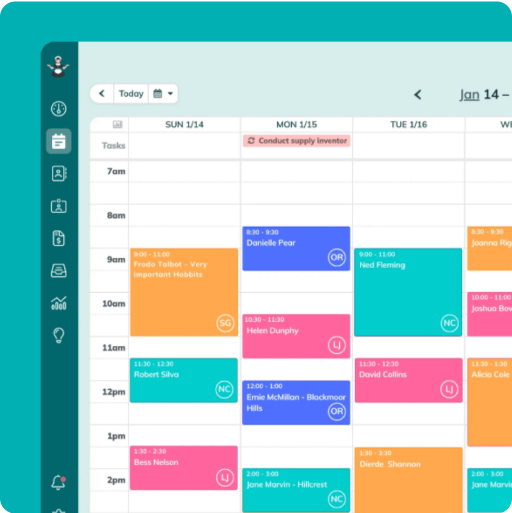
Simplify and enjoy your scheduling with a scheduling software made for maid services
- Have a beautiful calendar that's full but never stressful.
- Make your cleaners happy and provide all the information they need at their fingertips.
- Convert more website visitors into leads and get new cleanings in your inbox with high-converting booking forms.
- Become part of a community of 8000+ cheering maid service owners just like you.
Start your FREE ZenMaid trial today and discover the freedom and clarity that ZenMaid can bring to your maid service! Start your FREE trial today