Frustrated with your scheduling? Try the easiest-to-use calendar app, made by and for maid service owners.
Brought to you by expert cleaning business owners

Tips and advice shared here have helped us grow our own maid services. The ZenMaid team currently has 5+ current and former cleaning business owners on our team, including our Founder and CEO, Amar. We’ve been in the maid service industry for 10+ years and counting.
We partner with amazing leaders in the cleaning industry, including Debbie Sardone, Stephanie Pipkin, Angela Brown, Chris Schwab, and many more — all to provide you with the latest industry insights.
We’ve built the easiest-to-use, comprehensive cleaning business software, built specifically for the industry!
Listen on: Apple Podcasts, Spotify, or YouTube
Introduction
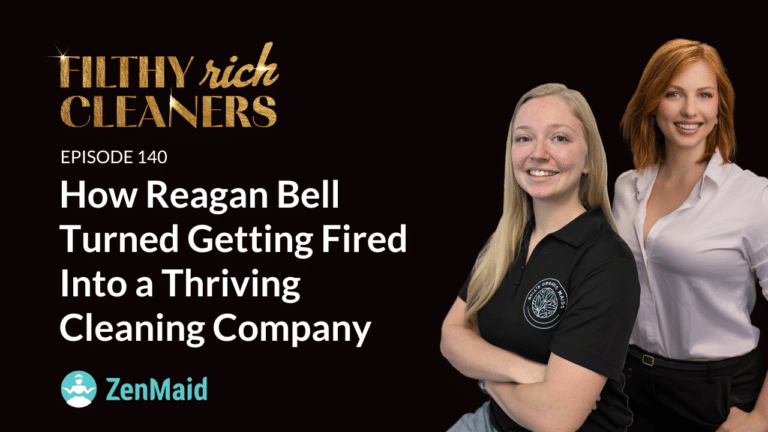
Stephanie: Hello everyone, welcome or welcome back to the Filthy Rich Cleaners podcast. I am your host, Stephanie from Serene Clean, and today’s fabulous guest is Miss Reagan Bell. I personally asked her to be on the podcast to share her story.
She is so young and so motivated and inspiring, and she has quite the story — coming from another cleaning business to starting her own, and now looking towards going to remote ownership. Again, very young. Reagan, you’re what, 21, I think?
Reagan: 22 now.
Stephanie: 22, the bright old age of 22, and she is just killing it. We’ve been in communication for a long time now, and like — I gotta get you on the podcast because this is an incredible story. So Reagan, tell us, where are you from, where’s your business, and we’ll go from there.
Reagan: Yeah, absolutely. I’m actually from the Pittsburgh, Pennsylvania area. That’s where I started cleaning, and then I migrated to Texas, lived there for one year, and now I’m in Orlando, Florida. That’s where our company is based, and we’ve been here for what, three and a half years now. So that’s where our company is too.
Starting in Cleaning at 14
Stephanie: That’s amazing. So you’ve been cleaning pretty much your adult life, it sounds like.
Reagan: My first cleaning job was when I was 14 years old. I actually started in a commercial building that my dad worked in. It was a little office building, and I started there. Then as soon as I got my license, I immediately started a house cleaning job in my town. So I’ve been cleaning since then.
Stephanie: Wow, that’s incredible. And did you always just like it, or was it more like you need a job, this is fine, etc.?
Reagan: Honestly, I really enjoyed it. I grew up with a single dad, so I was kind of always cleaning the house. We didn’t have a woman around, so it was just always me. As soon as I got the residential cleaning job, it just clicked in me. I loved cleaning, and from there I learned how to get better. I’ve tried other jobs like retail, and it’s just not for me.
Stephanie: No, that makes perfect sense. And obviously being raised by a single parent, you probably had a lot of examples of work ethic. I know for most folks I know who have been raised by single parents, they’re very, very hard working, just because they saw it exemplified.
Reagan: Oh yeah. He worked all day, every day. I would only see him in the evenings sometimes. So I was taking care of the house, doing my own laundry by like ten years old. Cleaning was kind of just destined for me.
Stephanie: A very independent woman from a young age, it sounds like.
Working for a Toxic Cleaning Business in Texas
Stephanie: So what took you to Texas? You moved to Texas and that is where you worked for a cleaning business, right? And you actually got moved up in the company, from the sounds of it.
Reagan: Yeah. So my husband now — he was my boyfriend at the time — we were like, we just need to move down south, get away from this northern weather. So we went to San Antonio, Texas, because I actually had family there, so it made sense for us.
I started working for a cleaning company, and it was a contractor position. The pay sounded great. I was 18 years old, so it was awesome for me, and I started cleaning. The owner was just very toxic. She would call and cuss us out if we missed anything in the house. It was kind of just a weird environment, and she was actually a remote owner, so we never met her or even saw her or anything like that.
So it was a weird situation. And then she promoted me to CEO. She said, “Well, since you’re young, you’re good with tech, why don’t we just promote you to CEO and you can run the company?” And I was like, “Oh, that sounds great.”
Stephanie: Oh gosh.
Reagan: So we went with that, and I really didn’t get any training. She ran her whole business through Meta, like Facebook Messenger. So when people would reach out for cleanings, it was always through a messenger, and I would just answer people back, schedule people, and that was kind of my transition to CEO. It was kind of weird.
A couple months in, she eventually said I didn’t have enough empathy, I just wasn’t nice enough to people, I guess. And so she fired me.
Stephanie: Oh my gosh, I just can’t imagine giving that feedback to you. Like, you’re so nice. Do you think it was about something else?
Reagan: I definitely do. I knew she had a lot going on in her personal life. Like I said, you make a mistake, she cusses you out. She’s cussed clients out, and she’s had horrible Google reviews, to the point where she took down her entire Google page because of it. And it wasn’t even the cleaners, because her cleaners are actually great, but it was just her and her attitude. Even clients picked up on it. It just wasn’t a good environment at all.
So yeah, she fired me. But I actually took it as a blessing. It inspired me. We moved away and I just felt the confidence. I was like, I can just do this on my own. And yes, that’s what I did.
Stephanie: Honestly, I think that probably was one of the best things to ever happen to you — getting out of that crappy situation, but also being able to be exposed to a cleaning business and have to interact with customers. It sounds like it was really the training grounds for you of opening your own business.
Reagan: I feel like it was a nice stepping stone for me, because I already had the cleaning down. I was a good cleaner, so I needed that business experience. And I didn’t even know that’s what I wanted to do. It was actually that weird timing where I just graduated high school, I’m looking to go to college, and then it worked out — perfect timing. So I was like, you know what, I’m not even going to college, let’s just open up a business.
Starting Her Own Company in Orlando
Stephanie: That’s incredible. A lot of people just think about opening a business, and we have a lot of listeners who are your age, we have lots of listeners who are much older who have had full-blown careers in totally different fields. So to hear that at that young of an age you had the balls to do this — I would love to just walk through where your mind was at. What were your fears? What were you unsure of?
Reagan: Honestly, my boyfriend and I, we were really tied to that area, because we had just moved there. We lived there for a whole year. After I was fired, I was like, “Well, I want to open this up, and why don’t we just go try a different city, just to move around?”
Stephanie: You don’t want to steal all her clients? Because that would have been my temptation if I got fired. Like, “I’ll take your whole business, lady.”
Reagan: Yeah, I mean, I guess I definitely could have done that, honestly. We were in the mindset of just trying out a different area. We were into traveling at the time. So I was like, “Oh, let’s just go try somewhere else.”
Honestly, I would say it was really scary for us. I knew I wanted to be a business owner. It’s hard for me to work for other people. I like doing my own thing, being in charge. So I just knew that’s what I wanted to do.
As far as moving, when we were looking for an apartment, we had a German shepherd, so it’s really hard to find a place that even allows that kind of dog. So we had such a hard time finding a place in Florida. I was switching between Tampa and Orlando. I’m like, well, as soon as we can get a place, that’s what city we’re going to. And it ended up just being Orlando.
As soon as we moved, we were terrified, because we were like, we’re not going to be able to afford this. I have no clients, how is this going to work? Honestly, I just started posting on Facebook groups, doing as much as I possibly could to get any sort of schedule.
I think the very first clean I did was a free cleaning in exchange for a review. The rest were paid after that. And she — the girl that left the review — also recommended us on Facebook. Honestly, it was just those first few clients that I really tried to get to stick with us, and they actually did.
I don’t know, it was kind of crazy looking back. I don’t even know how I achieved it. It was really scary, but I kind of just jumped in full force. I didn’t even get a job anywhere else. I just was like, I’m going to do it. I just went all in and tried to fill up my schedule as much as possible. And I’m here.
Stephanie: That’s incredible. You went to a new city where you didn’t know anybody, started a brand new business from scratch, and then it was just one free cleaning, getting that word-of-mouth traction. That’s the power of the free cleaning. If it’s the right person, obviously, it really can work. It is ideal if you have somebody who’s local, knows a lot of people, likes to yap, likes to spread good word of mouth for you.
So it sounded like you had a really good first go of it. But I love that you just put yourself out there. You’re like, “We’re doing this damn thing. I’m not going to go get another job. This is going to work.”
Luckily, especially in Florida — I believe Florida, Georgia, and Texas have the most cleaning businesses in the United States in each state. So tons of competition, but there’s just so much demand for work. You could throw a rock and find a house to clean. It’s just the competition.
Reagan: Oh definitely. There’s a lot of competition here, but the demand is very much there. It would be really hard to not get clients. I’m sure that’s part of the reason why I was able to start off the ground and get clients that way. But I just made sure the cleanings were very thorough, very good too. People stuck with us because of that, and we still to this day have the same clients that we started with. So that has really helped.
What She Learned from the Toxic Job
Stephanie: I’d love to hear — obviously, you learned a lot of what not to do at your former place of employment. So I’d love to hear your biggest takeaways of what not to do, versus what did you learn that was actually good there.
Reagan: Yeah, absolutely. Big no’s for me were the team and the culture. There was absolutely no culture, especially since we had never even seen the owner. It was very remote, and she was a private person, even to the point where she lied about where she lived.
Stephanie: Wow. How did you hear about that job? Was it just Indeed or how did you even get hired there?
Reagan: Yeah, Indeed actually. There was just no culture, and that to me — I didn’t really like that. And the way that she managed her team, like I said, calling us, cussing us out. A lot of people quit. Turnover was very high with her company.
I didn’t like the way that she treated her team. So that was a big no for me. I was like, when I start my business, we’re going to care about the team.
Stephanie: Yeah, you’re going to respect people. What a concept.
Reagan: Yes. I want the culture there. I want team bonding. I just want a positive environment. So negative environment was a big no, so I definitely learned with that. And it has worked, because our turnover is like nothing. Of course as you grow it’s going to get worse, but I’ve kept the same employees that I’ve hired.
On the positive side, I think just learning how to talk with clients, get people booked on the schedule — that’s actually how I found out about ZenMaid. So I learned how to use CRMs, how legally a company is set up, how to talk to people. I wasn’t empathetic enough according to them, so I now take that sometimes. If they say something’s wrong, make sure I’m caring. So yeah, that’s definitely something that I learned from her — just learning how to talk to people, in the good ways, not the bad ways.
And I was a better cleaner after working for her. The way she cussed us out also put some fire under you, because it’s like, oh, you’re going to get fired.
Stephanie: How did training happen there? Did you just shadow, or what was that like? Did they run teams?
Reagan: No training.
Stephanie: No training. Oh my. Wait, were you an employee or an independent contractor?
Reagan: Contractor.
Stephanie: Okay, I gotcha. That makes a lot of sense then.
Reagan: She ran all independent contractors, so there was no training for that reason, and you just had to be a good cleaner, of course. The way she would do it was, for your first day, you would go with just a client, and that would be a free cleaning for them.
Stephanie: Did she pay you that, though, for that?
Reagan: Yeah, she paid me, and the client gets a free cleaning. It’s like a test clean, in exchange for feedback.
The W-2 vs. IC Decision
Stephanie: What was — I mean, were you insured? Did she actually make you guys be proper independent contractors?
Reagan: No. She said her business had insurance, but we didn’t have to get insurance.
Stephanie: Well, this isn’t on you. I’m trying to skewer this woman’s business practices. So I’m curious, did you have to bring your own tools and supplies, or did she provide those?
Reagan: Yes, so I had to bring everything of my own. She paid decently well for the area. As far as the pay structure and everything was set up, I think it was definitely legit. But yeah, no insurance or anything.
Stephanie: That’s interesting. I know from what I’ve heard that ICs — a lot of times the companies will still have an umbrella policy to cover their independent contractors in case the IC’s insurance does not cover whatever incident occurs. But that’s really interesting. I think what this probably showed you is that you want to go with W-2s. Is that the choice that you went with?
Reagan: Yes, it definitely should be. I only do W-2, and that’s exactly what I’m doing now. Especially when it comes down to the supplies and everything. That was something huge that I did learn, because she got audited, and she got fined a lot because she was running things like a W-2 system would go. She was paying a lot to the government after that. So I just didn’t want to take the risk. I was like, we’re just going to do W-2 employees, and it just makes sense.
Stephanie: I’m so happy that you shared that, because that is the big risk with independent contractors. If you even unknowingly do something wrong and you get audited, you can’t say, “Well, I didn’t know.” It’s like, well, we’re the business owner. It’s our job to know if we’re going to run that type of staffing structure. And same with W-2 — just me saying I didn’t know XYZ doesn’t mean I get out of paying something or following the rules. Which is why we have to just stay on top of it and expose ourselves to information about the various business structures, especially state to state. Florida’s very, very business-friendly. It’s definitely one of the better states to run a business. But I’m happy to hear that you went with W-2, especially with the culture that you want to build — harder to do with contractors for sure.
Reagan: Oh yeah. I also just hire based off of personality too, and I perform the training. Anybody can be trainable if they have the personality for it. So I honestly would rather that than a contractor. It’s so competitive here that I worry people are going to try and take my clients and do something gross, so I just don’t even go down that route.
Year One and First Hires
Stephanie: That makes perfect sense. So I’d love to hear — that first year, I assume you got fully filled up pretty fast and then had to start hiring. What did that look like? Or tell me the timeline on that.
Reagan: Yeah. So the whole first year I was in business, I didn’t hire anyone, so it was just me. I let my schedule get totally packed, which I kind of enjoyed because of the money. And then at some point, I kind of lost track of what my goal was. I was like, you know, I built this company so I can run it remotely from anywhere in the world. And I was just full and cleaning. So I’m like, okay, I need to hire somebody.
My husband kept telling me, “You need to keep going.” He’s very pushy. He’s like, “You need to do what you came here to do.”
Stephanie: Yeah, I love that. Were you afraid to hire? What do you think was holding you back? Or was it just that security of like, “I’m making this money, I’m in control, I don’t have to deal with anybody else”?
Reagan: Yeah, honestly, I was pretty scared that I would hire someone and then not be able to afford my bills. I had the clients to give them, but then I’m like, well, what if I fill up their schedule and I have no schedule, then I can’t afford the bills? That was a big fear of mine.
I kind of just had to tell myself, it’s going to be okay. Get over it, take the risk, because there’s not going to be a perfect time. So I just told myself, there’s not going to be the right time, I need to do it now, or I’m just never going to be ready. I just knew it had to be done in order to achieve my vision and what I see in the future.
So I just made the leap and hired someone. I would say I was about a year and two months into the business at this time. I posted an ad on Indeed and did a couple interviews, and actually the first girl I hired is still with me today.
After that, the second and third hires were about four months apart. And then I was kind of at a stagnant point for a while. I just recently hired my fourth. It’s just so easy to get in the mindset of, “Oh, I’m cleaning, I’m making good money,” and then I have employees and I’m cleaning still. So it’s hard to jump over sometimes. Recently I’m like, okay, stop. I need to keep this going and keep hiring. I’m trying to just keep going and get myself out of cleaning. Now I’m just at the point where I can’t be cleaning anymore, because this is way too much. So I’m trying to fully back out of it.
Residential vs. Commercial
Stephanie: When you first opened, did you consider commercial? I know you said you have some commercial, right?
Reagan: Yeah.
Stephanie: What did that look like to create?
Reagan: I definitely considered it, and actually one of my very first accounts — I think I did a walkthrough of it the week we moved there. If you know what the Nextdoor app is, my husband was actually on there, just looking for work, and saw an opportunity and recommended me. I got this cute little museum, and we landed that account.
Not intentionally, of course. I was very much focusing on residential. I just knew how to clean those better, had a better idea on how to get the clients. So that was our main focus. Commercials, if they come along or people reach out, we take them, but we don’t put focus into that. It’s just mainly residential. But I definitely love commercials, so I would love to pick more of those up as time goes on, and possibly focus on that more down the road.
Personal Transformation through Business Ownership
Stephanie: It’s really crazy thinking about — I don’t know, I’m just blown away how nowadays, because of the internet and just in general the world, you’ve already got four employees, you’re 22 years old, you’re looking at wanting to do remote ownership so that you can travel. I know you said your husband’s already up in D.C., is it? Is he working up in D.C. right now?
Reagan: Yeah, D.C. area. It’s like a six-year contract, so he’s going to be there for a while.
Stephanie: Truly your goal is to be a remote owner from there. That’s incredible. You should be so proud of yourself, because that’s amazing. I know for most of us, at 20 or 21 years old, this is not what we were thinking about. So bravo to you for that. How do you feel this has changed you as a person? Obviously this has developed you incredibly well. Most people your age cannot say that they’re able to do this. So how have you seen yourself transformed?
Reagan: Honestly, going back to even the single parent thing, I feel like I’ve gotten very independent, and I kind of know how to manage myself well and just get into the adult world.
After we moved to Florida and I opened this business, I had to learn more about business — getting clients, managing a team. So it kind of rolled into listening to podcasts and business owners on Apple Podcasts. That’s all I would live on while I was cleaning. That in combination with putting all of the practices from podcasts into my business is what mainly transformed me. If I didn’t listen to podcasts at all, or follow people online that know what they’re doing, I probably wouldn’t have grown as much as I have now.
That’s been a huge part of my success in getting me to where I need to be. My husband also is entrepreneurial, so he’s got the same mindset. He’ll see if I’m falling out of line at all and help to get me back up, kind of tell me where I need to be. So that’s also been really helpful.
Just listening to people, because like you said, everything’s online. So there’s really no excuse. The mindset that you need to have is out there. You just need to learn how to do it. I’m naturally an introvert, so that’s been the hardest thing for me. Just talking to people, or even doing this, can be hard for me sometimes. So just getting out of my comfort zone has transformed me a lot too, and it’s something I’m still working on now.
Stephanie: I can totally agree with you. That for me was huge too. Just the online resources — it’s overwhelming because there is so much information, and sometimes some information is telling you the exact opposite of something else that you just listened to. So it’s hard to have that discernment, especially if you don’t have the experience of like, okay, both of these people seem knowledgeable, I don’t know which direction to go with. But that just tells you that there’s multiple ways to be successful in any business, of course.
Recent Implementations: Client Gifts and Checklists
Stephanie: Is there anything in the past year that’s really stood out that you’ve implemented, perhaps from a book or online resources? I would love to hear any recent things that you’ve implemented, whether that be customer side, managing employees.
Reagan: Honestly, listening to your podcast specifically has been super helpful. I actually did that workshop — I think that was over a year ago, or just a year ago now.
Stephanie: Tenacity?
Reagan: Yeah, the ladies at Tenacity. Since I did that, my organization using Confluence — I’ve started using that. I learned how to stay organized, because that was a big flaw of mine. I’m all over everywhere. So using Confluence has made a huge difference in personal and business life, because I can actually stay organized. The day-to-day tasks — I wasn’t getting stuff done and I’d forget things. So I really needed something that keeps me on track.
I’ve had ZenMaid since day one. The features that come out on there are always great, because then I can implement those as time goes on. I’ve had that from the start. I’ve had QuickBooks for payroll from the start.
Something I did start implementing recently that has made a difference — I gave my team little jars of honey from a local place, and then I got little thank you cards that I handwrote, and gave all of these out to our regular clients. And they loved it. I got a lot of thank yous. Just little things for client retention.
Stephanie: That’s so cute. I love the honey. That’s a great idea, especially because — I haven’t mentioned, her business name is Bell’s Organic Maids. So I would imagine that your clients are very drawn to the more natural side of things.
Reagan: Yes, exactly. That was the thought behind it. And I’m trying to keep that implemented in other organic local brands, and trying to bring them in as gifts and things like that. Just to help people stick with us.
Stephanie: Little gems of delight. I love that. Especially when it’s a surprise. Nobody expects those things. I don’t know how much that costs, but it can’t be, you know, an arm and a leg, I would imagine. It’s more the thought of it all. A handwritten note, little cute jar of honey, that’s so sweet. I would love that.
Reagan: Honestly, it was only like five dollars per client, so that’s how much the little jar of honey is. So it’s easy enough.
We did that, and then also, all new cleans, we’ve started doing the checklist. I just did that, so we’ll see how that goes. But after listening to you say that, I’m like, okay, we’ve got to do the checklist, because it’s important.
Stephanie: I promise it is. I promise it’s worth it.
Reagan: And I also just realized, after some incidents we had, I’m like, yeah, I think we need something like this. Honestly, what caught my attention was the notes part, like cleaners being able to leave notes. I think that’s golden, so I’m excited to see how that goes.
We’ve also been leaving — on Canva, I made these — they’re not little, they’re like postcard size. They have a QR code for our Facebook page, trying to draw more people to our Facebook. And then I also leave behind a little branded hand sanitizer. On the postcard, it says thank you and a couple other things. So we always leave behind that as well, just to keep the reminder.
I notice a lot of people will book a first-time clean and then kind of forget. So that helps to keep the reminder of us in there. The hand sanitizer sticks around, so it reminds them to book again. I think that is the main things we really implemented. Nothing crazy.
Branding Consistency
Stephanie: That’s great, but I think you have a really good knack for branding already. It sounds like it’s very in line with your brand, your company name. I think it’s really important to always keep that in mind, because you can definitely tell if somebody has an established brand when something doesn’t go along with it — like, this doesn’t make sense, or people are just throwing spaghetti at the wall.
For example, this was funny — Gusto, you would know what Gusto is, right? The payroll software.
Reagan: Yeah.
Stephanie: That’s the payroll software that we use. I love Gusto. You guys have heard me talk about them. Not sponsored. I’ve been using them for years. They have a very consistent brand, typically. Almost always. They hit it out of the park. The website, everything feels very — they have a little piggy that’s animated and stuff.
And I opened up their website the other day to log in to check payroll, and I audibly gasped in a terrible way, because what was on their homepage was — all I can describe was, it looked like intestinal balloons that spelled out the word “small,” and they were trying to say that they were going small. But the whole design of it, it looked like just an AI nightmare of like the human centipede or something. It was terrible. I screenshotted it, I sent it to Amar. I was like, “This is some of the worst shit I’ve ever seen.” It was so off the mark. I was like, who greenlit this? It was so bad.
But it really hit me of, wow, you can be so on it, and then it’s like, if something is working, guys, don’t change it. For you, organic, I can literally picture what your branding probably is. The honey, I love that. The hand sanitizer, very natural. So it would be very odd then if you came in with something very harsh and chemical looking. Or even — you’ll see janitorial companies, how they’re branded as very sterile, lots of crisp blues and whites and things like that. You know what that feels like.
So I think just really leaning into what your brand is is already doing very well for you. You’re going to attract clients who are attracted to that, who want that. Sorry, I had to go on that — those intestine balloons are still haunting my dreams, Gusto.
Reagan: I totally get that, though. I feel like the feeling of the brand means a lot. People definitely aim for a certain feeling that your company brings. So you don’t want it to be thrown off.
Stephanie: No, definitely no intestines, that’s for sure. Small or large.
Staying Organized as an Owner
Stephanie: I also love that you’re highlighting how important organization as the owner is, because I think for me, that was one of my biggest problems — still to this day, one of my biggest problems during my life. If you could see this half of the room, you guys would be shocked and appalled. Not shocked, you’d be appalled. Nobody would be shocked.
But I think that organization and management of all of the little things — that’s where things really get run amok for us as owners, because we just have a million things to remember. Clients, especially when you add employees, there’s just so many things. And a lot of things that are told to us verbally, and then it’s just gone with the wind.
So do you have — obviously you mentioned Confluence for kind of like your task management organization. And there’s a lot of different softwares for this, guys. There’s Notion, there’s ClickUp, all sorts of project or task management softwares, your Outlook or Gmail calendar. Is there any specific things that have really helped you stay organized, or any tips that have helped you manage the chaos?
Reagan: Yeah, I mean, I won’t lie, like you said, I’m still a little chaotic.
Stephanie: Yeah.
Reagan: I think that’s always going to be there. But Confluence I use, so I put all of our systems in there and I write everything out. That kind of helps just to have things down and out of my head, because there’s a system for it. Especially since we’re not hiring on a regular basis — we’re not that grown yet — having all of the hiring system completely down, so when it comes for that time, there’s no confusion. There’s not like, “Oh wait, how did I do this? What’s next?” I just have all of the systems written down there, and that’s made a huge difference.
And then I also have a production tab, and I just kind of everything that I think of, I throw into that tab. So that way, if I’m off on a whim and I’m like, “Oh, I need to do this at some point, or I just thought of this idea,” I have to put it in there, otherwise it’s never going to happen. So just putting things down there, and then whenever I schedule out time to get the production list done, I start attacking those things.
Stephanie: Good idea. Like brain dumping in specific areas. Because I know exactly what you mean. Otherwise it’s just like, I just have these — it’s just pain. I don’t even know.
Reagan: Yeah. And then there’s even like — you actually just said, we use Notion, and that’s something we just recently did, I totally forgot about. We just implemented Notion, so I shared that with my team and made a little hub. Because I caught myself — I would just send them something, like, “Oh hey guys, I made this employee guideline sheet,” for example, because we had a few issues to fix and I wanted to have it documented. I sent this to them on a text, and it just gets lost.
So I’m like, we need a place, a hub, where they can find everything, all information. So I created a Notion to put our checklist, our storage unit inventory sheet, everything, the employee guideline sheet, and then they can literally just click it and then it takes them to that PDF file, or whatever it may be. So that’s just a hub where they can find everything they need with the company. That’s been huge for organization too. Just for even my team to go back and find stuff when they need it.
Stephanie: I think that honestly, other than ourselves being organized, communication amongst our teams is also one of the biggest areas that people struggle with, because they’re individually texting, or there’s no — like you said, the hub. The way I see it is, we’re not walking into an office every day and sitting in a cubicle where there’s a bulletin board. So we need a virtual bulletin board, which is exactly what you’ve created.
We’ve done the same thing in Slack, where it’s like, here’s the resource center. If you need whatever document or policy, it’s there. They can also access it through Gusto on any of the actual policies that they signed. But I think that — for any of you guys listening, if you don’t have a go-to place where everybody goes, everything’s in one place, so that they can easily reference and grab things, you’re going to be shouting into the abyss, like you said. Because you text it, “Hey guys, don’t forget this,” and then it’s gone, right? That’s not going to stick.
And how can it? Because they’re literally out cleaning probably while you’re sending them this. They’re — I mean, mind you, you know, like — so I understand why a lot of times our cleaning techs miss things, because they are literally physically doing something. I know for myself, when I’m cleaning, it’s very hard. I’m in the zone. I don’t even want to be on my phone, let alone be like, “Oh great, let me go check this policy at six PM tonight.” So it makes a lot of sense.
Reagan: Yeah, that was exactly the issue I was running into. I’d send that on the group text, and then it’s like, we’re talking about our cats, and then all the way up — it just gets lost, and they don’t have access to it again. Or they’ll text me a couple months later, “Hey, can you send me this?” And it’s something I’ve already sent to them. So it just didn’t make sense. I don’t know why it took me this long to figure that out, but I’m like, okay, we need a hub.
Stephanie: Yes. And honestly, a lot of times we just have to feel enough frustration with the situation to actually think about, “Oh, what would be the solution so I don’t have to do this thing again?” Ah, some type of hub. I think that’s where a lot of our solutions always come from as business owners. Like, “I’m so tired of beating my head against the wall with this. What could we do instead?”
I also love to hear that you’ve had systems and softwares in place since day one. Obviously ZenMaid — you said you saw that in the other cleaning business, so that’s really cool that she was using ZenMaid. So you decided to do that from day one. Is there any — was that a pretty clear choice for you? Did you think maybe I could go without this?
Reagan: No, honestly. Even with another cleaning company I worked for before, they used a different system, and I did not like how it was set up. Honestly, I think ZenMaid is easy on the eyes. It’s easy to read on the schedule. It’s easy to schedule people. It just makes sense for the eyes, the brain.
Stephanie: Clean. Very clean.
Reagan: Yeah. And something I was really bad with was texting appointment reminders, especially when hiring. It just isn’t going to happen. Or I would text somebody first thing in the morning and their clean was that day, so that doesn’t work. ZenMaid, I think it’s just needed for every cleaning business. I did the free version at first, and then whenever I was going to start paying for it, I’m like, okay, now let’s see what the other options are. And I just didn’t like any. ZenMaid just has all of the features you really need, and nothing else really offers that much. So I think it only makes sense.
And then we started — we switched our invoicing over to there. So we invoice through ZenMaid now.
Stephanie: Do you use Square or Stripe? I’m just curious.
Reagan: We used to use Square, but now we do Stripe.
Stephanie: Oh okay, cool. I was curious. And I love that you said the reminders — I’ll tell you right now, I’m supposed to have my cleaners here right now. They should be — like, my house should be getting cleaned. And I had skipped a cleaning two weeks ago because I was traveling. She said, “Great, your next cleaning will be May 11th,” today, after lunch. And she always texts me a reminder on Sunday night, because she doesn’t use any system with automated.
I didn’t get the reminder. They’re not here. I’ve been thinking all day, “Are my cleaners coming?” I don’t know. And so what I’m describing to you guys right now is exactly what your customers are experiencing, or you are having to manually text them. Like, I don’t like this. This is not good. This is the first time that this has happened. I don’t know if they’re coming or not. I’ve had to prep — I don’t like it. It’s not good.
And this is why we do text reminders, we do email reminders. But there is no reason the owner should be doing that manually. And I should really talk to her about getting and sending — what am I doing? I don’t want to be pushy. And also, I don’t think she knows what I do for work. I don’t, because I don’t want to freak her out and be like, “Hey, by the way, this is what I do.” I don’t want her to think I’m going to be picky or something.
But point being is just, how can we make our customers’ experience as easy and sure as possible? Because they’ve been cleaning for me for months, and this is the first time, and I’m like, I don’t like this. I’m not sure. And we always want our customers to be sure, so that they don’t have — this is in the back of my mind on a Monday. Like, are they coming? Do I need to leave? What’s going on? So I’m just sharing this anecdote because it’s happening literally right now. All the automated messages going out, anybody who’s still sending that stuff out manually — I need a spray bottle and I need to spray you like a bad cat, because you shouldn’t be doing that manually. That should be happening automatically.
Reagan: Yeah. It makes you lose that confidence that you would have if you got the reminder text.
Stephanie: Yeah, exactly.
Reagan: I even noticed there’s a lot of clients that also will forget. So they rely on having that text, because if not, they also forget.
Stephanie: Yeah. And you show up and then they’re like, “Oh, I forgot you were coming, I’m not ready, I didn’t pick up.” So it allows them to help you. Help help them help you, is what I’m trying to say. Like, obviously I pick up, I do all of these things in preparation for the cleaner, and obviously we want to make it easy on us and make it easy on our staff by reminding our clients. So it’s just a courtesy. And honestly, it’s not even just a nice-to-have, frankly. I think it’s a necessity.
If you want to own a business and not just be, quote unquote, “a cleaning lady,” you should be sending out reminders. Because look at every other professional service. When I get my hair done, I get reminders. When I get my oil change, I get reminders. This is — it’s not a nice-to-have, it’s an absolute bare minimum. So if we’re not doing these things, that’s really — and other cleaning companies are. And we want to charge premium, we want to be seen as all of these things, but we say we want these things but we’re not willing to pay to offer these things, even a small amount of that convenience for our clients and for us too. Sometimes you have to invest a little bit to make yourself stand out, and get fully booked.
Reagan: Yeah, I totally agree. And I notice as well, there’s a lot of clients — most clients, actually — love the consistency. They just want consistency. So when you don’t have that, I think that just shows you lacking in your company, and it’s just not a good look.
Bookkeeping and Taxes
Stephanie: I totally agree. Other softwares — you mentioned you already had QuickBooks as well. I love to hear it. So we’ve got a little bookkeeping queen here, which is awesome to hear. Because I think there’s a lot of folks who open because they’re great cleaners, and the business side of things they really struggle with. So love to hear that you’re doing your bookkeeping. Have you had any struggles with that, or has that been something that you wanted to outsource at all? I’m just kidding — we still do it in-house. I’m just curious.
Reagan: Yeah, I mean, I definitely do struggle with it. I am just definitely inconsistent on that side of things. I have things automatically logging, but then actually going in and organizing honestly takes so long for me to do, and I push it off, because I’m like, I don’t want to do that right now. So that’s something I definitely should be hiring out for. I don’t, but yeah, I do struggle there. I get it eventually, I get everything organized, but I slack with it.
Stephanie: No, I get it. And that’s why it’s a great thing too to outsource, if you can and when you can, with bookkeeping especially. Because it’s so important, but I could think of about ten million things that I’d rather be doing than bookkeeping.
Reagan: Yeah. Even with our taxes, I definitely hire out for. I tried to do that last year.
Stephanie: Yep. No, I have not done my taxes since before I — the last year I did my taxes was the year before I opened the business, because I was like, I’m going to mess something up.
Reagan: Oh yeah. I got confident, thought I could do it. And no, it was terrible.
Stephanie: Yeah.
Reagan: So I basically just keep the QuickBooks so at the end of the year I have all the information I need. I need to get better with that though, especially transitioning out of the cleaning field, running it remotely. I need to have the percentages down. I need to know exactly what’s coming in, going in, what category. So that is something I am going to start prioritizing, so I can figure that out. I definitely will need to be into that more on a consistent basis, probably weekly.
Stephanie: No, and it makes perfect sense, especially when you’re still in the field a lot. It’s just hard to prioritize that type of stuff. So I’m really excited for you to get out of the field, so that you can really put your business hat on fully, and not just be getting pulled in all of the directions.
The Timeline to Remote Ownership
Stephanie: What is the kind of timeline that you’re hoping to have for going remote?
Reagan: Let’s see. We’re moving in August. So I would say mid-August is moving time. There’s not really any leniency — it’s happening mid-August. So that gives like three months, or at least two months. Yeah, June.
So we have three months. I ideally wanted to be fully out of cleaning by June 1st. It’s looking like I’m still going to have one small commercial cleaning. It’s early in the morning, so none of my girls want to take it on. So I’m going to have something like that, and I think that’s going to be the only cleaning I’ll have. That’s easier. So I would say by July 1st, I’m fully done cleaning. I don’t want to be in the field whatsoever, because that’s going to give me a month and a half to have things fully ready. I want to make sure things are running smoothly before I fully move, and make sure it’s good without me.
Something I did recently this month — the girl that I hired, my very first hire, is promoted to field manager. That’s her position. She is just going to take care of the quality checks on cleaning. She’s going to do storage unit inventory. So we keep all of our supplies in a storage unit right now. It’s not big enough for an office.
Stephanie: Storage unit makes sense. Makes perfect sense. A lot cheaper too.
Reagan: Oh yeah. And it’s got little lockbox code things, so they just get the code, go in. So she’s going to take care of the inventory in there, and just a few other things where a physical person has to be here. So she is going to still clean, and then get an additional monthly stipend for the additional tasks that she’s doing. So that’s something that is in place this month that she’s already doing. Honestly, I really suck with the storage unit inventory and all of this stuff anyway, so it makes more sense, because she’s better at it than I am.
So yeah, that’s something that’s already going on. The next timeline is me just out of the field. July 1st, no supplies in my car.
Stephanie: Hell yeah. Promoting her to that — because I think honestly, when I think of any remote owners at all, or anybody who aspires to remote ownership, you are going to need somebody there when shit hits the fan, something goes wrong, somebody calls out. You need a plan for that.
So anybody who’s like, “This is my goal,” it’s like, well, that is going to be the number one. Just like if I were to open up any more locations in Wisconsin. Obviously I’ve thought through what does that look like? It’s like, well, I need somebody physically there to be the backup, to do the inventory, to do the maintenance, the training, that type of stuff. Somebody has to be there to do those things. You can’t really get away with it otherwise, outside of doing a complete different business model, independent contractors. So if you want to go the W-2 route, you’re going to need somebody, even if it’s part time — they’re cleaning regular houses, and then part time they’re available for this other stuff. You’ve got a great plan, hun. I think this is awesome.
Reagan: Yeah, that’s exactly how it’s set up. So she’s still cleaning right now, and then these tasks are just additional, so that’s why she’s going to get the stipend. And then we already talked through, this is kind of a growth opportunity. So as the business grows, the demand grows for her to be doing more tasks. We’re going to just take off from the cleaning schedule and grow the stipend. So it’ll grow with the company. Just started that this month.
Stephanie: Oh, that’s so cool. And honestly, if I could go back and redo it all, I would have done something more along those lines. If I were to start all over, I would have had that right away. Obviously it costs money. We know that that costs money. And if that’s not feasible for any of you guys listening right now, that should be hopefully the goal — that you can have a little bit of overhead to this type of thing. Reason being, so you can go on a vacation. So that you, if you get sick, you don’t have to go in the field. There’s a buffer in between you and the field. And obviously when you move away, you really need a buffer between you and the field.
Reagan: Yeah, exactly. That’s definitely not what I want to do — hopping on a plane to clean. So that’s the plan.
And then I am planning, for right now since we’re not super busy, I’m still going to handle the admin tasks. I’m going to schedule people, hop on the phone. I can do all of that for right now. At some point I would love to hire an office manager, but I don’t think we’re really there yet. So I’m going to handle it, kind of see how things go those first few months with me working from home fully, and managing, running the business. I think that’ll be a perfect amount of work for me at first. So she’s not handling talking to clients or anything like that. She’s just in the field, with some extra tasks.
Talking to the Team About Going Remote
Stephanie: And you can do all of those things remotely. So it’s really like a test run of what’s to come. I love that. I’d love to hear, how have you talked to your team about this? Because for me, when I went remote, with a couple of my staff members that have been with me since the beginning, it was a bit of, not pushback, but confusion. Like, how could this possibly work and things like that. So I’d love to hear, how have you broached this or positioned this to your team?
Reagan: So we haven’t actually really dove into it much. The main person that knows the most is the girl that I did promote, because we were going over how this is going to look. The rest of my team, they know that I’m moving, but I guess we didn’t really go too far into things yet. We do schedule monthly team breakfasts just for bonding time, so we do plan to let them know about everything at the next team breakfast. The last one was a good bit ago, and she wasn’t promoted yet, so it wasn’t the right time. So next time we’re going to go over it more.
I did see confusion from one of the girls. She thought that she was going to lose her job, so I was like —
Stephanie: Yeah.
Reagan: So I had to reassure them, everything is going to stay the same. I still want to fly down here at least every two months, do the team bonding. Flights are pretty cheap, so it’s not a big deal. I still plan to do that. Otherwise, I don’t even see them that much, so I’m like, it’s really not going to be much different. If anything, it’s going to be better for them, because I’m actually going to be more on top of things.
Stephanie: More available.
Reagan: Yeah. Because I clean way too much right now. So I’ll actually be available full time. So I think it’ll be helpful for them.
Keeping Culture Strong Remotely
Stephanie: That’s amazing. It just is really amazing that this is even possible. It is so cool that remote ownership is possible. You can do it in a great way that serves your team, and it doesn’t have to negatively impact them. I’m really happy that you’re already bringing up the culture thing, because that’s the toughest part. Remote ownership with culture — that is the toughest part. And keeping that on track. You have to be pretty diligent with it.
Reagan: Yeah, that’s actually what I was going to ask you. How do you keep such a good culture without you even being there?
Stephanie: The vibes are immaculate, I must say. It’s definitely the people in charge who are physically there are very aligned with the culture. Obviously I knew them also. They help with that. I also think that we literally have systems built for culture.
A lot of that is going to be just the online communication. As I mentioned, we use Slack for our communication in the company. And we literally have channels that really allow for me to connect with them.
So number one, I’m still running — we do a team meeting every Monday morning. That is virtual, so all — not the whole team joins, but while they’re driving to jobs, they can listen in. Some of them are in our physical office with the managers, and we’re all calling in. So it’s kind of like a hybrid meeting. I run that every single week, no matter what.
Also, half that meeting is literally made for connection. Today, halfway through the meeting, we ask a question of the week. That question is literally for us to connect over and to learn about each other. We ask what’s something you’re excited about or grateful for, which is usually we’re talking about our weekends. We share what we did over the weekend. And then we ask a question. For example, this morning’s question was, what is one of your favorite board games or card games, or do you have any memories from childhood related to a certain game? And there was stories that I — if April’s listening, April, you know what story I’m talking about. Things you learn about people when you ask questions like that. I’ve worked with this woman for seven years, and I’d never heard that story before.
So it really allows for — I know it sounds silly, but it’s just like, just let them talk about themselves and talk about yourself. It’s nothing to do with work. Literally, I pay — half the meeting every week is that I pay for that, because that’s how important I think it is to connect. Especially because, even if I was physically there, they’re out cleaning. It’s a very independent thing.
And then secondarily, when it comes to Slack, I’m always making sure that I am hopping in and commenting and reacting to the before-and-afters. We have a whole channel that’s for before-and-afters. That’s where they submit them. Making sure I’m responding and saying great work.
Number two, we have a social chat. The whole channel is called just Crew Chat. That is for socializing. We’re just shooting the shit there. We’re sharing what’s going on. I just did a landscaping project this weekend. I shared that. Anytime they share, we’re commenting on stuff. It’s nothing to do with work at all. Just knowing them as people, I think, is important. Again, I’m not hiring, I’m doing nothing.
And so I also think that our orientation really establishes the culture very well too, because there’s videos in it. There’s videos of me talking about why I built this business, why it’s so important, what we’re all about.
I also think the metrics that we track and report on in the meeting are important. Like how many cleanings that we’re doing every year, how much we’re putting into retirement — that’s a KPI. I say every single Monday, how much did we get in tips? How much did we put into our 401ks through Gusto Guideline? I also do, what charity are we donating to this month on behalf of which staff member? The KPIs we report on are literally our culture metrics, I would say, that I really find important. Obviously sharing any positive feedback that we got.
And then something I just recently implemented actually — I realized that we’re sharing a lot of positive feedback when it’s coming from clients. So reviews — when we’re getting a review, then we’re like, “Great job, so-and-so, you got this review. Great job, Jenna. Great job, Jessica.” But one of the things I took away from the conference I just went to is, positive reinforcement on all behaviors that we want, not just reviews. If they’re acting with integrity, if they’re being really communicative, if they’re having a great attitude — all of these things that we want to encourage.
I’ve started — this is going to sound really bad, but when you want to talk about systematizing — I literally hook up Claude. Actually Veronica, my executive assistant — I figured out how to do this, and now she does this. So Claude, which is AI, guys — we hooked that up to our Slack. We’ve instructed Claude to comb through all of the individual chats between the managers and the cleaners. And it’s combing through and trying to find examples of behaviors to call out publicly in front of the rest of the crew.
So every single day, Veronica puts on a platter, “Here are two or three examples of people behaving in positive ways that we want to highlight.” She gives them to me, and then I put them out to the crew chat.
I know that sounds really cold and robotic, but it’s making sure that I do not forget to do this or let it slide by the wayside, because things just get busy. Things can get really busy and you just forget to give the accolades and call out the good behavior, because it’s easy to do when there’s a review. It’s right there. It’s like, oh my gosh, look at this review that we just got. But I think it’s all of these little behaviors.
Somebody got locked out last week on a first-time clean. They followed the exact lockout protocols. They proactively reached out to the client, and then they filled us in. They did everything right. We got into the house. So instead of just being like, “Good job” to them, I then called it out in the crew chat. “Hey, these two cleaners, they followed the exact right protocols,” and I explained exactly what they did right. “That was great communication. Thank you so much. It makes our job easier to handle the problem.”
So it really is as nuanced as little nitty-gritty examples. But once you start, it becomes a habit. It’s a process of, every single day we’re looking for things to call out. And that feels really good. And it’s also showing the newbies, “Oh, the boss likes when they do that. Maybe I should do that too.” So it’s culture, but it’s also a lot of accolades.
Of course, when I do go back to Wisconsin, I always make sure I’m there for a team meeting. If we can do a cookout, or we’ll do — we have an Adopt-a-Highway section, so that could be one. Go find an Adopt-a-Highway, go do some volunteering with your team and then take them out to lunch. Have a pool party or a cookout, or whatever it is that you guys like to do. Have them bring their kids, make it a whole family thing. When I do go back to town, I try to make it count and spend time with them.
Yeah, honestly, those are the things that really come to mind. And just taking an active interest in their life. For example, like I said in the team meetings, where they’re answering the question about their weekend, one of our newer cleaners, she’s like, “Oh yeah, I did some fishing this weekend with my boyfriend.” I’m like, “Well, where do you like to fish?” Be a good podcast host, if you will, and ask them follow-up questions on what they say, and actually listen. I know that sounds really basic, but just take an active interest in their lives, especially — I’ve never met this woman in person. She’s brand new, and I’m making sure that I’m paying attention to her when it counts, with my little bit of time that I do. So I know that that was long-winded, but those are some of the examples of how I handle culture remotely.
Reagan: Yeah, that was really great, honestly. That is why we do the team breakfast. It’s not even related to work at all, and it’s just — they are paid time, because I want everybody to show up, and they’re paid. I pay for the breakfast, and we all just have fun. We don’t even talk about work unless it comes up, and they’re like talking about a clean that they do.
But yeah, I did recently get Slack and I got people to join. And I just don’t really know how to utilize it. So after hearing you say all of that, I think that makes perfect sense. The positivity I really want to throw out there, so that way they feel valued, seen, and we just all have that connection. I know that they all connect well together.
So right now we use a group text, and like the other day one of the girls got a new bunny, and she’s sharing it on the group, and there’s things like that. Now I have a better understanding on how we can use Slack, because I’m totally going to do those different channels. So we can just have fun with it.
How to Get the Most Out of Slack
Stephanie: Yeah. I’d be happy — once we get done with this, I’ll screen record and show you the structure of our Slack, just to show you examples. And don’t forget, once you start getting into Slack, they have something — the Canvases — which is where our bulletin board is. Slack has so many uses. It’s just amazing. But I’ll record you a little example to show, because I think once you get that down, it’s amazing. I am such a Slack fangirl. We really love it. You can set up auto reminders. You can set, you know — I use it for myself all the time to not forget stuff.
So there’s so many cool features. I would definitely say, take a little bit of time and learn Slack to the best of your abilities, because there’s just so many things. For us, we literally set up Slack bots. So for example, the lockout — they send a message that says, “Hey, we’re locked out, the code’s not working.” We have an automated Slack bot, which is triggered by that keyword of “lockout,” and it says, “Locked out — did you do one, two, three, four?” So that we as the managers aren’t having to manually be like, “Did you do this? Did you do this? Did you do this?”
So it teaches them over time, once they keep getting that response when that happens, how to behave. And we’re not having to jump in and be like, “Well, did you call the client? Did you —” One of my biggest frustrations with managing people is the pulling of teeth of getting the information to solve the problem. So we just — it makes us want to pull our hair out of, why can’t they proactively communicate so we can fix this problem for them, or teach them how to fix it themselves?
So a lot of that is just repetitiveness. They need to see things over and over and over again. And instead of us just fixing it, being like, “Hey, great. Next time, reach out to the client first, and then let us know if they answered, how long it’d be.” Like all these things that we want to know so that we can then jump in and solve if we need to.
So again, long-winded, I get really excited about Slack. And I promise they’re not sponsoring me. It’s just been one of — it’s the one thing that we implemented in a year and a half, two years ago, that has had one of the biggest impacts on how we are able to manage the business and communicate more effectively and just have proper communication. So I’m a big fan.
The Crazy Client Horror Story
Stephanie: But before we go, Reagan, I have to hear this story about this old lady who was being a total psycho to your cleaner. Because I was like, “Tell me a horror story,” and you wrote it down, and I was like, “Oh my gosh, that’s terrible.”
Reagan: Yes, that was a crazy moment, honestly. At this point in the business, I’ve kind of grown to a point where it’s like, if there’s a crazy client, you kind of just have to go along with it, put out the fire — even if you take a loss from it. I just don’t think it’s worth the time, the energy.
So what happened was, it was an initial deep cleaning. Two of the girls went — we always do two people on initial deep cleanings, because we just never know. Two people go out. And I will say too, we do the hourly rate, and we’ll do capped cleanings if they want to cap it at a certain amount. So she did a three-hour capped cleaning. And then I always tell them, make a priority list, because we will not get to the entire house within this time. And she said, okay, no problem. She even said, “Can we use some of my products though? They are organic.” And I told her, we’re open to that, we just don’t use bleach products for our cleaner’s sake.
So they get there and start the cleaning. Everything happens, they finish the cleaning. Then I get a call from both the girls — on a three-way call. And I’m like, okay, that’s a weird sign. It’s a three-way call, and they’re like, “Okay, this house was crazy. We never want to go back.” And I’m like, “Whoa, whoa, what happened?”
And they were like, “Yeah, so the first 30 minutes of the cleaning, she had to walk us around the house and show us how to clean things. For example, how do we dust a ceiling fan, and ‘make sure you’re doing top to bottom.'”
Stephanie: Oh my gosh.
Reagan: “This is how we wipe the counters.” Just kind of showing them how they’re supposed to clean. And they’ve been working with me for almost two years now.
Stephanie: Yeah, how insulting. Especially — I’m sure she’s like, “I’d like to teach a lady about it.” She was maybe anxious or whatever, but it’s like, you’re hiring a cleaning company. You don’t need to show them how to wipe things down.
Reagan: Oh yeah. It was just — they thought it was so strange. And then they also had mentioned, she had cameras all around the house, in every room. Which is like, okay, I see places with cameras.
And then, on the client side of things, she’s texting me, and she’s like, “Yeah, so I was watching them the whole time on the cameras, and it looked like this one paused for a second.” So she was taking out time for that. And then she said, “Also, there was 30 minutes for orientation. I shouldn’t be charged for orientation.” And I’m like — I was like, “We don’t —” That’s not a part of the clean. After that, I actually put in our policies that they clock in as soon as they get there and unload their supplies. So now it’s in the policies.
But yeah, so she starts docking all of this time, and then she’s like, “Okay, so I should be charged for this amount of time, and not this time. And I’m only willing to pay this hourly rate, because I feel like that’s what they’re worth.”
Stephanie: Oh my gosh. Ew. You gave her the price ahead of time, right? You told her the hourly rate, right?
Reagan: Oh yeah. We send service policies, we sign it beforehand. We do all the necessary steps upfront, and she just totally disregarded a lot of it. Honestly, this happened a while ago, so I don’t remember every detail, but there was multiple things that were in our policies, and then she was just like, “Oh no, no.” She was just totally going over and then telling me what she’s going to pay, what she’s going to pay for.
Stephanie: Nothing triggers me more than when somebody says, “This is what I’m going to pay because this is what I think it’s worth,” after agreeing to a price. That’s insane. Insane.
Reagan: Yeah, honestly, I was so shocked by it. She was just telling me how it’s going to go after literally signing everything, agreeing. It was just kind of crazy.
Stephanie: I can just picture her, like, heavy breathing into her camera, taking notes as the girls pause in the cleaning. Like, “Oh, she checked her phone once.”
Reagan: That was the crazy part to me, honestly. And the girls just felt so uncomfortable there. So micromanaging. For me, I know when somebody’s watching me, I can’t even type on the computer if somebody’s watching me type. My fingers don’t work. I’m okay with — if clients are in the house, it is what it is. But when they’re literally watching you as you work, I’m like, I’m going to break something of yours if you don’t look away.
Stephanie: Oh yeah.
Reagan: And then she actually even said, “Well, one of the girls was a little less efficient than this girl, so I think the rate —” And that’s where she starts adjusting the hourly rate. She’s like, “This is what she’s worth, and here’s what she’s worth, so here’s the total of the hourly rate I’ll pay.”
Stephanie: But it’s so tough, because you’re charging hourly because she wants limited — I just know if you had charged flat rate, it would have just been like, “Well, they should have got this much done. Blah blah blah.” So it’s like, I really think there was no way to win with this lady. Clearly.
Reagan: No, no. Yeah, it’s just one of those things where I was like, either way, we could have won about this, she wouldn’t have been happy. So it just is what it is, and we just don’t move forward.
I’ve learned early on that after the first few weird incidents — and I spent hours in the messaging trying to figure things out — it’s not worth the time. Because at the end of the day, you don’t want the bad review on your business, and just give them whatever they want. It really sucks. It just sucks.
Stephanie: It hurts you too.
Reagan: It sucks, yeah. I think it’s necessary, because I don’t want the bad review, and it’s not worth sitting there and arguing for hours.
Stephanie: Oh yeah. And I’ve literally — this is something that we’ve definitely gotten stuck in. Of like, principally, we know this customer’s wrong. But then I start looking at the hours I’ve paid my managers to deal with this, and I’m like, cut it. Cut our losses. We’ve already spent so much on this, and going to the cleaner and asking blah blah blah. It’s just like, they’re wrong, they’re blacklisted. We have a “do not clean” list, and it gets bigger every single year, I swear. It is what it is. Just add them to the “do not clean” list.
Reagan: Yeah. That’s all you can do, and you have to take losses sometimes. It just happens. I think that’s just in the business. You can’t do anything about crazy people. And sometimes people seem great when you go to book them, and then they’re the opposite.
Stephanie: Yeah. Sometimes there’s no red flags, and that’s all you can do, is have the signed policies. So anybody who’s listening, if you haven’t had a crazy one like this, they’re coming. I promise. It’s not if, it’s when. Get freaking client guidelines, get policies, and get them signed. You must have them signed, or you can’t hold them accountable. And even if they do sign, sometimes you’re just like, screw it, I don’t want to deal with this. But at least you have something to fall back on. So let Reagan’s pain be your guys’ lesson.
Reagan: Yeah, it’s inevitable.
Stephanie: They are. Absolutely. I’m just glad that you were able to get her off the books, and it is what it is. Just learn from it. That’s the thing — every time we have a situation like that, it’s like, what can we learn? What do we need to implement? What phrasing do we need to change? Is there something we can do on the intake side of it? But they’re still going to slip through the cracks, and you just have to kind of brush it off your shoulders and be like, “Yep, not our client.” And most people are reasonable, and some aren’t. So I’m just glad that you got rid of her.
Reagan: Yeah, we definitely — right after that, I started updating our service policies. I’m like, can we throw these few things in there? Because they’ll literally pick out the smallest details. “Oh well, it doesn’t say this.”
Stephanie: Correct. Yep. And unfortunately, the ones who are going to be like that, they are the ones who are going to nitpick and all of that. So you have to be really, really highly specific. Like, this, this, and this. We don’t do this. Because otherwise, if you give an inch, or if there is room for interpretation, they’re going to interpret. So don’t leave the room for it. Sometimes your guidelines or policies, they feel harsh, but it’s like, nine times out of ten, you’re never going to have to use it. But that tenth one, you are going to be so glad that you wrote it as harshly as you did. Because you can always make exceptions to your policy, but it’s an exception.
Reagan: Yeah, most definitely. I’m sure that even once they read the policies, people that were going to do something might not do something. It just makes you look more logistic.
Closing
Stephanie: No, I totally agree. Well, I’m glad that you were able to learn from it, and I’m glad that you never sent your ladies back there again. Reagan, this has been awesome. I’m so happy you agreed to join me, because you really are inspiring. Have you connected with Zyla yet, in Indiana? I think you guys would hit it off, because she is also right around your age, and she’s killing it. You guys remind me of each other a lot.
Reagan: I don’t think so, but was she on the podcast?
Stephanie: Yes, she was. She owns Fishers Enhanced Cleaning in Fishers, Indiana. And Zyla, shout out to you. She is just killing it. I love seeing young people do things like this.
Reagan: I remember that episode, and I thought that was really inspiring, especially at the young age. I feel like it’s kind of your own world out here when you’re that young.
Stephanie: Yeah. It’s tough because a lot of people will just discredit because of your youth, of like, “Oh, you don’t know what you’re doing.” And it’s like, trust me, no matter how old I was, I wasn’t going to know what I was doing. My age has nothing to do with that.
Reagan: Yeah.
Stephanie: And also, you have the energy, and obviously you have years ahead of being able to build. So I think it’s a huge advantage, and very inspiring, and also just super cool for other young people to be able to see, like, “Oh, she can do it, so so can I.” But yeah, you guys would totally hit it off. I don’t remember what episode she was. She has used ZenMaid for a long time as well. I think she posts in the Mastermind sometimes too. So if you’re a member of the Mastermind, you guys can find her around there on Facebook.
And speaking of, if people want to follow you, Reagan, or follow your business, where can they find you?
Reagan: Bell’s Organic Maids on Facebook. Our website is organichousecleaning.org. You can find my personal Facebook. It’s just Reagan Bell. And yeah, I think that’s really all I want. Honestly, I have Instagram, but it doesn’t get used, so no point there.
Stephanie: Same. We’ll definitely link it all below. And again, I’m so, so grateful. We’ll have to connect again after you do the transition to moving to remote ownership, and maybe in six months or so we’ll do a second episode and see how it’s going, and see what you’ve learned from there.
Reagan: Yeah, that’s awesome. I really appreciate this. It’s just great.
Stephanie: Thanks, Reagan, and I’ll see you soon, okay?
Reagan: Yeah, you too. Thank you.
Stephanie: If you enjoyed this episode of the Filthy Rich Cleaners podcast, please be sure to leave us a five-star review so we can reach more cleaners like you. Until next time, keep your work clean and your business filthy rich.