Frustrated with your scheduling? Try the easiest-to-use calendar app, made by and for maid service owners.

Brought to you by expert maid service owners
Pricing can be a complex and even emotional topic for new cleaning business owners. It may bring up feelings of inadequacy, fear around losing customers, and uncertainty about the longevity of legacy ones. And this may mean that you don’t think about pricing or increasing it as often as you should.
Pricing correctly, fairly, equitably, and profitably isn’t as impossible a task as it may seem upfront. While there is no one perfect way to price your cleaning services, at ZenMaid, we’ve seen countless maid service owners take a few similar factors into account when pricing their services.
This guide provides the exact pricing formula used by over 2,000 successful cleaning businesses, including industry benchmark data, real calculation examples, and strategies to protect yourself from underpricing. Whether you’re just starting out or refining your existing rates, in this article, you’ll learn how to price cleaning services that cover all costs and deliver consistent profit.
Table of contents
- ZenMaid’s Foolproof Pricing Formula for Cleaning Business Owners
- Why Accurate Pricing is Critical for Cleaning Business Success
- Finding Your Target Hourly Rate
- Choosing Your Pricing Strategy
- How to Calculate Your Pricing
- Factors Affecting Cleaning Service Pricing
- Protecting Yourself From Pricing Disasters
- Industry Average Prices for Cleaning Services
- How to Adjust Pricing Based on Production Rates
- How to Price Cleaning Packages
- Wrapping up
- Frequently Asked Questions About Pricing Cleaning Services
ZenMaid’s Foolproof Pricing Formula for Cleaning Business Owners
ZenMaid’s pricing formula is trusted by cleaning business owners because it’s specifically designed to ensure profitability while remaining competitive. It’s based on real data from real, professional maid services, not theoretical calculations.
This easy-to-implement system has been tested across different markets, team sizes, and service types, and it consistently produces profitable rates that keep cleaning businesses sustainable and growing.
Here’s the exact four-step process:
- Find your target hourly rate
- Calculate how much square footage you can clean in an hour
- Develop a pricing strategy
- Use the pricing formula
If you aren’t sure where to start, we’ll go through each step in the process below. If you have numbers ready to go, feel free to use the pricing calculator right away! Our step-by-step calculator accounts for all business costs, including hidden expenses that many cleaning businesses miss, and helps you set rates that actually sustain growth.
Cleaning Service Price Calculator
Plug in your numbers to see what to charge for one-time, bi-weekly, and monthly cleans.
One-Time Clean
$200
Per clean
Weekly Clean
$180
$720/month (4 cleans)
10% recurring discount
Bi-Weekly Clean
$190
$380/month (2 cleans)
5% recurring discount
Every 4 Weeks
$300
50% additional charge
Why Accurate Pricing is Critical for Cleaning Business Success
The best price you can charge for cleaning services is the one that covers your overhead, labor costs, and desired profit margins at a minimum. This ensures you run a profitable business all around — you and your employees are paid a good living wage, your regular and emergent costs are covered, and your clients understand your pricing.
But setting the right price for your cleaning business isn’t just about covering costs. It’s about building a sustainable, scalable operation. ZenMaid’s pricing approach addresses each of these factors:
- Proven Accuracy: Our pricing formula has been tested and refined by actual cleaning business owners (including our CEO, Amar Ghose, and team members who’ve run successful maid services). It accounts for variables that generic pricing guides miss, like regional cost differences, team efficiency variables, and hidden operational expenses
- Easy to Implement: Unlike complex pricing systems that require constant recalculation, ZenMaid’s formula gives you a clear baseline rate that you can quickly apply to any job. Once you know your hourly rate and square footage cleaning speed, you can quote jobs confidently in minutes, no spreadsheets or complicated math needed
- Protects Your Profit Margins: The biggest mistake cleaning business owners make is underpricing. Our formula ensures every job is profitable by building in proper margins for labor, overhead, supplies, and unexpected costs
- Scales With Your Business: Whether you’re a solo operator or managing a team of 20 cleaners, this pricing system adapts. The formula works for all service types: standard cleaning, deep cleaning, move-in/move-out, and commercial cleaning
As you’ve probably gathered, each of these methods for pricing services and charging clients has its own strategy associated with it, which means each pricing strategy has its own pros and cons. Choosing your pricing strategy isn’t necessarily tied to its accuracy, but it will have an effect on your entire business model, from client and employee communication to audit timing and increases down the line.
Finding Your Target Hourly Rate
Charging for cleaning services by the hour, as Serene Clean does, has a host of benefits: regular payroll processing, regular client charges, and clear opportunities for routine price increases.
But finding the perfect number to charge for house cleaning isn’t easy. There’s a lot to take into account when deciding how to structure pricing! To find your target hourly rate, you at least want to consider:
- Your production rate
- Your direct business expenses
- Your indirect business expenses
- Your business’s finances
If you want to turn a profit (and of course, you do), then you need to add your location to this list as well as all your costs. Consider a residential cleaning company in New York City versus one in Heron, Ohio. If they were to charge the same price, the cleaning company in New York City would simply be less profitable than the one in Heron, Ohio, because the higher cost of living in New York means the company needs to pay higher wages.
Higher labor costs without a higher service price mean a lower profit for your company. But higher labor costs may also occur because you’ve chronically underpriced your services, overserviced specific locations, or both. The actual time spent on a cleaning job must equal the time allocated — and this is called your production rate.
Determining your production rate
Your company’s productivity rate is based on how fast your cleaners clean. Having a firm grasp on this amount of time and how it changes based on the type of cleaning service provided will help you know how many hours are needed for a home cleaning.
After you’ve found your hourly rate, understand how many square feet you can clean per hour. Now, at first, this can seem hard to find, but you likely already have the information you need — it’s just a matter of finding it! Use data from past cleaning jobs to learn how fast you can clean 500 square feet. You’ll want to calculate an average from your recent jobs.
If you don’t know what to look for, ask yourself the following questions:
- How long did the last 10 typical jobs take you?
- How many employees were on the cleaning job?
- How many square feet were the homes?
Or, start by recording this data for the next week and then use it to find your average.
Several variables can affect your average cleaning rate, so use only typical homes when calculating your average cleaning pace. Your typical homes are the predictable ones that are simple to clean, requiring only your basic cleaning services. We’ll touch on how to avoid pricing disasters in these kinds of homes at the end of this article!
Calculating your direct and indirect business expenses
There are two main types of expenses:
- Variable (direct expenses): These are costs that are directly related to the cleaning that is done, such as cleaner labor and the cost of supplies
- Fixed costs (indirect expenses): Indirect costs are the things you must pay every month, regardless of how many cleaning clients you might have. These include utilities, rent, uniforms, advertising, SEO, social media, software, office staff wages, etc.
Every house cleaning business owner should know their current (and yearly) labor cost percentage. Not only does this determine the hourly rate you pay for wages and the number of hours you allocate to the job, but it also offers you options for employee growth, promotion paths, and increasing retention.
But above all else, having this information on hand is a must in order to give a proper estimate for the service you offer. There are three basic financial reports to take into account to understand your average expenses:
- Cash flow report
- Balance sheet
- Profit and loss statement (income statement)
The third statement is a big one: it’s your roadmap to profit. If you don’t understand it, you could be losing money without knowing why.
An income statement shows the sales you have made over a given time period (week, month, year, etc.) minus your labor costs. The total is your gross profit (GP). From the gross profit, you then subtract your fixed costs, which will give you your net profit.
Understanding where, when, and how money flows through your business is tremendously important to using pricing to grow your business, build employee loyalty, and, most importantly, ensure you and your employees are paid comfortably and predictably.
Choosing Your Pricing Strategy
Cleaning business owners tend to use one or more of the following strategies to price their services:
- Flat rate pricing
- Hourly rate calculations
- Square footage pricing
- Per-room pricing
- Specialty service add-ons
Each of these strategies comes with its own implementation plan and adjustment timeline. Every business owner should not only master pricing changes but also continuously improve their strategy until it feels right. Hybridizing strategies is also helpful, especially if you offer custom services or both commercial and residential cleaning.
Once you’ve chosen a strategy, the next step is to build it out. In other words, how frequently do you hope to charge for services? Do you want your main revenue to come from weekly cleans, bi-weekly, or monthly with extra fees?
Many residential cleaning companies push for bi-weekly cleans. Offering a small discount of around 5% is a great option to incentivize clients to choose these more frequent cleans. On the other hand, charging more for monthly cleans is a good way to help clients choose more frequent cleans. It’s often reasonable to charge an additional 50% for a monthly clean.
We see too many cleaning business owners charge the same rate for bi-weekly and monthly cleans. When this happens, your client has no reason to choose bi-weekly over monthly.
Adapting Your Pricing Strategy As You Scale
Determining an effective pricing strategy is crucial and should align with your current business standing and long-term goals. Assessing your booking rates and understanding your clientele’s price sensitivity are essential.
If you find that your services are in high demand and your schedule is usually fully booked, you can safely assume that your clientele highly values your services. This usually means they are more willing to pay a higher rate, which allows you to adopt a premium pricing strategy. Premium pricing reflects the high quality and demand for your services and provides additional revenue that can be reinvested into growing and enhancing your business further.
On the flip side, if your booking rate is lower than you want it to be and you’re struggling to cover operational costs, you need to find a different approach. Penetration pricing, where you initially set a lower price to gain market share and cover your fixed expenses, might be a viable strategy. This can help attract a customer base and establish a foothold in the market. Once a loyal clientele is built and market recognition is achieved, you can gradually adjust prices to a higher point.
Another idea is to craft custom packages. Offering tailored cleaning packages can encourage customers to engage with your services over a longer term. This not only helps cover your fixed costs but also enhances each customer’s lifetime value, thereby boosting your overall profitability.
Structuring packages that provide value while ensuring profitability will create a win-win scenario for your business and clientele.
How to Calculate Your Pricing
We’ve made it to the pricing formula. After you’ve gone through all the steps above, this next step is pretty simple. And remember — if you have your numbers ready, you can go ahead and plug them into the calculator here:
[pricing calculator]
First, take the square footage of your client’s home and divide it by your production rate per hour. Then, multiply it by your hourly rate. The total number is how much you’ll charge for a single job in that client’s home:
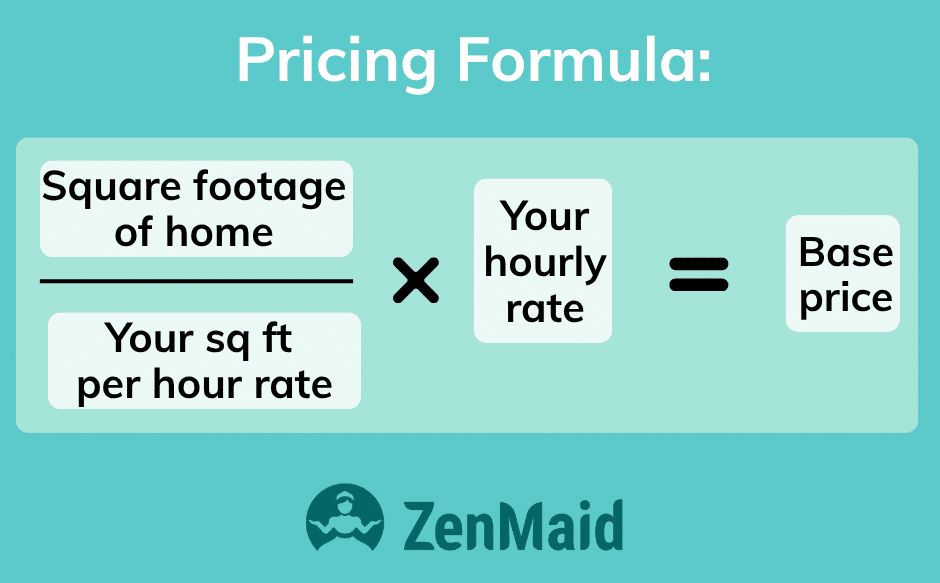
So let’s use an easy number as an example: If a client with a 2,000 square-foot home calls you looking for a quote, divide 2,000 by 500 (rate of square feet cleaned per hour), multiplied by $50 (an hourly rate). The total one-time clean for that client is $200.
Offering a 5% discount for bi-weekly cleans is a great incentive for clients. Using the $200 example above, this would mean a client can have a 2,000-square-foot home cleaned twice a month for $380 (after the 5% is applied). This is an example of a baseline bi-weekly rate.
Your monthly cleans can have an additional 50% charge to encourage more frequent cleans and account for the extra dust and dirt the home will accumulate between cleans. Using the $200 example, a monthly clean would cost a 2,000-square-foot client $300 (after an extra 50% is added). This is an example of a baseline monthly rate.
You can use this formula to calculate any specialty service in your business. Just play around with different percentages and values until you come to a reasonable and profitable baseline.
Charging A Minimum Rate
No matter what kind of service you’re offering, it’s important to set a minimum rate to avoid losing money on out-of-scope services. This will save you the headache of negotiating with a client who might only want a certain room in their home cleaned. Or perhaps, if they have a smaller home, that would only require an hour of cleaning based on your square footage cleaning rate.
Set this minimum rate using the pricing calculator and the base amount required to make a profit per clean. Guaranteeing yourself a minimum rate per clean also makes it easy to communicate expected wages to your employees, whether they’re new or looking to level up.
Factors Affecting Cleaning Service Pricing
Sometimes, you will find that what a client included in your booking form doesn’t match the residence. Once you get to their house, you find out there are a lot of factors at play that should have affected pricing.
Here are some additional, less common factors to be aware of:
- Size of the Area to be Cleaned: The total square footage or the number of rooms and bathrooms can greatly affect the time, effort, and resources required to complete the cleaning task
- It’s important to note, however, that square footage pricing often doesn’t cover the reality of cleaning a given space. Don’t leave money on the table if you’re using square footage as your primary price factor
- Level of Clutter: A cluttered space can take longer to clean, as it might require decluttering before the actual cleaning can commence
- Type of Cleaning Required: Whether it’s a standard cleaning, deep cleaning, or a specialized service like carpet cleaning or window washing, different types of cleaning should come with different pricing structures
- Frequency of Cleaning: Regularly scheduled cleanings may be priced differently from one-time or less frequent cleanings; if your techs are going to a new place, you’ll likely want to budget more time for an hourly clean on the first visit to make sure everyone has enough time
- Accessibility: If certain areas are hard to reach or the location is in a high-traffic urban area, it may add to the cleaning time and cost
- Special Requests or Preferences: Clients may have special requests, such as using eco-friendly cleaning products or working outside standard hours, which can also affect your labor and supply costs
- Pet Situation: Homes with pets may require additional cleaning efforts like fur removal, which could mean more time on site, which should influence the price
- Parking Facilities: In urban areas, the availability of parking near the location can be a factor, as it may affect the ease with which cleaners can access the site
- Supplies Provided: Whether the cleaning company needs to provide all cleaning supplies or if some are provided by the client can also impact the cost
- Lifestyle Factors: Does the client smoke indoors? Does the client keep surfaces clean during the week? Do they host a lot of guests?
- Urgency: Urgent or last-minute cleaning requests, especially those that require you to rearrange schedules, should carry premium pricing
Pricing Common Add-On Services
Offering add-ons to your residential cleans is a practical way to accommodate more services and gives a nice boost to revenue. It can also help protect you from charging too little for last-minute requests from clients.
Services like laundry, dishwashing, or organizing could be additional and would affect the overall pricing. Here are some popular add-ons along with average price ranges. Your exact pricing will depend on your location and unique market.
- Inside Windows Cleaning: $5–$10 per window, depending on size and accessibility
- Oven and Refrigerator Cleaning: $25–$50 per appliance
- Cleaning Baseboards: $0.50–$1.50 per linear foot or $10–$20 per room
- Cabinet Cleaning: $5–$15 per cabinet, depending on size and condition
- Carpet Spot Cleaning: Generally $10–$30 per spot, based on size and stain type
- Eco-Friendly Cleaning Upgrades: An additional 10–20% on top of standard cleaning fees
- Wall Washing: $25–$50 per room, depending on wall size and level of soiling
Protecting Yourself From Pricing Disasters
Even with accurate pricing formulas, unexpected situations happen. The key to protecting your profitability is setting clear expectations upfront and having systems in place to handle exceptions.
With flat-rate pricing, you need to protect yourself from pricing disasters. We’ve all been there: after quoting a home, we walk into a cleaning job that takes way longer than we estimated. There are mountains of clutter, piles of dust, and floors in need of a little more love than you budgeted. So what do you do?
When taking any new job, set the precedent with clients that you may need to charge more if a visit takes longer than planned. An example line you can add to your contracts is, “quoted prices assume average-sized rooms in average condition. Extra hours needed to clean will be priced with an additional $50 per hour.” When a client agrees to this ahead of time, you’ve protected yourself from being underpaid.
You can also protect yourself from employees trying to take advantage of an hourly pricing model this way. Hourly pricing can mean disincentivizing employees to clean fast. Include an approved number of hours in your booking form to notify both your client and employee how much time you’ve allotted for a specific clean. Then, tell your employee to seek approval from you or the office to add time if needed, and only work that additional time if approved.
When you find yourself in a job taking longer than expected (which is bound to happen at some point), take a break from cleaning to notify the client that an extra fee will be added to keep cleaning. If they give you the go-ahead, you can proceed and charge extra as needed.
If the client declines moving forward, then you can wrap up the job without any penalty. Don’t wait until you’re at the end of a job to notify the client of an extra charge.
Pro Tip: Use ZenMaid’s booking forms to collect detailed information during the quote request process. Ask about pets, number of occupants, frequency of cleaning, special requests, and whether the home is in “move-in ready” condition. This upfront data gathering helps you quote the first time accurately and avoid surprises that eat into your profit.
Industry Average Prices for Cleaning Services
Understanding industry pricing benchmarks is essential for accurate pricing, but remember: these are averages across the entire United States. Your specific rates should be based on YOUR costs and YOUR local market. Use these numbers as reference points, not absolute targets. ZenMaid users typically price within or slightly above these ranges because our formula ensures all costs are properly covered.
Why these averages matter: They prevent you from pricing too far outside market expectations while ensuring you’re not leaving money on the table. If your calculated rate is significantly lower than these averages, you’re likely underpricing. If it’s much higher, make sure you’re offering premium value that justifies the difference.
The standard flat rate for cleaning services can vary widely depending on the location, the size and condition of the space, the type of cleaning required, and the cleaning company itself. Here’s a breakdown of standard cleaning rates based on averages from HomeAdvisor and Angi
- Hourly Rates: Standard cleaning prices also range from $35–$60 per hour for each cleaner. The national average cost of house cleaning is noted to be $40–$50 per hour, per cleaner
- Per Room Rates: The rate is about $30–$50 per room
- Square Footage Rates: Cleaning a 2,000-square-foot home can cost about $0.06–$0.16 per square foot, which would total $110–$320
- Flat Fee Rates: For a typical three-bedroom, 2,000-square-foot home, the cleaning cost usually ranges from $160–$200. A one-bedroom apartment is priced at around $80–$110
| Cleaning Type | Hourly Rate | Flat Rate | Sq Ft Rate |
| Residential Cleaning | |||
| Standard Cleaning | $25–$50 per cleaner | $100–$200 | $0.05–$0.16 |
| Deep Cleaning | $40–$100 per cleaner | $200–$400 | $0.13–$0.17 |
| Move In/Out Cleaning | $40–$100 per cleaner | $300–$400 | $0.13–$0.20 |
Add-on services such as changing bed sheets, laundry, interior and exterior window cleaning, fridge cleaning, oven cleaning, etc., come with additional costs ranging from $4–$50 per service. In ZenMaid, you can easily add these extra charges to your cleaning job.
When to Structure Pricing and Pay
Once you start hiring a cleaning team, you need to be cognizant of how much or how often you change your pricing and pay structures. So, we encourage you to experiment more when you are on the smaller side, because once you start changing people’s expected pay structures, you should expect consequences and a lot of emotions related to that — after all, now you’re messing with people’s money.
Experimentation is easier when you are smaller. Keep in mind that as you continue to grow, it’s going to be harder to steer the ship and change direction.
If you find that you are significantly undercharging or that a different pricing structure would bring in significantly more revenue, know that communication is key. Set meetings with your office and technical teams to communicate your decision and the reasons behind it. Pace the rate of this change slowly, giving at least three months’ notice to employees and either 30 days’ notice to clients or whatever you’ve agreed to in your terms of service contract.
How to Adjust Pricing Based on Production Rates
If you need to adjust your prices, but aren’t sure how to roll out the change, start by looking into your production rate. Focusing your labor hours per cleaner can be clarifying: are more experienced cleaners faster, or do they provide a higher quality clean? Are you budgeting too much time for new cleaners and losing out on potential business?
Paying close attention to your production rates will not only help with scheduling, but will also help you keep an eye on customer needs as they change. Depending on your business, location, and services you provide, your prices or your service packages may be locking out potential customers. Do clients often come to you looking for a smaller service than your minimum, such as wanting two bathrooms cleaned but not a whole house? Do some clients ask for additional services once cleaners are on site?
Hourly, production-based rates lend themselves well to flexibility — and upselling time. Consider the customer asking for bathrooms cleaned: one cleaner could take that job for two hours. Using the industry averages, you could earn an additional $50–$100 in gross profits per smaller clean like this, using an hourly price structure.
At Serene Clean, this type of “limited hours pricing” has earned them a lot of smaller, regular clients out of people who would have otherwise been priced out of cleaning services. This has made a significant impact on the shape and size of Serene Clean, as they are now able to service more clients, earn more money, and maintain their pricing structure as they scale.
How to Price Cleaning Packages
You may be looking at all of this math and saying, I’d rather create a detailed checklist and charge by square foot. Add-on services can cost extra.
This is fine! Amanda Stovall talks about her approach to this type of pricing at Stovall’s Cleaning Services, where clients were offered options from three tiers of cleaning services. The benefit of offering package pricing at flat rates is that money is a bit more stable from service to service: you and your cleaner both know how much to expect at the end of a given job.
But this type of pricing model can often introduce unforeseen confusion. Cleaners may not complete jobs in time. Checklists are essential to maintain, update, and enforce with cleaners and clients alike. Quality may be at risk if a job takes longer than anticipated, which may also put other jobs in jeopardy if you’re short-staffed.
There are many ways to adapt your business systems and training methods if you’d prefer to offer packages. It’s not impossible, it just requires clear communication about standards, services, and boundaries with clients. Depending on your desired style of doing business, and especially if you want to serve more commercial clients, flat-rate and square-foot pricing based on packages like this may be an easy way to get new business.
Wrapping up
Your cleaning business’s success starts with finding the right rates to charge.
Luckily, finding the perfect pricing strategy for your cleaning business doesn’t have to feel like solving a complex puzzle. With ZenMaid, you can take the guesswork out of quoting and make the process as clean and simple as the services you offer. Our software comes equipped with an instant booking form feature, making it effortless for your clients to get accurate quotes online directly from your website.
Say goodbye to pricing woes and hello to a smoother, more professional booking experience with ZenMaid.
Frequently Asked Questions About Pricing Cleaning Services
How much should I charge to clean a house?
The accurate price to charge for house cleaning depends on your location, costs, and service type, but most professional cleaning businesses charge $100-$200 for standard cleaning of a 2,000 square foot home. To calculate your specific rate, multiply your hourly rate by the number of hours needed. For example, if your hourly rate is $50 and the home takes four hours to clean, charge $200 for a one-time clean. For bi-weekly services, offer a 5% discount ($190 per visit) to incentivize recurring bookings.
What is the most accurate way to price cleaning services?
The most accurate way to price cleaning services is using the square footage method combined with your calculated hourly rate. First, determine how many square feet you can clean per hour (most professional cleaners average 400–600 sq ft/hour). Then calculate your true hourly rate by factoring in labor costs, overhead, supplies, and desired profit margin.
ZenMaid’s formula is:
(Square footage of home ÷ Your sq ft per hour rate) × Your hourly rate = Base price.
This method is highly accurate because it accounts for actual time spent while providing consistent, predictable pricing for clients.
How do you calculate your hourly rate for a cleaning business?
To calculate an accurate hourly rate for your cleaning business, follow these steps:
- Calculate total labor costs: Employee wage + payroll taxes (typically 15–20% of wages) + benefits
- Add overhead costs: Insurance, supplies, transportation, equipment, and marketing (usually $15–25 per hour)
- Add profit margin: Most profitable cleaning businesses aim for 20–30% net profit
- Formula: (Labor costs + Overhead) ÷ (1 – Desired profit margin %)
Example: If your cleaner earns $18/hour, overhead is $20/hour, and you want 25% profit: ($18 + $20) ÷ 0.75 = $50.67/hour
This calculation ensures every job is profitable and all business costs are covered.
Is flat rate or hourly pricing better for cleaning businesses?
Flat rate pricing is better for scaling a cleaning business because it’s easy to implement and protects your profit margins. With flat rates, clients know exactly what they’ll pay, which increases booking confidence.
You’re also rewarded for efficiency — as your team gets faster, you earn more per hour of work. However, knowing your hourly rate is essential for setting accurate flat rates. ZenMaid’s approach: calculate your hourly rate first, then convert to flat-rate pricing based on square footage and service type. This combination gives you the profitability of hourly pricing with the scalability and predictability of flat rates.
How much should I charge for deep cleaning vs. standard cleaning?
Deep cleaning should cost 50–100% more than standard cleaning because it requires more time, effort, and supplies. If your standard cleaning rate is $150 for a 2,000 sq ft home, charge $225–$300 for deep cleaning the same space.
Deep cleaning includes tasks like scrubbing baseboards, cleaning inside cabinets, washing windows, and addressing areas neglected in regular maintenance. It typically takes 1.5–2x longer than standard cleaning.
ZenMaid users report that clearly differentiating these services and pricing accordingly increases both profit margins and client satisfaction — clients understand they’re getting more comprehensive service for the higher price.
How do I price cleaning services by square footage?
To price cleaning services by square footage accurately:
- Determine your cleaning speed: Track how many square feet you clean per hour on typical jobs (average is 400–600 sq ft/hour)
- Calculate your hourly rate: Use the formula above to find your profitable hourly rate
- Apply the formula: (Home square footage ÷ Your sq ft per hour) × Hourly rate = Base price
- Adjust for service type: Standard cleaning uses your base calculation. Deep cleaning adds 50-100%. Monthly cleaning adds 50%.
Example: 2,500 sq ft home, you clean 500 sq ft/hour, your rate is $60/hour: (2,500 ÷ 500) × $60 = $300 for standard cleaning
This method is highly accurate because it’s based on your actual performance data, not generic industry averages.
What factors should affect my cleaning service pricing?
Accurate cleaning service pricing should account for these factors:
- Property size and condition: Larger or more cluttered homes require more time
- Service frequency: Offer 5% discount for bi-weekly, charge 50% more for monthly
- Location: Factor in travel time and regional cost-of-living differences
- Service type: Deep cleaning costs more than standard; specialty services command premium rates
- Team size needed: More cleaners required = higher labor costs
- Special requests: Eco-friendly products, specific schedules, or additional tasks should cost extra
- Client expectations: High-end clients often pay premium prices for white-glove service
Pricing formulas help you systematically account for each factor, ensuring you never undercharge for complex jobs.
How do I avoid underpricing my cleaning services?
Avoid underpricing by using an accurate cost-calculation method that includes ALL expenses:
Common costs cleaning businesses forget:
- Payroll taxes (15–20% of wages)
- Vehicle maintenance and fuel
- Insurance and licensing
- Unpaid time (estimates, travel, admin work)
- Supply replacement costs
- Equipment depreciation
- Training and quality control time
ZenMaid’s formula protects you from underpricing by building in overhead costs and profit margin from the start. Additionally, set a minimum rate (typically $100–$150) regardless of home size to ensure small jobs remain profitable. Include contract language that allows you to charge $50+ per hour extra if a job takes significantly longer than estimated due to excessive clutter or undisclosed conditions.
How often should I adjust my cleaning service prices?
Review and adjust your cleaning service prices every 6–12 months to account for rising costs. Track your actual job profitability in ZenMaid or your accounting software — if your margins are shrinking below 20%, it’s time for a rate increase. Most successful cleaning businesses raise prices 5–10% annually to match inflation and increased labor costs.
When adjusting rates, communicate value to existing clients: “We’re updating our pricing to continue providing the high-quality, reliable service you expect while fairly compensating our professional cleaning team.” New clients always pay current rates; grandfather existing clients for 30–60 days before implementing increases.
What should I charge for cleaning add-on services?
Add-on services should be priced to boost revenue while remaining attractive to clients. Here are accurate price ranges for common add-ons:
- Interior window cleaning: $5–$10 per window
- Oven cleaning: $25–$50 per oven
- Refrigerator cleaning: $25–$50 per appliance
- Laundry service: $25–$40 per load
- Baseboard cleaning: $0.50–$1.50 per linear foot or $10–$20 per room
- Cabinet interior cleaning: $5–$15 per cabinet
- Eco-friendly product upgrade: 10–20% additional fee
These add-ons are easy to implement in ZenMaid — you can add them directly to cleaning jobs during booking or quoting. Price them profitably but not so high that they discourage uptake. Add-ons can increase average job value by 15–30%.
How do I price my first cleaning jobs if I’m new?
For your first cleaning jobs, use competitive market research to set initial prices, then adjust based on your actual costs and speed. Call 5–10 local competitors to get quotes for standard services in your area. Position yourself in the middle of the price range — not the cheapest (which attracts difficult clients) but not the most expensive (until you build a reputation).
Track your time carefully on the first 10–20 jobs to calculate your accurate square footage cleaning rate. Once you know how fast you work and your true costs, use ZenMaid’s formula to set profitable flat rates. Don’t stay at “beginner pricing” forever — raise rates once you have testimonials and proven quality.
Can I charge premium prices for my cleaning business?
Yes, you can charge premium prices (20–50% above market average) if you offer superior value that justifies higher rates. Premium pricing works when you provide:
- Exceptional reliability: Never miss appointments, always on time
- Higher quality standards: More thorough cleaning, attention to detail
- Better customer experience: Professional communication, easy booking, responsive service
- Specialized services: Eco-friendly cleaning, specific expertise (luxury homes, post-construction)
- Trust factors: Insured, bonded, background-checked staff
ZenMaid’s scheduling and communication features help you deliver the premium experience that justifies premium pricing. Position yourself as the “best” rather than the “cheapest”, target clients who value quality over price, and consistently deliver exceptional results. Premium pricing is more profitable and attracts better clients who respect your time and expertise.
QUICK TIP FROM THE AUTHOR
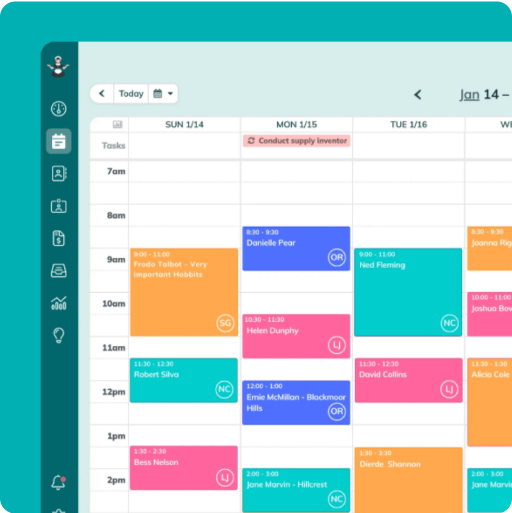
Simplify and enjoy your scheduling with a scheduling software made for maid services
- Have a beautiful calendar that's full but never stressful.
- Make your cleaners happy and provide all the information they need at their fingertips.
- Convert more website visitors into leads and get new cleanings in your inbox with high-converting booking forms.
- Become part of a community of 8000+ cheering maid service owners just like you.
Start your FREE ZenMaid trial today and discover the freedom and clarity that ZenMaid can bring to your maid service! Start your FREE trial today