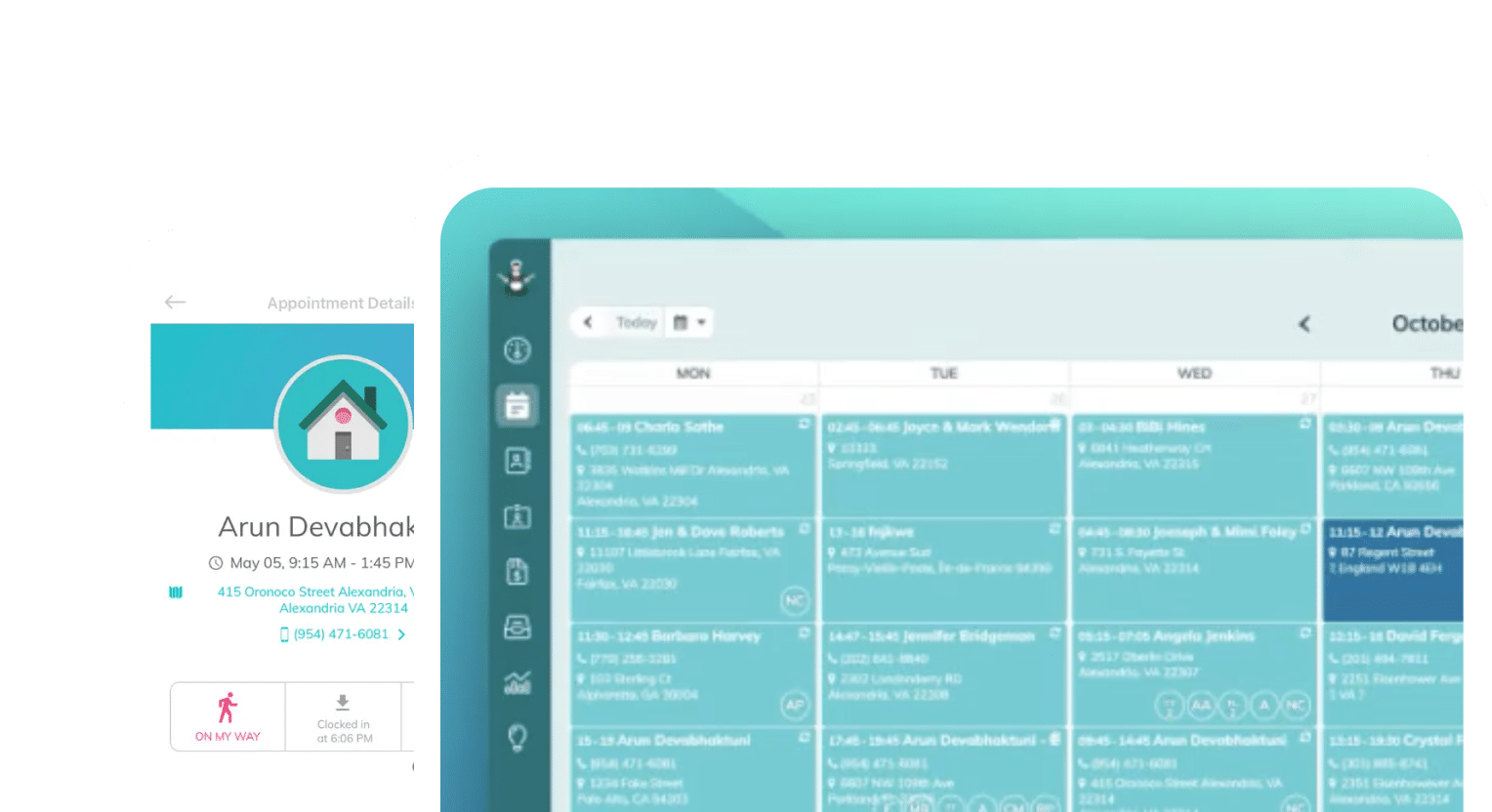
Frustrated with your scheduling? Try the easiest-to-use calendar app, made by and for maid service owners.

Brought to you by expert cleaning business owners

Tips and advice shared here have helped us grow our own maid services. The ZenMaid team currently has 5+ current and former cleaning business owners on our team, including our Founder and CEO, Amar. We’ve been in the maid service industry for 10+ years and counting.
We partner with amazing leaders in the cleaning industry, including Debbie Sardone, Stephanie Pipkin, Angela Brown, Chris Schwab, and many more — all to provide you with the latest industry insights.
We’ve built the easiest-to-use, comprehensive cleaning business software, built specifically for the industry!
Listen on: Apple Podcasts, Spotify, or YouTube
Introduction
Stephanie: Hello, my friends. I am so excited for you to hear this conversation with Miss Maria Dorian. She is one of my favorite people ever. She’s an absolute delight. Little content advisory warning: there are some swear words in this episode, so if you’ve got little ears around, put some AirPods in. Can’t wait for you to hear it. Enjoy.
Stephanie: Hello, everyone. Welcome or welcome back to the Filthy Rich Cleaners podcast. I am your host, Stephanie from Serene Clean, and today’s lovely guest is my friend, Miss Maria Dorian. Maria is my teammate at ZenMaid. She also is an incredibly experienced cleaning business owner with many, many years of experience under her belt. She runs several different companies. Maria, can you tell the people all of the things that you do? You do so many things.
Maria: Yeah, I do. Plus now I have hobbies, which is kind of cool.
Stephanie: Yes, ew, what are those?
Maria: A whole new world for me.
Stephanie: What are those?
Maria: Ah, right, I know. Okay, so first, most people would know me from being the owner of Task Away VA, a virtual assistant company. And then, let’s see, I had a maid service in Austin, Texas that I ran for 14 years, sold it right under a million in run rate, and then started another service in two locations here while doing it all remotely in Spain. That would be it. And then obviously I’m on the ZenMaid team. I should have mentioned that first.
Stephanie: No, it is amazing all of the things that you do. And as Maria just mentioned, guys, she lives in Spain. She runs her cleaning service in America completely remotely, and she just has such a wonderful mind, especially for things like automation, delegation — as she mentioned, being the owner of Task Away VA. She knows how to systematize. And Maria and I had a conversation a couple weeks ago with one of our content writers, ZenMaid Jenna, a fabulous writer, and she was asking about how we utilize software. And the conversation just kind of went a very interesting direction. We talked far further than software, I would say. And that was prompting me to ask her to be on the podcast again. Maria has been on the podcast — we’ll definitely link her original episode down below, guys, if you have not watched that one. It’s a great one. But in this conversation, I would love to expand upon what we discussed when we were conversing with Jenna a few weeks ago, specifically on how we see the industry changing, how we stay on top of things, how we stay in front of the competition, and just how it has changed and how you have seen it change recently.
How the industry has changed
Maria: Yeah, so when I first started my cleaning business in Austin, there really wasn’t any competition. If you guys know Sharon Tinberg, she was one of the biggest competitions. And I tell this story very often — she’s probably rolling her eyes going, “Okay, we’ve heard that story before.” But I remember one day driving on 35, which at the time had hardly any traffic, and one of their cars passed me. It was the Upstairs Maid at the time, passed me on my left-hand side. And I remember thinking, “I wanna be them when I grow up.” There really wasn’t a lot of competition.
And obviously now, fast forward, it’s a huge market. Now it seems like, like you said, everybody and their grandmother — literally everybody and their grandmother — has a cleaning service, is starting a cleaning service, a different model of cleaning service. Because before then, we didn’t have the digital cleaning services that we do now, which would be people like me that are running everything remotely and all the booking forms and all that fun stuff. So fast forward, yeah, it’s kind of a different world when it comes to cleaning. And I think even just the very function of cleaning in people’s homes has changed. So for me, I’ve seen massive, massive changes and lots of growth, lots of new ways of having to think through things, having to keep up and adjust. Even COVID was huge for us. It changed so many things, especially on the employee side. So yeah, just massive, massive changes and growth.
Standing out when everyone has a cleaning business
Stephanie: For those of our listeners who are new or even considering opening a business, I hear so much, or I see in the Facebook groups, like, how can I possibly stand out from all of this competition? Like you said, everybody and their grandmother is opening a cleaning business. And so I think that is a huge concern for people, and valid if they are really struggling, especially against maybe bottom-of-the-barrel pricing, a race to the bottom. I have lots of thoughts on how to stand out from the competition, but for somebody who is newer — what do you have to say to them? And what can we tactically do in order to make that happen?
Maria: So it’s definitely a numbers game, right? And I always recommend that you use the resources that you have right now, today, at your disposal. So maybe you’ve got somebody coming in from the corporate world — this is really common. People from Microsoft and all these big-name companies that are starting their cleaning service. So you may not have that budget, but look at what you have right now, today, at your disposal. You probably have time. And so even just flyering your five rounds when you are cleaning a house is helpful.
You might be able to do things that those larger companies can’t or won’t. So it could be approaching an apartment complex and saying, “Hey, how about I clean your lobby area in exchange for letting me put flyers out?” There are things that you can do where you are now that will help you stand out. For us, back in the day — because I never had a big startup fund — what we did have is we were on a really, really busy street, actually the biggest street in our city. And we put out one of those little tents with the balloons. And we had somebody out there in costume, in a maid costume, saying, “Get your free donuts and quotes.” Like, anything and everything.
Stephanie: Oh my gosh.
Maria: Yeah. And then, because the building was so large that we were in, we spoke to our landlord and he let us do a citywide garage sale. So of course we were advertising, “Hey, citywide garage sale put on by Welcome Home Cleaning,” all of that good stuff. It’s cleaning for a reason. That’s a great way to make yourself stand out. There are just lots of things that you can do. I would say, especially if you don’t have a huge budget, get really, really creative and find creative solutions.
Stephanie: I had never heard the maid outfit thing. That is incredible. I love that. We had never done a home show or anything like that. I don’t know if every city does that type of thing, like home and garden shows, that trade show, if you will. We were going to do one in March of 2020, and then everything got canceled, of course, because of COVID. But what I was going to do is my very burly, large male employee that I had at the time — we were gonna put him in a maid outfit and have him go around the trade show and send people to our booth, for a raffle or a giveaway or whatever. It’s really the concept of purple cowing it.
And what’s really coming to mind is there’s this sound bite that you’ll see on home renovation accounts and things where it’s just like, you gotta get good at being poor. And what that means — and I don’t mean that in any negative way — is you need to be creative. If we don’t have money, we need to use something else, right? And that is going to be creativity and getting out there and being bold, because you don’t have the luxury of sitting behind your computer and just running ads and paying to get that visibility. Obviously the things that Maria is describing do take money. However, you’re really exchanging mostly your time for the results, as opposed to money for the results.
And so I think it takes a certain level of unabashed guts and going out there. You kind of have to put all shame out the window and just don’t be afraid to be cringe. I think that’s another thing that people really struggle with — whatever, my generation and younger, we’ll call it cringe, but like the trying, the earnestness. I think that millennials and above are good at it, but anybody my age or younger really struggles with, like, don’t be seen trying, because if you fail, that’s embarrassing. Where it’s like, you need to throw that completely out the window nowadays.
Getting creative — and getting hungry
Maria: Yeah, for sure. And I think another thing that I had going for me was, at the time, I was hungry. And so those things — getting in a maid outfit, or going to a teacher’s back-to-school and offering all the teachers a free goodie bag — none of that mattered when you’re hungry and you’re in a situation of, if I don’t clean houses for a living, my family doesn’t eat. So I think just having that drive and motivation helped at the time immensely. So find the hunger, find the why. It’s almost like the expression, feel the fear and do it anyway. Just say, you know, F it and move forward, and don’t even think about the fear, and just do whatever you need to do to get those phones ringing and clients booked and employees working and all that fun stuff.
Stephanie: Oh, absolutely. And there really is something incredibly powerful about meeting people, getting out there and networking in that manner. Because a lot of people, I think they say, “I’ll do anything,” but what they mean is, “I’ll do anything behind the computer where I don’t have to put myself out there,” or “I’ll do anything but get on video.” It’s like, so you won’t do everything. You have a very limited capacity for that bravery that it takes. Because what we’re really talking about is sales and marketing, but in a very tactile, get-out-there, pound-the-pavement kind of way, which works really well for home service businesses — incredibly well — because it’s the trust economy, as we always talk about on the podcast. You need to be trustworthy, and what better way to do that than to actually meet the person? They see your beautiful shining face and they’re like, “Yeah, let me give you a shot,” right?
Naming — and renaming — your company
Maria: Yeah. And I also think adjusting where adjustment needs to be made, and constantly moving with the times. When I first started, looking in the paper at the time, all these cleaning services with big names — I thought, how do I make myself stand out? It’s that getting creative. You’ve got all these big names that everybody knows: the Molly Maids, the Maid Brigades. So I’m like, you know what? I’m gonna be different and stand out. So I called my original service Marvelous Maria’s Cleaning Company. And it’s just me cleaning. You don’t have to deal with the company — which I know, I’m like, oh, that’s terrible, but that’s what I needed to do at the time to get up and running.
And so I remember when I finally told some of my clients who were just used to having me as a cleaner, “Hey, I’m no longer gonna clean your house, and I’m no longer Marvelous Maria.” A lot of people were like, “Well, what? We want only Marvelous Maria.” Well, sorry, it’s time to adjust, man. So just adjusting and pivoting quickly — huge.
Stephanie: I feel like every time I talk to you, I learn more. Lore drop. I had no idea that that was your company’s original name. That’s awesome. Have you seen that show, what’s it — Marvelous Mrs. Maisel? What’s the name of the show?
Maria: Oh yeah, I did, actually. Yeah, yeah, Marvelous, yeah.
Stephanie: Yeah, yeah, totally.
Maria: I guess I’m like, you have to — I’m being Marvelous Maria.
Stephanie: Oh my goodness, I love that. And I think it’s really interesting that you just said you did what you had to in the beginning, and you can always pivot. It reminds me of — I named my company, I always say I named it wrong, because I named it Black River Falls Cleaning Services. Obviously my business is now Serene Clean, because I had no foresight for how large it was going to get, or that it would go beyond serving the Black River Falls area. But honestly, if I flip that on its head, that did wonders for me in Black River Falls for the first two years, because it was so smack on the head. This is what we are. It was incredible for SEO because the town name was in it. It worked very well for me.
So I always — hindsight 2020, just like what you’re doing — it’s like, oh, long-term, in the longevity of your business lifespan, that doesn’t make sense for the five years. But that first year, it made a hell of a lot of sense. And so I’ve never really thought of it that way, that sometimes we do things that are not scalable whatsoever, but we have to do them, and they actually help us.
Maria: Yeah, and then you pivot when that particular decision just doesn’t serve you well. And I think pivoting quickly is one of the keys to success. And it’s no different than now — of course, the name of my company is The Villages Cleaning. And when we look at it, wait a minute, The Villages — obviously we serve an area, so the two areas that were The Villages is perfect, but does The Villages really match if we were to open up in, I don’t know, San Diego or some larger city? It doesn’t. So even us, we’re having to rebrand to The Funky Sponge, which — yeah, it got a funny — and so we’re having to do a whole rebrand and a whole thing, and we’re going for it, and I fully trust that it’s gonna be great and it’s gonna be well received.
Stephanie: Oh yeah, I’ve seen all the branding for that. Ryan shared it with me and instantly I was like, I love this. It’s just so visceral, it’s great, the care, everything’s amazing. So I’m super excited for that, for sure.
Communication and consistency
Stephanie: Okay, so we talked about comparing now versus then when you first opened, and I wanna talk about what we now need to do in order to stand out that maybe when you opened before, you didn’t have to. Obviously we’ve talked about creative marketing, but I wanna talk about the service itself, company culture, that type of thing that allows us to stand out. So what are some of the things that you feel we’ve had to really up the ante on and provide more for the client?
Maria: Yeah, I think when it comes to certain things like communication and, gosh, customer service — huge, right? Before, we could probably get away with not sending out text message reminders or making those phone calls. People just expect different now. So communication — effective communication, because obviously there’s a difference — consistent communication. And then when it comes to the cleaning and the service, same thing. Clients just need to be able to know that they can trust what they’re getting at every single visit, every single time. And I feel like that is probably one change that I’ve seen, that it’s imperative. You have to be able to do that.
And I think some of that was always true to a certain extent — I just think people were maybe much more lenient about those kinds of things. But now it’s imperative. I don’t think you can actually run a successful cleaning company without those types of things. Which is where software comes in — hugely impactful in getting the communication and the consistency of service.
Stephanie: I think you’re right. Obviously I didn’t have a cleaning business 20 years ago, but I would hazard a guess that before things like Google My Business, or Yelp, or any of these online review sites existed, the leniency of allowing certain behaviors or subpar service was because people couldn’t easily shop around — or as easily. Obviously you could ask around, like you said, you could check the paper. But now, other options are at their fingertips, for better or for worse. It’s kind of like online dating, where people are flooded with options. So if you start acting right, their eyes will start to wander, and you have to just be on it.
And I totally agree that excellent communication — but I think consistency is the key word and name of the game. You need to do it over and over again. And if you are just trying to rely on things like you remembering — I always talk about that as a—
Maria: Terrible system.
Stephanie: Yes, exactly! It’s not a system, y’all! You relying on yourself to remember anything is a recipe for disaster. You’re setting yourself up for failure — not because you are a failure, but because that is a failing thought process. It just doesn’t work.
Maria: And I will say, to counter that: “Oh, but my office manager, she’s been with me for 10 years, she knows all of the things.” That’s still a terrible system. It relies on the memory, and that person gets hit by a bus, and literally all of the amazing lessons they’ve learned, the history, all of it goes with them. So yeah, putting everything in an SOP, having a system for that — we’re preaching to the choir, but it’s the difference between having a business and having a job, or creating a job for yourself.
The double-edged sword of online reviews
Maria: And yeah, with the online reviews, that’s another one. Online reviews are a double-edged sword. On one hand, when a client calls and says, “Hey, I found you on Yelp” — I see that, Stephanie, I think you’ve got like a thousand-something five-star reviews, something crazy like that?
Stephanie: I think we’re at 500 across all three locations.
Maria: 500, okay. Yeah, I remember it being some crazy good number, I looked.
Stephanie: Yeah, we got like seven last week. We were cooking.
Maria: Yeah, so it’s a double-edged sword. On one hand, it’s great, it’s amazing, it’s free marketing — that marketing is on 24/7, right? But it’s an incredible amount of accountability, because you have to go to those standards. The very person that found you on Yelp, Google, Facebook and thought, “Wow, this company has five-star reviews” — something goes wrong, ooh, I know exactly where to go bash them.
Stephanie: To hurt them, yes, exactly.
Maria: And one negative review literally can cost you thousands of potential customers. So that has upped the game. It holds us accountable, man. I love ’em, but at the same time, I’m scared.
Stephanie: I feel like it’s a gilded cage, or a golden shackle, if you will. They have done everything for us, but also it’s terrifying how much it can hurt you. But like you said, it’s a good thing, because it holds you to that high standard. If you are getting consistently subpar reviews, that is communicating something to you. And it could be not even related to service — it could be related to communication or setting expectations. It also means maybe you’re not doing the proper vetting, and you’re getting reviews because you’re selling on the cheapest option. Well, people shopping for the cheapest option a lot of times are the worst people ever to work with. And I’m not saying all the time that somebody hunting for a bargain is a bad person, but we have consistently had some of our worst nightmare experiences with people who are very, very price sensitive. Because they’re so price sensitive, they’re like, “This must meet every magical expectation I have.” So the stakes are so high, compared to somebody for whom this is a smaller fraction of their income. Obviously you still gotta nail it for them — you have to nail it for everybody — but the expectations of some of those very price-sensitive shoppers can be very hard.
How to respond to a bad review
Stephanie: And when I look at our worst reviews — I mean, we have very few, I think we have like two one-star reviews in the life of the business, or something crazy like that. One of them from my very first employee, Gabby. You, she left me a one-star review. You suck, Gabby.
Maria: You suck, Gabby.
Stephanie: Well, she’s the one who clocked in at a job site for four hours, sat in her car trying to game the ZenMaid, and then clocked out and left. So I have many other stories related to Gabby, and I’ll say it with my chest, for sure. But luckily — and lesson here, guys — how you respond to reviews, even negative ones, can shape the narrative completely. If you are pissed off, walk away from the computer. Now we’ve got AI, so there is no reason that your review responses should read anything but wonderfully professional.
And so in that instance, it was like, “Oh, so sorry, but we can’t service former employees as a policy, and additionally you’re out of our service range.” So the way I worded it said exactly to the reader, this is a former employee, without me being like, “You’re just blah, blah, blah.” It also said, we don’t even service that area. So this is a one-star review from somebody who used to work for me. There are ways that we can phrase things in the response. And if you did wrong, you need to make sure that it’s like, “As discussed, we reached out. I’m so glad that we could make it right.” Tell a narrative — thank them in the review response.
Maria: You know, in the moment you get a one-star review — especially if it’s your company, and especially if you did the cleaning — you’re like, “Oh my gosh, did they see what their home looked like? And did you see, I gave them a discount?”
Stephanie: Yeah, like, oh my God, dude, we were there for two days. I gave them a discount and then we’re getting a one-star review, right? And so it’s so easy to take that stuff personally. And especially since, as business owners, we think, “Oh, they’re attacking me.” It feels like a personal attack, like somebody is attacking my baby.
Maria: But like you said, walk away, use AI. But the most important thing you said is just remember: they’ve already left you a one-star review. It doesn’t matter what they think. That’s their truth. Don’t try to change their truth, but speak to everybody who will be reading that review — your potential customers, your potential prospects. Speak to them. So that’s your new audience. Forget the crazy who left you the one-star review. Your audience is the person who’s gonna think about buying from you in six weeks, a month, two years, who will be reading that review. That’s the person you want to talk with. That’s the person you’re speaking to.
Stephanie: You’re speaking to, yeah, exactly. Thank you.
Maria: That’s the person you’re speaking to.
Treating refunds as a marketing cost
Maria: And then the other thing is, there’s so many times when something will happen in our business and we get into this “But that’s not fair. We were there for two days. Their house was filthy. They didn’t tell us,” whatever the thing is, right? And when the customer starts fighting us for money back, a lot of times we get stuck in this thinking of, “No, I’m not giving their money back.” But sometimes you kind of have to count the cost. Is it worth it to not give them the money back and end up with a one-star review — which, especially on platforms like Yelp and the way their algorithms work, can actually hurt you, because they’re weighted more than a positive review?
And so I always count it as: okay, let’s not look at this as, is it fair, or should this client get their money back or not. Let’s look at it as a marketing cost. With $250, $300, is that worth it for that person to go away, if it means they don’t leave me a one-star review? If we can make it right so that they don’t leave a one-star review and we can keep our great ratings. So changing my mindset like that gets me out of the emotional, “I’m going crazy, I need to day drink because I’m so upset about this client that’s complaining,” into: all right, what is it worth to me as a marketing cost to be able to make them go away, but we keep our five-star Google reviews? Which ultimately, like I mentioned, is that marketing 24/7 — easy, free.
Stephanie: That is such a profound way to think about that. I’ve never thought about it that way. You’re really talking about kind of like an insurance deductible. You are paying in order to not take the hit to your reputation, considering how powerful the reviews are for you. And so I’m really happy you brought up, do not think of it in terms of fairness.
We actually had that happen, I think earlier this year. It was kind of a regular client who really wanted to keep it at a certain amount. We could never get through the whole home, and expectations were just misaligned. And we did the final cleaning, and she was so upset. My managers were kind of listing, logically speaking, “This makes sense that we got through this much because of this, this, this.” She wasn’t gonna be using us again, and she was so upset. And I was just like, okay — because they were like, “How much should we comp?” That was basically the discussion, the semantics. “I think we should only comp this much, because of X, Y, Z,” trying to figure out what feels fair. And I was like, no. The goal is for this now-former client to walk away from this interaction at least feeling neutral about us. Can we make it neutral? Because we made it right. And I was like, what does that mean? Comp the whole damn thing.
Is it fair? Technically, no. Does that matter to her? No. Can we logic our way and explain, “Well, actually, customer, X, Y, Z, and this is why”? That doesn’t matter to her right now. She needs to feel heard. She needs to feel seen, and we need to try to make it as right as we possibly can. And in this situation, it’s like, part ways. We don’t wanna work with her again, frankly, because we know it’s just not gonna be satisfying — it’s the expectations of time. She thinks we can clean three times as fast as what is actually possible. So let’s just part ways on amicable terms. And all my mind went to was, let’s avoid a bad review. Let’s avoid a bad review.
Being right vs. being successful
Maria: And it feels like you’re letting the customer win.
Stephanie: I can’t think of it like that. We can’t think of it like it’s a battle.
Maria: Not at all, y’all. My good friend Derek Christian always said, “Do you wanna be right, or do you wanna be successful?” Sometimes it’s exactly that. And I’m definitely not saying — because I’ll hold true to this as well — definitely not saying give money back every time there’s a problem. You’ll go back and forth.
Stephanie: Don’t be a pushover.
Maria: Don’t be a pushover either. Don’t be a pushover, because that actually creates different problems as well. And believe it or not, it really is all in the way you handle a bad review, because you can handle a bad review in a way where you give money back — and I’ve seen this so many times — and they still leave a one-star review.
Stephanie: Because it wasn’t about that.
Maria: Because it was never about that. They didn’t feel heard, their lack of expectations and experience. Even money back didn’t make up for it. So in certain cases it’s like you said, weigh it as a marketing cost. And really just, how can I make this right? And literally say that to the client: “I’m devastated that you’re so disappointed, and this was not what you deserve. How can I make this right?” And a lot of times they won’t even ask for money back. They’ll just be like, “I just wanted to express my displeasure.” They need to be heard.
Stephanie: So I think, especially when I was younger — both in age and in business ownership — my ego, my need to be right, the principle of the matter, self-righteousness basically is how I would describe it. That was a huge flaw of mine. And I definitely got that from my dad, who was a business owner, and he would do anything to prove that he was right, as opposed to just letting it go. There was no letting it go. And some of my biggest regrets in business are not letting things go, because I’m like, “They need to know how wrong they are, and I’m gonna be the one to show them.” And it just doesn’t — it’s like, get over yourself. It’s just a very immature way to be, and self-righteousness will never, ever serve you in your business. Ever.
Maria: Yeah, true. But at the same time, you have to know — because I have studied this a little bit — it actually comes from childhood, that need of what’s fair. That’s instilled. What’s fair, what’s not, it’s a childhood thing. So, you know, grow up. I’m glad that you grew up.
Stephanie: Natural.
Maria: It’s natural, so don’t beat yourself up too much. I’m glad that you did. Now you learn, and look how amazing and successful. It’s great.
Thinking like a business owner
Stephanie: Yeah, and I think just the biggest thing — and we talk about this time and again — is just removing yourself from the situation emotionally so that you can think clearly and think long-term and big picture. Right now, big picture: is this $175 gonna kill your business? Or is digging your heels in and not giving that money back — or not replacing the thing? We just replaced, I talked about last week, we replaced the microwave that stopped working, apparently the day that we cleaned. I don’t think we broke it, but I’m like, you know what, replace the microwave. It is what it is.
Maria: I’ve definitely dug in my heels many times.
Stephanie: Yes, yeah.
Maria: So, not a pushover — but it’s about being strategic and business-minded, and also realizing that you have a responsibility to all of your stakeholders. It’s not just, what’s fair? You’ve gotta think about your employees. What’s the impact of looking up and seeing, “Oh my gosh, we’ve got 150 reviews and they’re all 3.9 and subpar,” because you haven’t made good decisions? And those reviews, like we talked about, are all symptoms of what’s happening internally. So it’s about thinking strategically a little bit.
Stephanie: Oh, I love that — the concept of stakeholders being your staff members, and that when you are not being a good steward of your business, you are hurting their potential future income, benefits, all of the good that you can do. So really being able to think long-term and remove that volatility, it’s only gonna benefit you.
When to stand your ground
Stephanie: And I say all this to say, as Maria said, it doesn’t mean that we don’t sometimes say, “Nah-ah.” We’ve been accused of crazy stuff — stealing nail clippers one time, a blanket, scoping out houses or jet skis, and people going to the — like, crazy stuff. And we have absolutely been like, “Absolutely not.” So when we are being accused of something, that is when I would say we most dig our heels in — not being combative, but also never going to admit fault when it comes to something with our reputation that we absolutely, there’s no proof it happened. And obviously it doesn’t mean your staff can’t steal things — we’ve all had staff steal things, I mean, Maria, I’m sure you’ve had that happen before. But it doesn’t mean you need to just lie over just because somebody accused you, because you very well may have a staff member who’s innocent.
Maria: I remember one time, a client actually said, “Hey, if you clean for us, you have to use our Rainbow vacuum.”
Stephanie: Ew, yuck!
Maria: Oh my God, such a pain in the freaking ass.
Stephanie: I would never use one.
Maria: Again, that and a Kirby — ah, never, never, never. 7,000 pounds of a staircase.
Stephanie: Oh my gosh, having to breathe — oh my gosh, terrible.
Maria: So we used her Rainbow vacuum, plugged it in, and her outlet blew up, which blew up the vacuum. So of course we’re like, well, it was in our care, control, and possession, let me see if the insurance will cover it. They wouldn’t cover it. Okay, I don’t wanna buy this lady a $1,500 Rainbow vacuum. So — talk about digging in my heels and being a good steward — my butt decided to do a little bit of research on why the plug blew up in the first place. So I hired an electrician for like 100 bucks, did a whole lot of research, to find out that whoever owned the house before wired that particular outlet incorrectly. So it was like, oh look, we’ve got proof, we’re not paying for it. So there does come a time where you have to defend your business, absolutely. So definitely not saying to be a pushover.
Turning problems into policies
Stephanie: Yeah, and also, things like that really help shape policy going forward. Because every time we have situations like that, it has helped guide us on how to handle things in the future — learning, what a concept, right? Learning from past experiences. And so for us, if we use a client’s vacuum, we are not culpable if something happens like that. That’s why we like to use our vacuums, because then we’re 100% responsible. We’ve had the same thing happen, where an outlet was wired improperly — old house — and it burned. It didn’t burn the house down, that’d be crazy, right? But the outlet was out. And they were trying to — and it’s like, no, this isn’t us. Because we plugged a vacuum into your house, but the assumption is that your electricity and outlets are in good, working, safe order, right? So there’s only so much to do. If you don’t want to expose yourself to any risk, well, then don’t open a business, go work for somebody else. But there are things we can do to mitigate that risk — with policies, with procedures, and with, “Okay, yep, this doesn’t make sense, I’m actually going to pursue X, Y, Z.”
Maria: So yeah, I think it’s really just taking a balanced approach to all of this, and knowing that every situation is different. You may handle a similar situation differently just based on how the customer’s acting. It’s just like, if you’re at the airport and the person in front of you is screaming at the airport representative because they can’t make it on a flight, and then you’re sweet as pie and somehow you get a flight — it’s amazing when that happens, right? It’s the same thing. I’ve definitely had situations where I’m like, “We really like this client, so therefore they are going to get a certain thing,” because they’re wonderful to us. And other people who are crying wolf all the time, well, we’re kind of sick of this.
Stephanie: Yeah, for sure.
Maria: I also think one of the best things you can do for your business is, when something happens, my personal challenge to myself is to instantaneously say, “All right, what do I need to do to make sure that this thing never happens in the life of my company ever, ever again?” It’s like a personal challenge. And so if I start to think that way, then at least I can be proactive and change policies — sometimes change people, because maybe sometimes it’s not a policy problem, it’s a people problem. So, what do we need to do to change things to make sure we never have this thing happen in the life of our company again?
Systems, software, and getting paid
Stephanie: That is such a good framework to think of, and especially just tying back to utilizing software to avoid things altogether, right? Like the reminders. Okay, you show up to a client’s house, they’re like, “I didn’t know you were coming, because you forgot to send the reminder text last night.” Well, how about we just eradicate the need altogether and have automatic reminders through something like SendMate, right? And how many of our listeners have not gotten paid for a job because they didn’t have a credit card on file — just like I didn’t in the beginning, and then I got burned enough that I learned, because the pain was so high it surpassed my discomfort with asking people for their credit card number. When I lay it out like that, that was the discomfort, and I had to get over it because it was too painful not to.
Maria: Sometimes you just — we’ll tell you this, and you just have to experience it yourself, and then you’ll do it. No joke, especially when you have to look at a cleaner in the face and say, “I’m so sorry, your check is gonna be a couple days late because Susie Jones still hasn’t paid us for that $700 job.” Why? Oh, because she was supposed to call with the credit card the next day. When we were on the phone, she’s like, “Oh, my credit card’s in the car, can I give it to you later?” And then you book the job without getting it, and now you’re very, very stuck. You learn real quick to never have that happen to you ever again.
Stephanie: Yes. And of course the software is a huge part of that.
Client red flags
Stephanie: Absolutely. I wanted to answer a question we got from one of our listeners, in the Facebook group, about red flags to look out for with clients. And the reason I bring this up is, obviously we’re talking about preemptively striking and preparing the company for success with bookings — whether that be booking credit cards, having client guidelines signed, policies. So I’d love to hear certain red flags that maybe you have ignored over the years, or looking back now in hindsight, what things are telltale signs for you?
Maria: So oddly enough — and I can’t figure out why — it seems like if something is gonna go wrong at a job, it’s those same-day service requests. Have you ever noticed that? Don’t know why that is to this day.
Stephanie: I think because maybe they’re frantic. Things are in a bit more of an emotional, volatile, frantic state, because it’s last minute and maybe they weren’t planning to get a cleaner, so they’re already stressed. A lot of times for us it’s like a move-out, right? They’re like, “I was gonna do it, I don’t have the ability now, I have to hire somebody, spend all this money I didn’t expect.” So I think it’s kind of like the environment that we are coming into is potentially volatile.
Maria: Potentially, yeah.
Stephanie: So lately we’ve kind of been thinking, huh, do we not need to do one-time cleans? Well, obviously same-day cleans — even if we’ve traditionally always been able to do it and happy to serve, especially if there’s room on the schedule.
Maria: So this question’s a little bit difficult for me, because I can see it from two angles. I can see it from my previous company, where we prided ourselves on being able to serve the white-glove client, the client who’s been through their 12th cleaning service, because we had trained — our standards were so high, and we trained our techs, and we had low turnover, almost non-existent turnover. So those pickier people, we were able to handle them. But it took a lot of time to get there, a lot of training, a lot of effort, a lot of systems. So I would say now — not that we don’t have a great, strong company, I just think we still have some growing to do — for me right now, a red flag would be the client who says, “Hey, I’ve been through my third, fourth, fifth cleaning company.” I think that might be maybe an orange or a yellow, amber flag. But maybe there needs to be a lot of digging down and understanding what caused those other relationships to not work.
But for me, I always joke, it’s the client who seems to micromanage and ask a gazillion questions. It usually starts off with “your people”: “Do your people, will they clean the top of my alarm clock? What about the shutters, will they open the shutters?” Yes, of course we’re gonna open the shutters. “Are they gonna get on hands and knees?” So maybe the clients who already have an expectation of how they want their clean to go, and our service is misaligned with their expectations. So not so much a red flag, maybe — maybe it’s a red flag in terms of, hey, we need to know that if it’s not a right fit, it’s gonna end up causing issues. And I would say just good old gut feelings. You might do a walkthrough or a quote, and you’re like, “I can’t put my finger on it. She was nice, everything seemed fine, but I just have this gut feeling that something is wrong.” So for me, I always teach, if you have a gut feeling, trust that. That’s your instinct, that’s your first brain and your stomach and all the neurons and all the science-y things behind gut feelings. Go with the gut feeling. Your brain may not have the information just yet. It’s gonna get the information, but it has that experience to know that something is off here.
Stephanie: I totally agree. And I think that what you were describing — people wanting to tell you or know how the cleaning is gonna get done, meaning literally how do you do this task. Whenever anybody says “hands and knees,” what they really want is detailed floors, right? But instead of saying detailed floors, they’re basically saying, “I expect you to accomplish this task in a certain way,” which is always going to not be good, because they are not the professional cleaner. They’re also not the owner, who is going, “I’m never going to ask my staff to do that.” It’s like, yes, lady, you can clean your house on hands and knees. We’re not gonna do that, because of sustainability, the health of our cleaners — and you don’t have to. That doesn’t need to be done that way. So if they’re looking for it that way, that’s not gonna be a good fit, because we’re never going to ask our staff to do that. So if they’re asking a lot of questions about how a task is going to be performed — where it’s like, when my house is getting cleaned in half an hour, the cleaners will be here and I literally don’t care how it’s getting done. All I care about is the end result. I care that it’s clean. That’s all that matters.
Maria: If they’re rude or short with you, basically unpleasant — huge red flag. Because when you think about it, they’re calling you. They’re entering your space, your place of business, your phone. If they’re that way with you before you even step in the home, think about putting your cleaners there, or yourself. Now you’re on their turf, in their environment — it’s gonna be so much worse. So if they’re unpleasant on the phone when they’re calling you, that’s a huge red flag that it’s gonna be so much worse than you can imagine when you’re on their turf.
Payment red flags and price-sensitive clients
Stephanie: Oh, such a good point. And I think another thing I would say is, anytime they are squirrely about payment, that is a huge red flag. Like you pointed out — “Oh yeah, I’ll call later with my card.” Obviously it doesn’t mean they’re not gonna call, but most likely they might be squirrely. And if that first clean goes rough with payment, you can bet your ass it’s probably gonna keep happening on maintenance cleans. So anytime they act weird or off about the payment, or can’t talk about it — obviously money’s a difficult subject for some people, but it’s like, this is what the price is, how are you gonna pay, these are our options. That’s how cold it should be. It’s just part of the process of booking. And so if they’re acting odd about that, then I don’t know about that.
Stephanie: I’m trying to think of other ones, looking back on difficult clients. I think anytime they use the words — like you mentioned in the beginning — kind of service hopping. And if they come back with anything related to, “Well, my old cleaner did it for this price,” then it’s like, then go hire that cleaner. Why aren’t you working with them if they were such a good deal? So that tells you a lot. If they say anything related to that, that’s a red flag for sure for me.
Maria: It is a red flag. And I’ll tell you, a lot of times what happens is they might go ahead and sign up for the service, but especially if the price difference is big — okay, “I was paying my cleaner 75 bucks a cleaning, and now you’re telling me it’s $139 per visit,” huge discrepancy. They might let you in, they might clean, but they’re gonna be micromanaging and picking, looking for things that weren’t done well. And of course we know, the more they look, the more they find, and the more they find, the angrier they’ll get. So that’s another red flag, you’re right — when they’re overly price sensitive, I’ll say budget friendly.
Stephanie: I remember we had a new client who canceled immediately after the first maintenance. He just kept saying things in his emails along the lines of, “This is way more than we paid before, but we’ll give it a try. I guess we’ll give it a go.” And it felt very passive aggressive, as if he was trying to get us to come down on the price or make us feel bad about our pricing. It’s like, dude — and I just wanted to be like — and I think we responded in a way of, “We can be budget conscious in these ways, but how much money you can spend on this is not my epic problem. This is the price, man.” And then he did cancel after the first maintenance, because in his mind the value wasn’t there. And I was not going to convince him of that, and he could not say anything he was unhappy with. The cleanings went literally flawless. It just, in his mind, was too much for him to spend. And okay, that’s fine for him, but that’s not our problem. And just the way he was communicating it felt very icky to me. I didn’t like that at all.
Maria: We’ve had that too, where they hold that over your head and they don’t want to let it go. But they’re always really probably unhappy. If they can’t afford it, they can’t afford it, right? And we always like to say, “Hey, what’s more important to you? Is it price or is it quality? You’ve got to pick one. If you can’t pay the price that we’re asking, we can come down on price, but you’ve got to know that the quality is going to take a hit.”
Stephanie: Yeah, you’re going to have less spaces done or something.
Maria: Yeah, exactly. The scope of work is going to change. So no, you’re not going to get the beautiful scope of work that we normally would in a deep clean. We’re not going to hand-wash all your baseboards and detail all your light switch plates and electrical sockets. But with a lower price, we might be able to make something work where it’ll be a win-win. But yeah, when they complain about the price, and it’s the price, the price, the price — the value’s not there for them, and they probably won’t be able to get past that.
Flat rate vs. hourly
Stephanie: I will say also, we’ve switched to flat rate the past couple of months completely, and it’s gone so incredibly well. And for those of you that are still charging hourly — obviously I charged hourly for seven years, I thought it was wonderful for a long time, and it still can work heavily. But if you charge hourly, you may run into clock watchers. And I will say, we just had this happen with a flat rate client who was originally hourly. We switched her to flat rate, and it does not pay for her whole home to get cleaned. It really should take like four and a half hours. She only wants to pay for like three and a half. So even at flat rate, it still applies. And she sent an email that the new cleaner left early from the job and didn’t get through what other cleaners did, because we had switched cleaners. And the cleaner clocked out two minutes before the scheduled end time. And that kind of clock watching — even though it’s like, no, and also, they’re not understanding that we’ve never been able to get this whole home done. It’s like they alter the actual facts of what’s occurred in the service. And we have that kind of thing happen a lot, where even if it’s all in writing, we’ve got a paper trail of, “As agreed upon, you know that this is a limited scope of work. Your home has never and will never get done for this price. If you want the whole home done, it’s gonna be this price.” And they refuse to accept that. And it’s very frustrating.
Keep a paper trail
Maria: I think the other one, when I think back at some of the issues we’ve had in recent years, is being disorganized on the phone — oddly enough, over-talking, over-communicating, and being kind of scattered on that initial call.
Stephanie: Chaotic, yeah — has usually turned out to be a red flag when it’s time to do the cleaning. Something always seems to go wrong on those jobs as well.
Maria: But I think that’s the thing — it’s just seeing the pattern, recognizing those patterns. And if you have office staff or a VA, training them on how to recognize those patterns and what to do to get out of a job gracefully, so that you all don’t have to deal with all the bad repercussion stuff that’s inevitably gonna come.
Stephanie: Absolutely. And it’s why I will always tell you guys, please have a paper trail of everything. Please have your calls recorded. If you’re not using a software that records your phone calls, you gotta get on that, because that’s gonna protect you so much. We use Quo, OpenPhone — and all of the calls are recorded, it’s wonderful. We also try to do everything over email, as much as possible. Obviously the call is recorded, but this way I don’t have to go back to the call recording. And if something does happen over the phone, we will send a summary to the client: “As discussed on the phone, this is what’s changing, this is the plan.” Just so that you have that paper trail to reference. Because there is nothing more satisfying than saying, “As listed below in the email that you agreed to, X, Y, Z.”
And again, it comes back to the whole, it’s not about being right. But if this is a regular client who you’re having regular services for, it’s important that we’re all on the same page. And sometimes they can just be forgetful, too. I’m not always saying this is malicious. They could just be remembering wrong and not realizing it. So giving them the benefit of the doubt and having everything in writing allows no wiggle room for the facts of the matter. And that saves you so much frustration. Because how many of you are having conversations with clients and there’s literally no record of it? And all of a sudden it’s he-said, she-said. And clients do not like that, and you don’t like it either. So why don’t we just erase that all together? Have it in writing. Then there’s no confusion.
Assume good intent
Maria: Yeah, and our brains are funny with the way we remember things and interpret things. You know that just by living your daily life. You’re like, “I swear I do not remember putting that soda on the counter,” but yet there it is. It’s totally there. Or “I went back and watched my Ring cam, and sure as heck, I really did leave flowers on my car.” My brain is funny. So having everything documented in writing, recorded — it’s just good business. And a lot of people don’t have malicious intent. I always like to assume that people do not have bad intent. It keeps me out of that emotional, us-against-them, bad mentality.
Stephanie: I think that trait is a really important one, and one of the most important traits I would argue you need to have as an owner — don’t assume bad intent, and being really cynical and thinking that everybody is out to get you. Because it’s gonna put you in a really defensive position, whether with staff, with customers, with your coworkers, whoever. And I see it in my staff who are that way, or I see it in customers too. If you are thinking in that manner of everybody’s out to get you, it’s gonna get you in needlessly hot water, because you’re gonna take offense to everything. You’re gonna read into things where you don’t need to. So just trust that adults are going to communicate effectively, and if they are not going to communicate well, then you don’t need to read under the multiple layers and say, “Okay, are they being passive aggressive?” It’s just, teach them to be forthcoming too: “I expect you to communicate well with me.”
And actually this is something I’m teaching my 11-year old right now, because she’s starting to get to the point where she’ll do stuff mindlessly. This is a funny story, but I was making coffee — you know I have one of those milk frothers — and I had like two minutes before I needed to jump on a meeting, but I needed to pee really bad before this meeting. And I was like, how do I get this done? So I was like, “Here, Olivia, I’m gonna go pee really quick, you take this milk frother and froth my coffee.” I came back, poured my drink, and I’m on my call now. And I’m like, why is this spicy? So I put the call on hold and I’m like, “Hey yo, Olivia, did you put a lot of cinnamon in? Why is this so spicy?” She’s cracking up. She’s like, “Remember this from the refrigerator, Mom?” She put hot sauce, like sriracha, in my coffee. In the two minutes after I peed.
Anyway, so she’s getting to that age where she’s starting to do things mindlessly, and of course that was funny, but what I’ve been telling her is, think of the end result. Think about — not to make you afraid, but as a thought exercise — think about the worst thing that could happen, and make your decision on whether you move forth to do the thing based on the worst possible outcome.
Maria: For you, I mean, you’re right. If you dismiss it — “Oh, that person had a weird comment about the beautiful girls, but I’m sure it’s fine” — you decide to be passive, maybe you aren’t bold and can’t say no, or maybe you’re a people pleaser. Well, think about if something were to happen in that home. Then you’ve got to live with, “Oh man, I knew it on the phone, and I put them in that situation.” So think of the worst possible thing that could happen.
Safety first
Stephanie: Yeah, and especially with — obviously we don’t want to be paranoid, but in this instance of safety, it is a very specific industry that we’re in. We’re going into people’s spaces, into their kingdoms, and so we’re putting our staff potentially at risk. If we ignore those types of red flags, you will never live with yourself if something bad happens. Anytime something has happened safety-wise, I’ve made episodes about it, and I’ve done my due diligence — we do what we can, of course — but it literally chokes me up when I think of what could have happened if they didn’t get out of those situations. So if you ignore anything like that because you don’t want to rock the boat — if you can’t do it for yourself, which I know a lot of us struggle with boundaries for ourselves. But I never struggle with boundaries for my staff, interestingly enough, because it’s like that mama bear protectiveness of, “No, I am the steward of their safety,” and I need to do everything I can to make sure that I’m a good steward of it.
Maria: Yeah, amazing. That’s awesome.
Stephanie: They all get pepper spray when they start at Serene Clean. They get pepper spray.
Maria: Oh, that’s awesome, Stephanie.
Stephanie: Yeah, oh yeah. If they want it — and if they do, they have to go through a training of how to use it. It’s actually pepper gel, because it’s sticky, so it doesn’t spray back on you, and it’s going to stick to the assailant better. So pepper gel, guys, highly recommend it. And again, I never want to make people paranoid, but I also am very much a realist of, like, shit happens, and people sometimes take advantage of opportunities that arise, and you’re alone in homes with people. So we’ve got to take that shit seriously.
So I would say that’s the final big red flag area — I just want everybody to always be thinking safety first in all capacities. And that means lots of things, right? Are they asking your cleaners to climb on ladders? Are they constantly pushing the boundaries on scope? That can be a total red flag too. “Can you do this? Can you do this? Will you clean the gutters?” This is my biggest boundary problem I’ve had over the years in the business — saying yes to things and then putting my cleaners in positions where all of a sudden they’re painting apartments and touching up paint on turnovers. And that wasn’t cool of me, and I did that. So I need to — you know, I don’t talk to the customers on the phones. That’s the rule.
Goals, hobbies, and life in Spain
Stephanie: Well, Maria, this has been lovely. What are the goals for this year? Do you have any specific goals in mind that you’re willing to share, for your business or for yourself personally?
Maria: Yeah, we’ve got a lot of really big goals for the company this year. Obviously the big name change and the brand change is going to be huge for us. And then we’re looking at going from a 100% subcontractor model to having our first employees, and what that looks like, and all the culture stuff and all the things that need to change for that. That’s on the business side. Obviously Task Away keeps moving and growing and doing its thing — we actually have some really big changes on that front too. All exciting, all in the sake of keeping up with current trends. And personally, oof, I don’t know, I think—
Stephanie: You said you have hobbies? Tell me, do you have new hobbies?
Maria: Oh, hobbies, yeah. So I decided — okay, so I’m 51, and about six months ago I decided, look, some of the things that I really like, that I thought, “Oh, it would be so cool to learn how to do X, Y, Z” — like, I think this was eight months ago, I was like, “You know, I really like the French language, but I never really sat down to learn.” So this year I decided, you know what, no more. The things that I said I wanna do, I’m gonna do them. So I started picking up learning how to play piano, which is very slow going, but it’s really fun. It’s kind of fun to turn it all off. And the same with guitar. And then I just decided, my goal is to be fluent in French. So I’ve been practicing a lot of French. And that would be my third language that I’m fluent in. And for no reason other than I think it’ll just be cool to say I can speak three languages fluently. So those are my goals.
Stephanie: Oh my gosh, I just love that. I find you so inspirational, and you just have such a wonderful energy about you. And you’re very brave, too, I would say. You are a very brave woman — and I mean that in the most complimentary way possible, not passive aggressive, like “you’re so brave.” But because you did, like, moving to another country, and you’re very bold and open to experiences. And if we wanna dance in a nightclub in Barcelona at 2 a.m., we’re gonna do that. Because me and Maria did that last year, and we’ll have to do that again. I’ll see her in two weeks, I’m so excited. We’ll have to hit the town again, because it was fun.
Maria: Absolutely. My digestion’s not ready for the late-night eating yet, because that is such a culture shock. I mean, you’re in Spain, so you know how it is.
Stephanie: Yeah, for sure.
Maria: It’s like, you go to make a reservation for dinner and most places don’t even open until about eight o’clock at night. And from eight to nine, it’s cocktail drinks or non-alcoholic drinks. But dinner services start at either nine o’clock at night or 11, so you get to choose. Do you wanna eat dinner at nine or 11? Which to me, even now, is like, why would I wanna eat dinner at 11 o’clock at night? It’s still crazy to me.
Stephanie: Yeah, that’s like my most wild culture shock experience when I went over last year. I was like, this is — I’ve never imagined doing this. And then just everything not opening till 10. It’s just all shifted.
Maria: It’s all shifted.
Stephanie: Yeah. So it’s a beautiful country, I’m so excited, and I can’t wait to see you. I’m so excited to spend time with you again. And Maria, we’ll be sure to link your businesses down below. Guys, if you’re looking for a virtual assistant, absolutely check out Task Away VA. She’s got some amazing people over there and can help you guys get your shit together, if that is a problem for you, like it is for most of us. And Maria, we will see you next time. See you in two weeks, and thank you for joining me.
Maria: Thank you for having me.
Stephanie: Absolutely. Everybody, please hit that like, hit that subscribe, leave some love in the comments for Maria below, and we’ll see you on the next episode of Filthy Rich Cleaners. Thanks, guys.