Frustrated with your scheduling? Try the easiest-to-use calendar app, made by and for maid service owners.


Brought to you by expert maid service owners
Listen on: Apple Podcasts, Spotify or YouTube
7 Years, 7 Real Lessons
Most cleaning businesses don’t make it to seven years. Many quit far before that. And for those of us who have made it this long — we’ve made so many mistakes, had our asses handed to us, and learned so much.
In this solo episode, Stephanie from Serene Clean shares the seven most important lessons from seven years of building her cleaning business from the ground up in western Wisconsin — now managed remotely from Savannah, Georgia, with $1.5 million in revenue by year three.
These aren’t the pretty lessons. These are the real ones.
Table of contents
- 7 Years, 7 Real Lessons
- Lesson 1: Always Be Hiring
- Lesson 2: Raise Your Prices Before You’re Ready
- Lesson 3: Difficult Clients Cost More Than the Business They Bring In
- Lesson 4: Your Values Are the Decision Maker Even When You’re Not in the Room
- Lesson 5: The Vacation Test
- Lesson 6: Pay Attention to the Moments That Change You
- Lesson 7: Community Is Not a Nice-to-Have
Lesson 1: Always Be Hiring
The thing that has propelled Serene Clean to the level it’s at now is having a hiring system in place at all times — not just when there’s an opening. Group interviews (covered in depth in Episode 42) have been central to that system, but the mindset matters just as much as the method.
You cannot predict what tomorrow will bring. Staff quit, go on leave, get pregnant, or need to be fired. If you don’t have a running list of interested candidates before any of that happens, you’re always reacting instead of deciding. That reactive position is where cleaning business owners feel most held hostage — stuck with bad fits because they have no options.
Always being in hiring mode puts you back in the driver’s seat. It doesn’t eliminate turnover — even in the summer of 2025, Serene Clean still struggled to keep up. But it blunts the effects significantly. And if having open job listings without a current opening feels wrong? You might have one tomorrow. Start the conversation today.
Lesson 2: Raise Your Prices Before You’re Ready
Stephanie opened Serene Clean at $30 an hour — already more than she thought anyone would pay, because the highest hourly rate she’d ever personally earned was $12. That money story almost held her back from ever raising her rates.
Her first price increase was from $30 to $33. Nobody cancelled. Nobody batted an eye. Every increase since has followed the same pattern: the fear of losing clients turns out to be far bigger than the actual loss.
Serene Clean recently moved to $60 an hour for first-time and sporadic cleans — a number that felt unthinkable even to 29-year-old Stephanie. The month it launched saw the highest number of closed leads since mid-last year. The market will often bear more than you think. The only way to know is to try.
If you’re scared, do it in chunks. Take 20 clients, raise prices on five, and see what happens. Then do the next batch. And rather than raising prices randomly, build a cadence. Serene Clean now audits every client every fall — notifying them whether their price is going up or staying the same — so increases feel like a normal business practice rather than a surprise.
The ideal is the fewest clients possible making the most money possible. And if you’re fully booked and can’t add staff, price is the only lever left to pull. Raise it before you feel ready. You’ll wish you had done it sooner.
Lesson 3: Difficult Clients Cost More Than the Business They Bring In
There have been multiple situations over the years where Stephanie held onto a client far longer than she should have because of the money — or took one on in the first place knowing full well it wasn’t a good fit.
The clearest example: a $5,000-a-month commercial account located an hour and a half outside of Serene Clean’s service area. Her gut said no. She said no. The client kept asking, and she caved. The sole staff member assigned to it was a nightmare. Managers were driving through snowstorms to cover. The stress was constant, the service was suffering, and after about four months, she cancelled the account.
The relief was immediate. And she doesn’t miss that money.
Compare that with Serene Clean’s largest current account at over $11,000 a month — absolutely worth the initial setup and stress because the logistics actually work.
The filter isn’t the size of the account. It’s whether you can actually deliver the service sustainably. Trust your gut during walkthroughs and sales calls. And use your client guidelines as a vetting tool — if someone refuses to sign basic policies before the first clean, that tells you everything you need to know.
Lesson 4: Your Values Are the Decision Maker Even When You’re Not in the Room
From day one, Serene Clean was built on three core values: family first, integrity, and a grateful and positive attitude. Seven years later, those haven’t changed — and they’ve done a lot of the deciding.
Over the years, Stephanie has paid a manager’s salary for eight months while she dealt with life-threatening health issues. She bought a custom wheelchair for a cleaner’s son. She fired a four-year employee who stole at a job site, even when it hurt, because keeping him would have been a punch in the face to every staff member who shows up and does the right thing.
Core values aren’t words on a wall. They’re only real if you live by them on your worst days — not just your best ones. When decisions are difficult to make, core values make them easy. When they’re difficult to execute, core values give you the reason to follow through anyway.
Choose values you’ll actually stand by. And when a hard moment comes, ask yourself: what does integrity require here? The answer is usually clear.
Lesson 5: The Vacation Test
Stephanie has operated Serene Clean remotely from Savannah, Georgia for over three years — more than 20 hours away from western Wisconsin. That didn’t happen overnight. It happened through the vacation test.
The vacation test is simple: take a trip and see what breaks. Then fix what broke. Take another trip and see what breaks next. Repeat until nothing does.
You can’t delegate everything at once, and you shouldn’t try. Start small — a Friday off, a long weekend — and let the gaps reveal themselves. Each thing that breaks is an opportunity to build a process, create an SOP, or cross-train someone. Over time, the business runs without you. That’s not a luxury. That’s the goal.
The vacation test also applies to your managers. When Stephanie’s head of HR said she hadn’t taken a real vacation in years because the work pile waiting for her was too stressful, that was a wake-up call. A business that only works when its owner — or any single person — is present is fragile. Build the redundancy.
Lesson 6: Pay Attention to the Moments That Change You
Stephanie still remembers the exact moment she was standing at her full-time job while a cleaning tech was at a client’s house — and she made money off of somebody else physically doing work. She said it out loud. It was one of the first massive mindset shifts of her business journey, and it changed her for the rest of her life.
Over seven years, there have been many of these moments. Learning about group interviews. Going remote. Attending CleanCon and seeing owners running businesses two, three, four times the size of Serene Clean. Each one unlocked something new.
You are not the fully evolved version of yourself or your business yet. That’s a good thing. Keep exposing yourself to new ideas, new people, and new ways of operating. After CleanCon, Stephanie is now actively exploring a transition from hourly to flat-rate pricing for maintenance cleans — something she never thought she’d consider — because every company doing $2 million or more has moved away from hourly. That’s not a failure of what came before. It’s what growth looks like.
Pay attention to the moments that shake your thinking. They’re the ones worth leaning into.
Lesson 7: Community Is Not a Nice-to-Have
There have been many moments over the past seven years where Stephanie felt like the weight of the world was on her shoulders — and almost quit. The thing that kept her going, more than once, was community.
Getting coaching in year one. Joining the ZenMaid mastermind from the very beginning and posting questions about her first big commercial bid. Going to CleanCon and seeing firsthand that other cleaning business owners were dealing with the same problems — and building something bigger on the other side of them.
When you hit a wall, the instinct is often to isolate. Especially when you feel stupid, or like a fraud, or like you have no idea what you’re doing. That’s exactly when you need to lean the other direction. Post in a group. Hop on a call with another owner. Go to an in-person event. Don’t ask “should I quit?” Ask “how did you solve this?”
There are people who have figured it out. That means it’s possible. And if it’s possible, it means you can do it too.
Community is what keeps you from quitting. Don’t wait until you’re at your wit’s end to seek it out.
QUICK TIP FROM THE AUTHOR
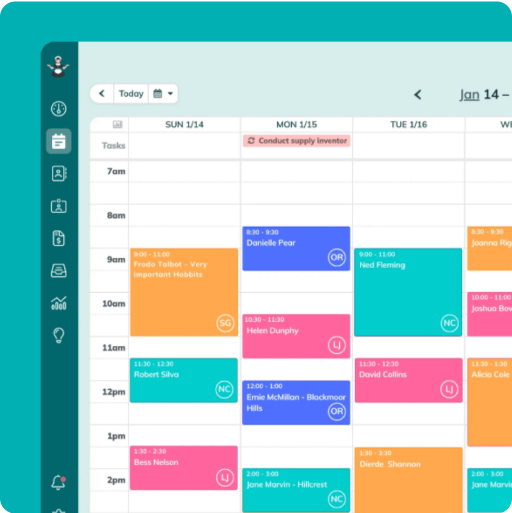
Simplify and enjoy your scheduling with a scheduling software made for maid services
- Have a beautiful calendar that's full but never stressful.
- Make your cleaners happy and provide all the information they need at their fingertips.
- Convert more website visitors into leads and get new cleanings in your inbox with high-converting booking forms.
- Become part of a community of 8000+ cheering maid service owners just like you.
Start your FREE ZenMaid trial today and discover the freedom and clarity that ZenMaid can bring to your maid service! Start your FREE trial today